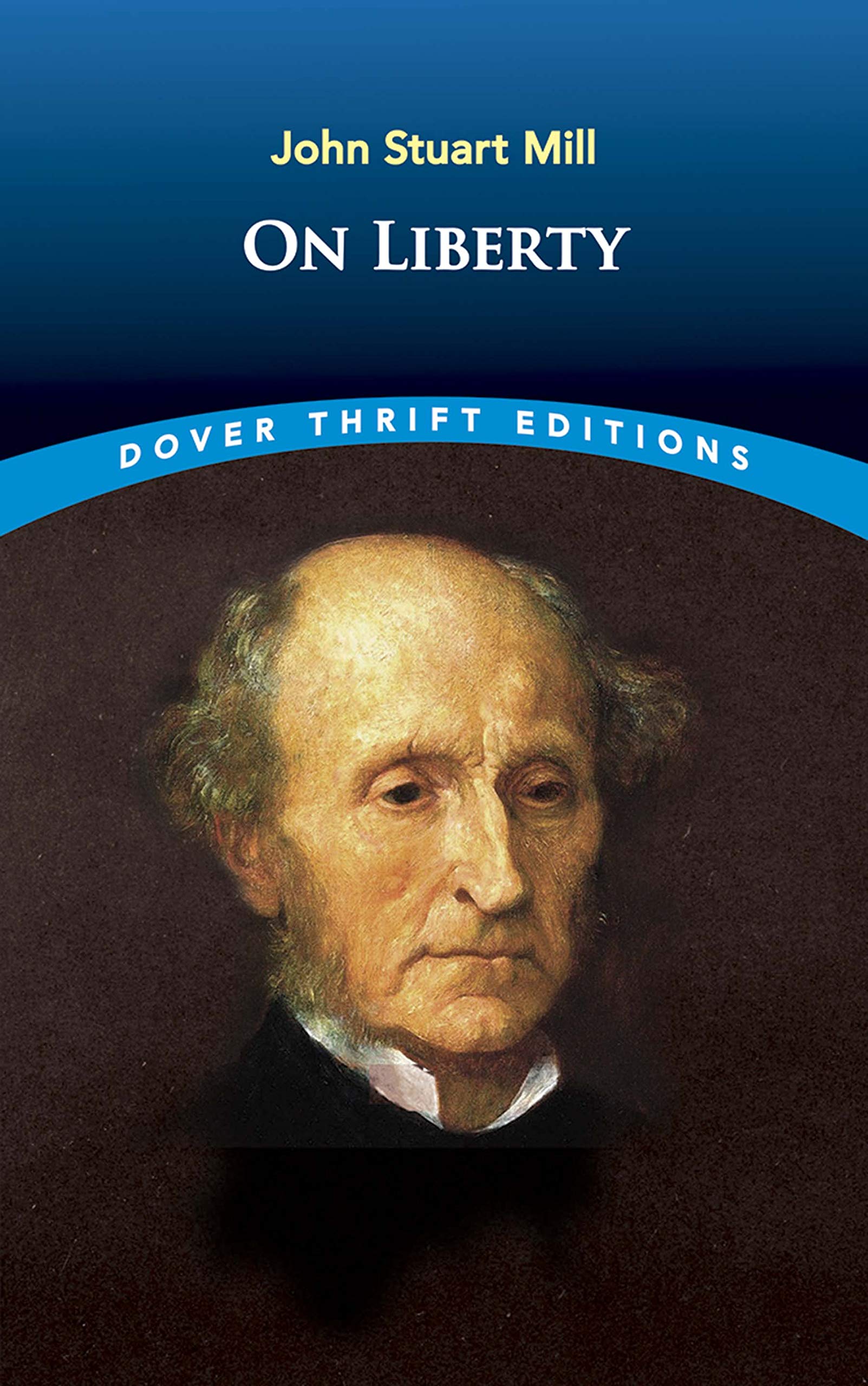
On Liberty: Chapter V
In this influential essay, Mill examines the nature of liberty as it applies to the individual and society as a whole. Read the full text here.
Here are links to our lists for the text: Chapter I, Chapter II, Chapter III, Chapter IV, Chapter V
35 words
19 learners
Learn words with Flashcards and other activities
Definition First

Other learning activities
Full list of words from this list:
-
treachery
an act of deliberate betrayalIn other words, society admits no rights, either legal or moral, in the disappointed competitors, to immunity from this kind of suffering; and feels called on to interfere, only when means of success have been employed which it is contrary to the general interest to permit—namely, fraud or treachery, and force.
-
adulterate
make impure by adding a foreign or inferior substanceAs the principle of individual liberty is not involved in the doctrine of Free Trade, so neither is it in most of the questions which arise respecting the limits of that doctrine: as for example, what amount of public control is admissible for the prevention of fraud by adulteration; how far sanitary precautions, or arrangements to protect work-people employed in dangerous occupations, should be enforced on employers.
-
ward off
prevent the occurrence ofThe right inherent in society, to ward off crimes against itself by antecedent precautions, suggests the obvious limitations to the maxim, that purely self-regarding misconduct cannot properly be meddled with in the way of prevention or punishment.
-
compulsory
required by ruleSo, again, idleness, except in a person receiving support from the public, or except when it constitutes a breach of contract, cannot without tyranny be made a subject of legal punishment; but if either from idleness or from any other avoidable cause, a man fails to perform his legal duties to others, as for instance to support his children, it is no tyranny to force him to fulfil that obligation, by compulsory labour, if no other means are available.
-
subsistence
a means of survivingThe question is doubtful, only when the instigator derives a personal benefit from his advice; when he makes it his occupation, for subsistence or pecuniary gain, to promote what society and the state consider to be an evil.
-
dissuade
turn away from by persuasion...if the principles which we have hitherto defended are true, society has no business, as society, to decide anything to be wrong which concerns only the individual; that it cannot go beyond dissuasion, and that one person should be as free to persuade, as another to dissuade.
-
solicitation
an entreaty addressed to someone of superior status...they cannot be acting wrongly in endeavouring to exclude the influence of solicitations which are not disinterested, of instigators who cannot possibly be impartial—who have a direct personal interest on one side, and that side the one which the State believes to be wrong, and who confessedly promote it for personal objects only.
-
anomaly
deviation from the normal or common order, form, or rule...I will not venture to decide whether they are sufficient to justify the moral anomaly of punishing the accessary, when the principal is (and must be) allowed to go free...
-
procure
get by special effortA further question is, whether the State, while it permits, should nevertheless indirectly discourage conduct which it deems contrary to the best interests of the agent; whether, for example, it should take measures to render the means of drunkenness more costly, or add to the difficulty of procuring them, by limiting the number of the places of sale.
-
fiscal
involving financial mattersBut it must be remembered that taxation for fiscal purposes is absolutely inevitable; that in most countries it is necessary that a considerable part of that taxation should be indirect; that the State, therefore, cannot help imposing penalties, which to some persons may be prohibitory, on the use of some articles of consumption.
-
imposition
the act of enforcing somethingIt is hence the duty of the State to consider, in the imposition of taxes, what commodities the consumers can best spare; and à fortiori, to select in preference those of which it deems the use, beyond a very moderate quantity, to be positively injurious.
-
subservient
serving or acting as a means or aidThe question of making the sale of these commodities a more or less exclusive privilege, must be answered differently, according to the purposes to which the restriction is intended to be subservient.
-
connivance
agreement on a secret plotIt is, therefore, fit to confine the power of selling these commodities (at least for consumption on the spot) to persons of known or vouched-for respectability of conduct; to make such regulations respecting hours of opening and closing as may be requisite for public surveillance, and to withdraw the licence if breaches of the peace repeatedly take place through the connivance or incapacity of the keeper of the house, or if it becomes a rendezvous for concocting and preparing offences...
-
implicate
impose or involve as a necessary resultThis question presents no difficulty, so long as the will of all the persons implicated remains unaltered; but since that will may change, it is often necessary, even in things in which they alone are concerned, that they should enter into engagements with one another; and when they do, it is fit, as a general rule, that those engagements should be kept.
-
abdicate
give up power, duties, or obligationsBut by selling himself for a slave, he abdicates his liberty; he foregoes any future use of it, beyond that single act.
-
pretext
a fictitious reason that conceals the real reasonA person should be free to do as he likes in his own concerns; but he ought not to be free to do as he likes in acting for another, under the pretext that the affairs of another are his own affairs.
-
gratis
without paymentInstead of his being required to make any exertion or sacrifice for securing education to the child, it is left to his choice to accept it or not when it is provided gratis!
-
defray
bear the expenses ofIt might leave to parents to obtain the education where and how they pleased, and content itself with helping to pay the school fees of the poorer class of children, and defraying the entire school expenses of those who have no one else to pay for them.
-
deprecate
express strong disapproval of; deploreThe objections which are urged with reason against State education, do not apply to the enforcement of education by the State, but to the State's taking upon itself to direct that education; which is a totally different thing. That the whole or any large part of the education of the people should be in State hands, I go as far as any one in deprecating.
-
auspices
kindly endorsement and guidanceBut in general, if the country contains a sufficient number of persons qualified to provide education under government auspices, the same persons would be able and willing to give an equally good education on the voluntary principle, under the assurance of remuneration afforded by a law rendering education compulsory, combined with State aid to those unable to defray the expense.
-
retention
the power of remembering past experienceOnce in every year the examination should be renewed, with a gradually extending range of subjects, so as to make the universal acquisition, and what is more, retention, of a certain minimum of general knowledge, virtually compulsory.
-
depravity
moral perversion; impairment of virtue and moral principlesYet the current ideas of liberty, which bend so easily to real infringements of the freedom of the individual, in things which concern only himself, would repel the attempt to put any restraint upon his inclinations when the consequence of their indulgence is a life, or lives, of wretchedness and depravity to the offspring, with manifold evils to those sufficiently within reach to be in any way affected by their actions.
-
transitory
lasting a very short timeWithout these habits and powers, a free constitution can neither be worked nor preserved, as is exemplified by the too-often transitory nature of political freedom in countries where it does not rest upon a sufficient basis of local liberties.
-
cogent
powerfully persuasiveThe third, and most cogent reason for restricting the interference of government, is the great evil of adding unnecessarily to its power.
-
devolve
pass on or delegate to another...if, in addition, the municipal corporations and local boards, with all that now devolves on them, became departments of the central administration; if the employés of all these different enterprises were appointed and paid by the government, and looked to the government for every rise in life; not all the freedom of the press and popular constitution of the legislature would make this or any other country free otherwise than in name.
-
bureaucracy
a government administered primarily by nonelective officialsIf every part of the business of society which required organised concert, or large and comprehensive views, were in the hands of the government, and if government offices were universally filled by the ablest men, all the enlarged culture and practised intelligence in the country, except the purely speculative, would be concentrated in a numerous bureaucracy, to whom alone the rest of the community would look for all things...
-
insurrection
organized opposition to authorityIn countries of more advanced civilisation and of a more insurrectionary spirit, the public, accustomed to expect everything to be done for them by the State, or at least to do nothing for themselves without asking from the State not only leave to do it, but even how it is to be done, naturally hold the State responsible for all evil which befalls them, and when the evil exceeds their amount of patience, they rise against the government and make what is called a revolution...
-
functionary
a worker who holds or is invested with an officeIf we would possess permanently a skilful and efficient body of functionaries—above all, a body able to originate and willing to adopt improvements; if we would not have our bureaucracy degenerate into a pedantocracy, this body must not engross all the occupations which form and cultivate the faculties required for the government of mankind.
-
pedant
a person who is preoccupied with rules and learningIf we would possess permanently a skilful and efficient body of functionaries—above all, a body able to originate and willing to adopt improvements; if we would not have our bureaucracy degenerate into a pedantocracy, this body must not engross all the occupations which form and cultivate the faculties required for the government of mankind.
-
dissemination
the act of dispersing or diffusing somethingBut I believe that the practical principle in which safety resides, the ideal to be kept in view, the standard by which to test all arrangements intended for overcoming the difficulty, may be conveyed in these words: the greatest dissemination of power consistent with efficiency; but the greatest possible centralisation of information, and diffusion of it from the centre.
-
constituency
the body of voters who elect a representative for their areaFor the violation of rules, they should be responsible to law, and the rules themselves should be laid down by the legislature; the central administrative authority only watching over their execution, and if they were not properly carried into effect, appealing, according to the nature of the case, to the tribunal to enforce the law, or to the constituencies to dismiss the functionaries who had not executed it according to its spirit.
-
pauper
a person who is very poorWhatever powers the Board exercises beyond this limit, were right and necessary in that peculiar case, for the cure of rooted habits of maladministration in matters deeply affecting not the localities merely, but the whole community; since no locality has a moral right to make itself by mismanagement a nest of pauperism, necessarily overflowing into other localities, and impairing the moral and physical condition of the whole labouring community.
-
subordinate
lower in rank or importanceThe powers of administrative coercion and subordinate legislation possessed by the Poor Law Board (but which, owing to the state of opinion on the subject, are very scantily exercised by them), though perfectly justifiable in a case of first-rate national interest, would be wholly out of place in the superintendence of interests purely local.
-
scanty
lacking in extent or quantityThe powers of administrative coercion and subordinate legislation possessed by the Poor Law Board (but which, owing to the state of opinion on the subject, are very scantily exercised by them), though perfectly justifiable in a case of first-rate national interest, would be wholly out of place in the superintendence of interests purely local.
-
docile
willing to be taught or led or supervised or directedThe worth of a State, in the long run, is the worth of the individuals composing it; and a State which postpones the interests of their mental expansion and elevation, to a little more of administrative skill, or of that semblance of it which practice gives, in the details of business; a State which dwarfs its men, in order that they may be more docile instruments in its hands even for beneficial purposes, will find that with small men no great thing can really be accomplished...
Created on Wed Jul 14 13:47:31 EDT 2021
(updated Wed Jul 21 14:42:22 EDT 2021)
Sign up now (it’s free!)
Whether you’re a teacher or a learner,
Vocabulary.com can put you or your class
on the path to systematic vocabulary improvement.