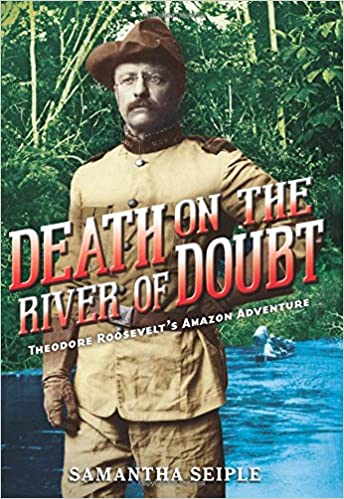
Death on the River of Doubt: Chapters 4–6
This true story chronicles Theodore Roosevelt's 1913 expedition into the Amazon jungle with a team of men including his son Kermit and renowned Brazilian explorer Cândido Mariano da Silva Rondon.
Here are links to our lists for the book: Prologue–Chapter 1, Chapters 2–3, Chapters 4–6, Chapters 7–15, Chapter 16–Epilogue
40 words
31 learners
Learn words with Flashcards and other activities
Definition First

Other learning activities
Full list of words from this list:
-
fluent
expressing yourself readily, clearly, effectivelyRoosevelt’s son Kermit, who spoke Portuguese fluently, was also on the expedition—although he didn’t want to be there.
-
ironically
in a manner characterized by incongruity or unexpectednessLike his father, Kermit was fearless. Ironically, this fearlessness scared his father, and it was a constant source of worry for him, especially when they were hunting lions, elephants, and rhinoceroses in Africa together.
-
brooding
deeply or seriously thoughtfulWhile Kermit and his father shared similar interests and character traits, their personalities were quite different. Kermit was quiet, brooding, and not much of a talker. Where his father had the gift of gab, Kermit had a gift for learning foreign languages.
-
gab
light informal conversation for social occasionsWhile Kermit and his father shared similar interests and character traits, their personalities were quite different. Kermit was quiet, brooding, and not much of a talker. Where his father had the gift of gab, Kermit had a gift for learning foreign languages.
-
welt
a raised mark on the skinAnd despite the heat and humidity, they were often forced to wear stifling head nets and gloves in order to protect themselves from the clouds of insects that hounded them. The worst were the piums, similar in appearance to a black fly, except the pium bit and sucked their blood. The bite itself didn’t hurt, but the itchy welt it left behind caused plenty of discomfort.
-
trivial
of little substance or significance“Men unused to the South American wilderness speak with awe of the danger therein from jaguars, crocodiles, and poisonous snakes, in reality, the danger from those sources is trivial, much less than the danger of being run down by an automobile at home. But at times the torment of insect plagues can hardly be exaggerated,” Roosevelt wrote.
-
ration
the food allowance for one dayBut most worrisome to Roosevelt was learning that Rondon had left behind food rations for his own men. Rondon thought nothing of it: He and his men would go without their rations to lighten the load.
-
deprivation
the disadvantage that results from losing somethingDeprivation and hardship were just part of the job of exploring and surviving in the Brazilian wilderness.
-
hardship
a state of misfortune or afflictionDeprivation and hardship were just part of the job of exploring and surviving in the Brazilian wilderness.
-
provisions
a stock or supply of foods“We took with us provisions for about fifty days; not full rations, for we hoped in part to live on the country—on fish, game, nuts, palm-tops. Our personal baggage was already well cut down...The things that we carried were necessities—food, medicines, bedding, instruments for determining altitude and longitude and latitude—except a few books,” Roosevelt wrote.
-
longitude
the angular distance from the prime meridian at Greenwich“We took with us provisions for about fifty days; not full rations, for we hoped in part to live on the country—on fish, game, nuts, palm-tops. Our personal baggage was already well cut down...The things that we carried were necessities—food, medicines, bedding, instruments for determining altitude and longitude and latitude—except a few books,” Roosevelt wrote.
-
latitude
angular distance between the equator and a parallel line“We took with us provisions for about fifty days; not full rations, for we hoped in part to live on the country—on fish, game, nuts, palm-tops. Our personal baggage was already well cut down...The things that we carried were necessities—food, medicines, bedding, instruments for determining altitude and longitude and latitude—except a few books,” Roosevelt wrote.
-
jeopardize
pose a threat to; present a danger to“No man has any business to go on such a trip as ours unless he will refuse to jeopardize the welfare of his associates by any delay caused by weakness or ailment of his,” Roosevelt wrote.
-
extract
a solution obtained by steeping or soaking a substanceAfter killing the men with their six-foot-long arrows—the tips of which were poisoned with a plant extract called curare—the Nhambiquara buried them in an upright position, with their heads and shoulders sticking out of the ground.
-
encroachment
entry to another's property without right or permissionFrom the time the first Portuguese explorer, Pedro Álvares Cabral, discovered Brazil in the year 1500, the Indian population was negatively impacted—from disease to enslavement to encroachment on their land and way of life.
-
adept
having or showing knowledge and skill and aptitudeCut off from civilization, the Nhambiquara Indians were adept at hiding from plain view in the rain forest.
-
outraged
angered at something unjust or wrongWith the arrow still sticking out of his strap, Rondon fired his rifle into the air, scaring the Indians off. At first, Rondon was outraged. He and his men wanted to kill them, to gain the upper hand. “Why I never dreamed that such a treasonous attack could happen...I escaped a shameful death at the hands of traitors!” Rondon wrote in his diary.
-
treasonous
constituting or having the characteristic of betrayalWith the arrow still sticking out of his strap, Rondon fired his rifle into the air, scaring the Indians off. At first, Rondon was outraged. He and his men wanted to kill them, to gain the upper hand. “Why I never dreamed that such a treasonous attack could happen...I escaped a shameful death at the hands of traitors!” Rondon wrote in his diary.
-
passive
peacefully resistant in response to injusticeDrawing from his experience in establishing peace with the nearby Pareci Indians, Rondon knew the best approach was to gain the Nhambiquara Indians’ trust. To do this, he and his men needed to remain passive and peaceful—no matter what.
-
stealthily
in a manner marked by quiet and caution and secrecyBut the Nhambiquara, cut off from society in the rain forest, weren’t aware of Rondon’s decision. Although the explorers retreated, the Nhambiquara stealthily followed them.
-
pied
having sections or patches colored differently and brightlyIn order to break through the communication barrier and begin peace negotiations with the Nhambiquara, Rondon set up a phonograph and played records. Like the Pied Piper, the music lured the Indians out of their hiding places and into Rondon’s campsite.
-
nomadic
relating to persons or groups who travel in search of food or workThe Nhambiquara were nomadic hunters and gatherers with Stone Age tools. Rondon’s gifts of metal tools were a persuasive means of communication, allowing him to forge a fragile friendship.
-
formidable
inspiring fear or dread“They are the most ferocious fish in the world,” Roosevelt wrote. “Even the most formidable fish, the sharks or the barracudas, usually attack things smaller than themselves. But the piranhas habitually attack things much larger than themselves. They will snap a finger off a hand incautiously trailed in the water...they will rend or devour alive any wounded man or beast; for blood in the water excites them to madness.”
-
rend
tear or be torn violently“They are the most ferocious fish in the world,” Roosevelt wrote. “Even the most formidable fish, the sharks or the barracudas, usually attack things smaller than themselves. But the piranhas habitually attack things much larger than themselves. They will snap a finger off a hand incautiously trailed in the water...they will rend or devour alive any wounded man or beast; for blood in the water excites them to madness.”
-
incite
provoke or stir upCherrie remembered the day he was attacked after slipping from a tree limb and slicing his arm open in the fall: “I realized that I was bleeding and that my blood would instantly incite an attack by the murderous fish...the lightning-like rapidity of the piranha left me little chance to escape unhurt...But I retained enough of my reason to know that my one chance of escape lay in keeping the fish at bay before they became crazed with the taste of blood...."
-
tortuous
marked by repeated turns and bends“The course is extremely tortuous...twisting and turning in every direction. The boatmen have some strenuous times in getting the boat around some of the curves,” Cherrie wrote in his diary.
-
foliage
the collective amount of leaves of one or more plantsAfter using his machete to hack his way through the dense foliage—all while getting stung and bitten by wasps and ants—Kermit would set up the sighting rod.
-
cartographer
a person who makes mapsAt the same time, Rondon used a compass to note the direction of the river. Later, Lyra, who was a cartographer, would plot the course and calculate the distance.
-
bleak
offering little or no hopeIt was also becoming apparent that the possibility of supplementing their food rations with game, such as the tapir, looked bleak.
-
plucky
showing courageIt was about eleven o’clock in the morning when Roosevelt, Cherrie, and Jose Antonio Cajazeira—the expedition’s “cool and plucky” medical doctor—climbed into the canoe they shared. It was the largest and most difficult one to maneuver.
-
maneuver
direct the course of or determine the direction of travelingIt was about eleven o’clock in the morning when Roosevelt, Cherrie, and Jose Antonio Cajazeira—the expedition’s “cool and plucky” medical doctor—climbed into the canoe they shared. It was the largest and most difficult one to maneuver.
-
lithe
moving and bending with ease“They were expert rivermen and men of the forest, skilled veterans in wilderness work. They were lithe as panthers and brawny as bears. They swam like waterdogs. They were equally at home with pole and paddle, with axe and machete...They looked like pirates,” Roosevelt wrote.
-
brawny
possessing physical strength and weight; rugged and powerful“They were expert rivermen and men of the forest, skilled veterans in wilderness work. They were lithe as panthers and brawny as bears. They swam like waterdogs. They were equally at home with pole and paddle, with axe and machete...They looked like pirates,” Roosevelt wrote.
-
deter
try to prevent; show opposition toWhen Rondon first hired him to go on the expedition, Julio was enthusiastic. This was unusual, since many men viewed working for Rondon as a form of punishment. It wasn’t just the harsh and isolated wilderness that deterred them. Rondon was a strict disciplinarian, ruling his men with an iron fist.
-
inhospitable
unfavorable to life or growthHis tough and authoritarian leadership style was necessary in the wild where disease, Indian attacks, and the inhospitable environment relentlessly threatened everyone’s lives. Rondon couldn’t risk a mutiny.
-
mutiny
open rebellion against constituted authorityHis tough and authoritarian leadership style was necessary in the wild where disease, Indian attacks, and the inhospitable environment relentlessly threatened everyone’s lives. Rondon couldn’t risk a mutiny.
-
insubordination
defiance of authorityIf any of his men showed insubordination, Rondon was quick to put them in their place.
-
gregarious
temperamentally seeking and enjoying the company of othersIn comparison, Roosevelt's leadership style was much more approachable. Even though he couldn’t speak Portuguese, the former president’s gregarious nature broke through the language barrier. One way he showed his appreciation to the camaradas for their backbreaking work was to share a chocolate bar from his provisions. He did this every day at noon.
-
conceivable
capable of being imagined“He was a charming companion...He was what we Brazilians call a ‘pandego’...‘the life of the party,”’ said Rondon. “And talk! I never saw a man who talked so much. He would talk all the time he was in swimming [sic], all of the time during meals, traveling in the canoe and at night around the camp fire. He talked endlessly and on all conceivable subjects.”
-
invariably
without change, in every case“His interest was so whole-hearted and obvious that the shyest, most tongue-tied adventurer found himself speaking with entire freedom,” Kermit wrote. “Every one with whom we came in contact fell under the charm. Father invariably thought the best of a person, and for that very reason every one was at his best with him—and felt bound to justify his confidence and judgment.”
Created on Wed Jun 29 20:24:26 EDT 2022
(updated Fri Jul 15 14:10:36 EDT 2022)
Sign up now (it’s free!)
Whether you’re a teacher or a learner,
Vocabulary.com can put you or your class
on the path to systematic vocabulary improvement.