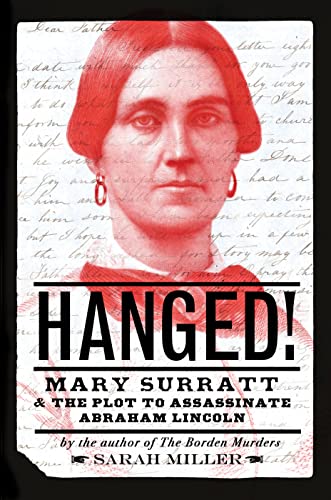
Hanged!: Chapters 11–15
This nonfiction narrative highlights the controversies surrounding the court-martial and hanging of boardinghouse owner Mary Surratt, who was convicted for being a part of the treasonous post-Civil War conspiracy to assassinate key members of the victorious government led by President Abraham Lincoln.
Here are links to our lists for the book: Chapters 1–5, Chapters 6–10, Chapters 11–15, Chapters 16–22, Chapter 23–Epilogue
40 words
69 learners
Learn words with Flashcards and other activities
Definition First

Other learning activities
Full list of words from this list:
-
scrupulously
with careful attention and effort to do something correctlyA meticulous, scrupulously fair man, General Hartranft would do everything in his power to make his prisoners comfortable without bending the steely rules that governed their incarceration.
-
austere
severely simpleConditions were austere at best. The cells were narrow enough for Mary to touch both sidewalls at once. There were no iron bedsteads or wooden chairs here, only a corn husk mattress and a toilet bucket. Nothing but “necessary food and water” was permitted to enter the cells, and that only in “small quantities.”
-
tribunal
an assembly to conduct judicial businessBy now Mary Surratt knew she was to be tried as a conspirator in the murder of Abraham Lincoln, for Colonel Olcott had made mention of “your trial” at her last interrogation. Worse, and perhaps as yet unknown to Mary, Andrew Johnson had issued a proclamation decreeing that the conspirators would be tried not in the civil courts but before a military tribunal.
-
belligerent
someone who fights or is fightingThe charge was more than homicide. It was deemed an act of treason. And the accused, Attorney General James Speed reasoned, were not simply murderers but “enemy belligerents.”
-
impartial
free from undue bias or preconceived opinionsRather than using the customary selection process that allows the defense to question and reject potentially prejudiced jurors, the government would appoint a tribunal of nine high-ranking military officers to decide the prisoners’ fates. In effect, the people who had accused Mary and her seven co-defendants were hand-selecting the men who would ultimately decide whether the defendants should be put to death. Neither would there be an impartial judge.
-
bunting
a loosely woven fabric used for flags, etc.Anyone known to be a Southern sympathizer was on edge. Many blanketed their homes with triple the usual amount of black crepe ribbon, banners, and bunting in hopes that a show of respect for the slain president would discourage the angry mobs from retaliating with “unpleasant visits”—or with flames.
-
fetter
a shackle for the ankles or feetTwo days later, on May 10, the eight defendants were brought before the court. Through the corridors and up the stairs they went, iron fetters clinking all the way.
-
iota
a tiny or scarcely detectable amountIn lieu of a jury, nine military commissioners ranging from lieutenant colonel to major general awaited the evidence. All were distinguished combat veterans of the Civil War. None of them had an iota of professional legal expertise.
-
eviscerate
take away a vital or essential part ofBrimming with energy, this experienced criminal lawyer excelled at “watching the movements of opposing counsel, unraveling the tangled skeins of testimony, and eviscerating truth from masses of conflicting evidence.”
-
arraign
call before a court to answer an indictmentOne by one, the prisoners were arraigned. All eight pleaded not guilty to the charges before being returned to their cells.
-
malady
impairment of normal physiological functionAnxiety was as conspicuous a culprit as any physical malady. The prisoners, the Philadelphia Press reported, were “already undergoing a living death.”
-
trifling
not worth consideringEvidence was a trifling matter as far as the public was concerned—you had only to look at her to see proof of her guilt.
-
privy
informed about something secret or not generally knownBut the papers were not privy to that evidence. There had not been a peep about Weichmann, and only fragments of John Lloyd’s story had leaked out. The vast majority of what the papers had to say about Mary Surratt was based on supposition, prejudice, and the most blatant of sexism.
-
impudence
the trait of being rude and impertinentThe Philadelphia Inquirer interpreted Mary’s desire for competent legal counsel as evidence of her “impudence.” Mrs. Surratt, the paper said, “evinces her boldness in sending for Hon. Reverdy Johnson.” The implication could not be missed: Mary Surratt was guilty, and a guilty woman should not have the audacity to hire one of the most respected lawyers in the state.
-
render
cause to becomeDiscovery, the process of obtaining evidence from the opposing side, would not be granted in this case, rendering the statements and confessions previously collected by the government inaccessible.
-
slovenly
negligent of neatness especially in dress and personIt was said in the Philadelphia Inquirer that Mary had been “very slovenly dressed” the day before and seemed “very much broken down and humbled” as well as visibly fearful.
-
contrition
sorrow for sin arising from fear of damnation“Mrs. Surratt, yesterday, for the first time, showed signs of contrition, and completely abandoned the stoical indifference she has maintained heretofore,” the Philadelphia Age agreed.
-
consternation
sudden shock or dismay that causes confusionSome without such contacts posed as reporters, much to the consternation of the authentic members of the press.
-
mettle
the courage to carry onBooth’s band of conspirators looked like a motley crew. It hardly seemed possible that these eight people possessed the mettle to unseat the most powerful men in the federal government.
-
patently
unmistakablyThere he sat, gazing straight ahead, with his manacled hands in his lap and his head propped upon the wall behind him. How could a man on trial for his life—the man the entire country already knew was the least likely of the eight to escape the gallows—appear so patently unruffled?
-
craven
lacking even the rudiments of courage; abjectly fearful“His whole bearing indicates the craven coward, and the great wonder is that he was ever entrusted to do a deed of blood that could not be done in the dark,” said the Philadelphia Inquirer.
-
pigeonhole
treat or classify according to a mental stereotypeHe himself was small and dark—so very much the image of a skulking villain that he might have been lifted from the pages of a mystery novel. His appearance made it easy to pigeonhole him in the role of a minion slinking away from his master’s deadly instructions, though in fact it had taken a great deal of courage to defy Booth’s instructions.
-
garner
acquire or deserve by one's efforts or actionsThe rest of the male defendants garnered far less attention. Their crimes were not so bloodcurdling, their appearance for the most part shockingly unremarkable.
-
ploy
a maneuver in a game, conversation, or situationSocial convention demanded that a woman should signify the loss of a husband by wearing this “deep mourning” for a year, but Mary Surratt’s husband had died over two and a half years earlier, leaving some to wonder if her black clothing was indeed only a ploy for pity.
-
incessant
uninterrupted in time and indefinitely long continuingWhat is certain is that Mary Surratt did everything she could to shield herself from the onlookers’ incessant stares. Her dark veil always hung before her face.
-
aspersion
an abusive attack on a person's character or good name“I have lived too long, gone through too many trials, rendered the country such services as my abilities enabled me…to tolerate for a moment—come from whom it may—such an aspersion upon my moral character,” the sixty-nine-year-old senator replied, his tone as grave as the insult.
-
manifest
clearly revealed to the mind or the senses or judgmentAs Johnson spoke, one member of the tribunal remembered, “his indignation was very manifest in his flushed face, but his remarks were quiet and dignified and full of irony.”
-
litigation
a legal proceeding in a courtThough they would go on to have distinguished careers, in 1865 both men were under thirty, their litigation skills largely untried. History would come to view them as too young and inexperienced and consequently too inept to handle such a momentous trial.
-
barrage
the rapid and continuous delivery of communicationGeneral Holt had chosen to open the prosecution’s case before the public with a barrage of evidence against her.
-
adjutant
an officer who acts as an assistant to a more senior officer“He was seemingly not only a willing witness, but a ‘swift witness,’” General Hartranft’s assistant adjutant later recalled, by which he meant that Weichmann testified with an exaggerated zeal and an eagerness to volunteer information, in a way that smacked of bias.
-
behest
an authoritative command or requestIn an effort to prove that Mary’s trip to Surrattsville on April 14 was not solely at Booth’s behest, Aiken brought out the fact that while she and Weichmann were at the tavern, he had written, at her request, a threatening letter to Mr. Nothey, the man whose debt Mary had said she intended to collect.
-
exemplary
worthy of imitationReverdy Johnson also succeeded in getting Weichmann to acknowledge that he had never seen the slightest indication of anything overtly wicked or immoral about his landlady. “Her character,” Weichmann freely admitted, “was exemplary and ladylike in every particular.”
-
rebut
overthrow by argument, evidence, or proofIn both breadth and length, no one else’s testimony would come close to equaling Louis Weichmann’s. Nearly seventy defense witnesses would be required to rebut him.
-
tenor
the general meaning or substance of an utteranceFrom the tenor of this young man’s evidence…he appears to have known that something was going on, but he could not get the right hang of it, and the whole party used him as a go-between.
-
arbitrary
based on or subject to individual discretion or preferenceThe Boston Daily Advertiser noted that he “seems more than any of his colleagues to chafe at the arbitrary rulings of the court, and often has hard work to keep his temper.”
-
berate
censure severely or angrilyA member of Hartranft’s staff recalled how the congressman never failed to jump at the chance to “rake the whole Confederacy, from Jeff Davis all down the line to the prisoners at the bar.” Always during these tirades he turned to the defense counsel, as if berating them personally.
-
flagrant
conspicuously and outrageously bad or reprehensibleAs far as he was concerned, the whole proceeding reeked of violations of the prisoners’ rights, as well as flagrant diversions from courtroom protocol.
-
succinctly
with concise and precise brevity; to the point“The first day disgusted him,” one reporter succinctly put it, “as he is a practitioner of law.”
-
broach
bring up a topic for discussion“When she first broached the subject to me, I did not know what she had reference to,” Lloyd said; “then she came out plainer; and I am quite positive she asked me about the ‘shooting-irons.’ I am quite positive about that, but not altogether positive.”
-
apprise
inform somebody of something“From the way he spoke, he must have been apprised that I already knew what I was to give him.”
Created on Tue Jul 02 11:09:06 EDT 2024
(updated Wed Jul 03 19:28:50 EDT 2024)
Sign up now (it’s free!)
Whether you’re a teacher or a learner,
Vocabulary.com can put you or your class
on the path to systematic vocabulary improvement.