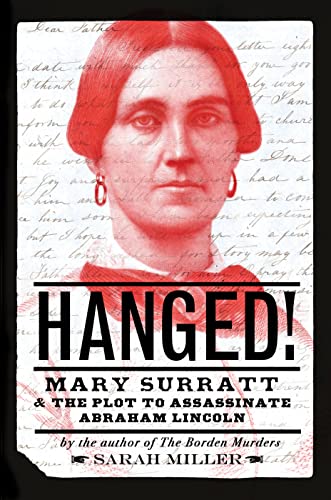
Hanged!: Chapters 6–10
This nonfiction narrative highlights the controversies surrounding the court-martial and hanging of boardinghouse owner Mary Surratt, who was convicted for being a part of the treasonous post-Civil War conspiracy to assassinate key members of the victorious government led by President Abraham Lincoln.
Here are links to our lists for the book: Chapters 1–5, Chapters 6–10, Chapters 11–15, Chapters 16–22, Chapter 23–Epilogue
40 words
53 learners
Learn words with Flashcards and other activities
Definition First

Other learning activities
Full list of words from this list:
-
qualm
uneasiness about the fitness of an actionMany Americans’ first impression of Mary would be of a woman admitting the police into her home without a qualm, as though she had offered up her wrists to be shackled as amiably as others might shake hands.
-
insinuate
suggest in an indirect or covert way; give to understand“The mother took it calmly as though she had been expecting it,” the New York Times reported, insinuating that an innocent woman would have been shocked to find the authorities ringing her doorbell.
-
paragon
model of excellence or perfection of a kindAlmost every word was a veiled insult, right down to the word “woman.” Any female qualified as a woman. “Lady,” on the other hand, indicated a paragon of femininity, a woman worthy of respect and deference, due to the refinement of her manners, breeding, and dress.
-
misgiving
doubt about someone's honestyA large woman, particularly one with a coarse (that is, masculine) expression, aroused immediate misgivings. And a shabbily dressed woman clearly took no pride in her appearance—something a lady would never dream of neglecting.
-
boon
something that is desirable, favorable, or beneficialIn 1852, much to Mary’s dismay, Father Finotti had been transferred to Brookline, Massachusetts. What constituted a genuine tragedy for Mary proved to be a boon for history, for their separation forced Mary Surratt to commit her woes to paper rather than whisper them in the confessional.
-
divulge
make known to the public information previously kept secretJust six letters written in Mary Surratt’s own hand are known to survive. All six of them are addressed to Father Finotti. This scanty handful of documents divulges an astonishing amount of insight into the harsh realities of Mary’s life.
-
censure
harsh criticism or disapprovalOn at least one occasion, John Sr.’s transgressions were so serious that Mary did not speak to him for “ten or twelve days,” leaving history to wonder what offense had prompted her silent censure.
-
indolent
disinclined to work or exertionShe was by then shouldering John’s duties as postmaster and likely managing the tavern as well, not to mention endeavoring to keep her children on a straight and narrow path while simultaneously preventing her neighbors and customers from discovering that her husband was an indolent drunkard.
-
credence
the mental attitude that something is believableA story such as this, appearing in print only once and from an unnamed source, hardly seems worthy of consideration as anything more than common gossip. But in fact, there are clues in Mary Surratt’s correspondence that lend credence to this rumor.
-
erratic
liable to sudden unpredictable changeBeautiful though her penmanship is, erratic spellings abound, and sentences often run together without punctuation or capitalization to divide them.
-
indifferent
showing no care or concern in attitude or actionJohn Sr. was either indifferent or hostile to the idea of paying for schooling for Isaac, Anna, and John Jr., terming one academy “unhealthy” for his son.
-
tenacity
persistent determinationMary did her best and was soon rewarded for her tenacity.
-
haphazard
marked by great carelessnessAlthough the original handwritten transcripts were carefully preserved in the National Archives, the questions and answers themselves were recorded in a haphazard manner.
-
terse
brief and to the pointThen, abruptly—sometimes smack in the middle of a witness’s reply—the answers shift from a verbatim account, complete with the usual verbal stumbles and hesitations, to a terse summary.
-
vehement
marked by extreme intensity of emotions or convictionsAnna’s protests were so vehement that her mother’s interrogation had to be interrupted in order for Mary to come and calm Anna.
-
curt
brief and to the pointThat curt note had perturbed Mary.
-
flummox
be a mystery or bewildering toHer insistence appears to have left the interrogator flummoxed. “I don’t know but I have misunderstood you,” he said.
-
stymie
hinder or prevent the progress or accomplishment ofIt is difficult to read the transcript without coming away with the impression that Mary Surratt’s responses had thoroughly stymied her interrogator.
-
meager
deficient in amount or quality or extentOn the floor sat a tin basin and a wooden toilet bucket. A plain wooden chair or two completed the meager furnishings. Little but spiderwebs adorned the crumbling wallpaper.
-
manacle
confine or restrain with or as if with handcuffsThough the men were blinded and stifled at all hours, mealtime proved an especial torment, for with manacled hands it was next to impossible for prisoners to guide a spoon to the misaligned mouth hole.
-
denote
be a sign or indication of“She was apparently about forty years of age, a tall commanding figure, rather stout, with brown hair, blue eyes, thin nose, and small, well-shaped mouth, denoting great firmness. This lady was Mrs. Surratt.”
-
reproach
a mild rebuke or criticismShe rather avoided conversation, and never uttered one word of reproach or virulence against those by whose authority she was imprisoned.
-
virulence
extreme hostilityShe rather avoided conversation, and never uttered one word of reproach or virulence against those by whose authority she was imprisoned.
-
abet
assist or encourage, usually in some wrongdoingFor the seventy-two hours he had remained silent, he had obstructed justice, as well as aided and abetted John Wilkes Booth’s escape.
-
glean
collect or gather bit by bit, especially informationHis report listed just three scraps of information he had gleaned: Lloyd was acquainted with Booth and Herold and had concealed their carbines in the tavern; on April 14, Mary Surratt had instructed him to have the weapons ready; Booth and Herold had arrived after midnight to collect the rifles.
-
complicity
guilt as a confederate in a crime or offenseAs far as investigators were concerned, John Lloyd had “virtually acknowledged complicity” with his second confession, giving them rock-solid grounds for trying him as a conspirator alongside Booth.
-
indict
accuse formally of a crimeIf Lloyd’s information was to be of any use against the conspirators, therefore, he could not be indicted in Lincoln’s murder.
-
embellish
add details toBoth Lloyd and the investigators, then, had an incentive to embellish the facts. The more Lloyd could be made to dread being prosecuted, the more information he was likely to volunteer.
-
indignant
angered at something unjust or wrongOne of the cavalry officers tasked with tracking Booth’s trail recalled the strain of working under “the weight of indignant and impotent grief that was added to a Nation’s sorrow for its loss, as the conviction settled upon the hearts of man that the murderer had escaped.”
-
unprecedented
novel; having no earlier occurrenceReward offers of $10,000, then $30,000, brought no useful leads. Fed up, Stanton issued a broadside on April 20 that placed an unprecedented price on Booth’s head.
-
secrete
conceal or place out of sightThe notice ended on an ominous note: “All persons harboring or secreting the said persons, or either of them, or aiding or assisting their concealment or escape, will be treated as accomplices in the murder of the President and the attempted assassination of the Secretary of State, and shall be subject to trial before a Military Commission, and the punishment of DEATH.”
-
pertinent
having precise or logical relevance to the matter at handFew other men had supplied as much pertinent information as the young clerk had.
-
relegate
assign to a lower positionThat evening, April 25, the Garretts relegated “Mr. Boyd” and his young “cousin” to the tobacco barn for the night. In fact, the two eldest Garrett brothers padlocked Booth and Herold into the barn, for fear that the pair of strangers might be horse thieves.
-
mitigate
lessen or to try to lessen the seriousness or extent of“Yes, sir,” she said, and then she appears to have done what she could to mitigate the damage this admission caused.
-
peripheral
related to the key issue but not of central importanceColonel Olcott cast about for a few more peripheral details he could compare with Lloyd’s version of the encounter.
-
scrutiny
the act of examining something closely, as for mistakesOver the weeks, months, and years to follow, Mary Surratt’s reply to this question would provoke more scrutiny than any other: “I only saw a stranger. I never saw him before. I never thought it was the Wood who was at our house.”
-
absolve
excuse or free from blameThis may have been an opportunity to absolve a piece of incriminating evidence—the carte de visite of Booth, found tucked behind a painting in Anna’s room. If Anna had secretly fallen for the dashing theater idol, as so many other women had, it could plausibly have accounted for why the assassin’s image had been in the house, as well as why it had been hidden.
-
pilfer
make off with belongings of othersStacks of envelopes, marked with the official frank of the Office of the Commissary General of Prisoners (the agency of the War Department in which Weichmann was employed), had been found in the bedroom he shared with John Surratt on H Street. This was a graver matter than simply pilfering supplies from his workplace.
-
purloin
make off with belongings of others“I am satisfied he has frequently purloined important papers which have been forwarded to Richmond by or through John Surratt,” Wood wrote of Weichmann.
-
ostentation
pretentious or showy or vulgar display“That her position sorely tried her, was apparent to all; but there was never the least appearance of guilt, and not for one moment did her faith in an All-merciful Providence waver. There was no pretence about it,—you felt that the woman was deeply and sincerely religious, yet without any ostentation.”
Created on Tue Jul 02 11:08:59 EDT 2024
(updated Wed Jul 03 19:28:09 EDT 2024)
Sign up now (it’s free!)
Whether you’re a teacher or a learner,
Vocabulary.com can put you or your class
on the path to systematic vocabulary improvement.