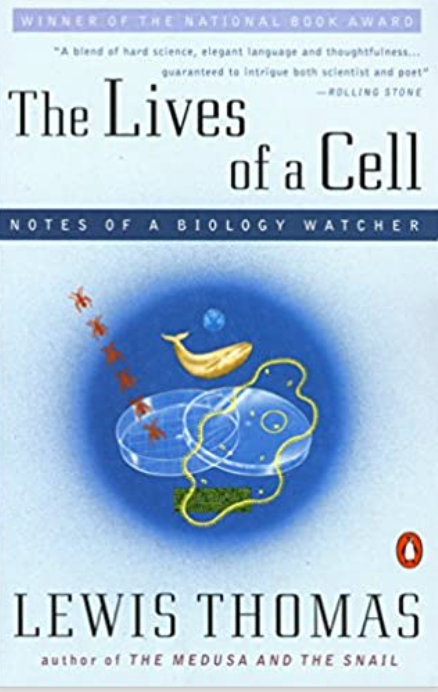
The Lives of a Cell: List 5
In 29 essays, physician, etymologist, poet, educator, and researcher Lewis Thomas covers a range of topics to illustrate his theme that all living things, including the Earth itself, are interconnected and interdependent.
This list covers "Some Biomythology"–"The World’s Biggest Membrane."
Here are links to our lists for the book: List 1, List 2, List 3, List 4, List 5
40 words
29 learners
Learn words with Flashcards and other activities
Definition First

Other learning activities
Full list of words from this list:
-
anecdote
short account of an incidentThey are as obsolete as the old anecdotes in which they played their puzzling, ambiguous roles, and we have no more need for the beasts than for the stories. The Griffon, Phoenix, Centaur, Sphinx, Manticore, Ganesha, Ch’i-lin, and all the rest are like recurrent bad dreams, and we are well rid of them. So we say.
-
manticore
a monster having the head of man and the body of a lionThey are as obsolete as the old anecdotes in which they played their puzzling, ambiguous roles, and we have no more need for the beasts than for the stories. The Griffon, Phoenix, Centaur, Sphinx, Manticore, Ganesha, Ch’i-lin, and all the rest are like recurrent bad dreams, and we are well rid of them.
-
exuberant
joyously unrestrainedThe Phoenix comes the closest to being a conventional animal, all bird for all of its adult life. It is, in fact, the most exuberant, elaborate, and ornamented of all plumed birds. It exists in the mythology of Egypt, Greece, the Middle East, and Europe, and is the same as the vermilion bird of ancient China.
-
vermilion
of a vivid red to reddish-orange colorThe Phoenix comes the closest to being a conventional animal, all bird for all of its adult life. It is, in fact, the most exuberant, elaborate, and ornamented of all plumed birds. It exists in the mythology of Egypt, Greece, the Middle East, and Europe, and is the same as the vermilion bird of ancient China.
-
ardent
characterized by strong enthusiasmThere are so many examples of hybrid beings in bestiaries that you could say that an ardent belief in mixed forms of life is an ancient human idea, or that something else, deeply believed in, is symbolized by these consortia.
-
consortium
a cooperative association among institutions or companiesThere are so many examples of hybrid beings in bestiaries that you could say that an ardent belief in mixed forms of life is an ancient human idea, or that something else, deeply believed in, is symbolized by these consortia.
-
cloven
(used of hooves) split, dividedThe Ch’i-lin, for instance, out of ancient China, has the body of a deer covered with gleaming scales, a marvelous bushy tail, cloven hooves, and small horns.
-
amiable
diffusing warmth and friendlinessNot all mythical beasts are friendly, of course, but even the hostile ones have certain amiable redeeming aspects.
-
libation
the act of pouring a liquid offering as a religious ceremonyThere are two great identical snakes on a Levantine libation vase of around 2000 B.C., coiled around each other in a double helix, representing the original generation of life.
-
niche
a small concavityHe is, in fact, an imaginary version of a genuine animal, symbiopholus, described in Nature several years back, a species of weevil in the mountains of northern New Guinea that lives symbiotically with dozens of plants, growing in the niches and clefts in its carapace, rooted all the way down to its flesh, plus a whole ecosystem of mites, rotifers, nematodes, and bacteria attached to the garden.
-
cleft
a long narrow openingHe is, in fact, an imaginary version of a genuine animal, symbiopholus, described in Nature several years back, a species of weevil in the mountains of northern New Guinea that lives symbiotically with dozens of plants, growing in the niches and clefts in its carapace, rooted all the way down to its flesh, plus a whole ecosystem of mites, rotifers, nematodes, and bacteria attached to the garden.
-
carapace
hard outer covering or case of certain organismsHe is, in fact, an imaginary version of a genuine animal, symbiopholus, described in Nature several years back, a species of weevil in the mountains of northern New Guinea that lives symbiotically with dozens of plants, growing in the niches and clefts in its carapace, rooted all the way down to its flesh, plus a whole ecosystem of mites, rotifers, nematodes, and bacteria attached to the garden.
-
allusive
characterized by indirect referencesThe story told by myxotricha is as deep as any myth, as profoundly allusive.
-
paramecium
a freshwater ciliate protozoanWhen the paramecium bursaria runs out of food, all he needs to do is stay in the sun and his green endosymbionts will keep him supplied as though he were a grain.
-
chimera
a grotesque product of the imaginationCytoplasm will flow easily from one to the other, the nuclei will combine, and it will become, for a time anyway, a single cell with two complete, alien genomes, ready to dance, ready to multiply. It is a Chimera, a Griffon, a Sphinx, a Ganesha, a Peruvian god, a Ch’i-lin, an omen of good fortune, a wish for the world.
-
proliferation
a rapid increase in numberThen, unaccountably, the whole idea abruptly dropped out of fashion and sight. During the past quarter-century almost no mention of it is made in the proliferation of scientific literature in entomology.
-
heuristic
using a general formulation to guide investigationThis huge idea—that individual organisms might be self-transcending in their relation to a dense society—was not approachable by the new techniques, nor did it suggest new experiments or methods. It just sat there, in the way, and was covered over by leaves and papers. It needed heuristic value to survive, and this was lacking.
-
visage
the appearance conveyed by a person's face“Holism,” a fabricated word, has been applied to concepts like the Superorganism. One wonders whether this word may not itself have scared off some investigators; it is a word with an alarming visage.
-
etymological
relating to the origins or development of wordsGeneral Jan Smuts, who invented it out of whole cloth in 1926, might have done better with “Wholism”; it would have served the same etymological purpose and might have been just secular enough to survive this kind of century.
-
secular
not concerned with or devoted to religionGeneral Jan Smuts, who invented it out of whole cloth in 1926, might have done better with “Wholism”; it would have served the same etymological purpose and might have been just secular enough to survive this kind of century.
-
emphatically
without question and beyond doubtThey take pains to explain that ants are not, emphatically not, tiny mechanical models of human beings.
-
benign
pleasant and beneficial in nature or influenceSome words are gradually altered while we have them in everyday use, without our being aware until the change has been completed: the ly in today’s adverbs, such as ably and benignly, began to appear in place of “like” just a few centuries ago, and "like” has since worn away to a mere suffix.
-
quark
fundamental subatomic particle that has a fractional chargeA few words are made up by solitary men in front of our eyes, like Holism out of Smuts, or Quark out of Joyce, but most of these are exotic and transient; it takes a great deal of use before a word can become a word.
-
transcendental
existing outside of or not in accordance with nature“Holism” suggests something biologically transcendental because of “holy,” although it was intended more simply to mean a complete assemblage of living units.
-
hallow
render holy by means of religious ritesOriginally, it came from the Indo-European root word kailo, which meant whole, also intact and uninjured. During passage through several thousand years it transformed into hail, hale, health, hallow, holy, whole, and heal, and all of these still move together through our minds.
-
genus
taxonomic group containing one or more speciesMeanwhile, a branch of gene became the Latin gens, then gentle itself; it also emerged as genus, genius, genital, and generous; then, still holding on to its inner significance, it became “nature” (out of gnasci).
-
physic
a purging medicinePhusis became the source of physic, which at first meant natural science and later was the word for medicine.
-
edifice
a structure that has a roof and wallsHe arrived at this after long observation of the construction of termite nests, which excepting perhaps a man-made city are the most formidable edifices in nature.
-
phoneme
a distinct speech sound in a particular languageIt makes pellets out of phonemes, implies that the deep structures of grammar are made of something like cement. I do not care for this.
-
discomfit
cause to lose one's composureWhenever you get the available answer to a straight question, like, say, where does the most famous and worst of the four-letter Anglo-Saxon unprintable words come from, the answer raises new and discomfiting questions.
-
fey
suggestive of an elf in strangeness and otherworldlinessIt turned from poik-yos into faigjaz in Germanic, and faege in Old English, meaning fated to die, leading to “fey.”
-
logos
a rhetorical appeal to the audience's reason or rationalityLeg in its senses of gathering, choosing, and speaking gave rise to the Latin legere, and thus words like “lecture” and “legible.” In Greek, it became legein, meaning to gather and to speak; “legal” and “legislator” and other such words derived. Leg was further transformed in Greek to logos, signifying reason.
-
admonition
a firm rebukeThe other word for man contains the same admonition, but turns the message around. It is wiros, meaning man in Indo-European, taken as weraldh in Germanic and weorold in Old English, emerging, flabbergastingly, as “world.”
-
goad
urge with or as if with a prodThe egg here comes from ak, a word for sharp, suffixed to akjo in Germanic, meaning “edge,” and to akjan in Old Norse, meaning “egg,” to incite, goad; the same root moves on into Old English as aehher and ear, for ear of corn.
-
augur
predict from an omenThe real egg comes from awi, meaning bird, which turned into avis and ovum in Latin (not known, of course, which came first), into oion in Greek, and was compounded with spek (to see) to form awispek, “watcher of birds” which became auspex in Latin, meaning augur.
-
auscultation
listening to sounds within the body with a stethoscopeOus became aus became “auscultation,” which is what leeches (leg) do for a living (leip) unless they are legal (leg) leeches, which, incidentally, is not the same thing as lawyers (legh).
-
shoal
a stretch of shallow waterLater, when the time is right, there may be fusion and symbiosis among the bits, and then we will see eukaryotic thought, metazoans of thought, huge interliving coral shoals of thought.
-
fugue
a musical form consisting of a repeated themeIn this sense, the Art of Fugue and the St. Matthew Passion were, for the evolving organism of human thought, feathered wings, apposing thumbs, new layers of frontal cortex.
-
apnea
temporary cessation of breathing, especially while sleepingBerkner suggests that there may have been cycles of oxygen production and carbon dioxide consumption, depending on relative abundances of plant and animal life, with the ice ages representing periods of apnea.
-
ordained
fixed or established especially by commandThere may have been elements of luck in the emergence of chloroplasts, but once these things were on the scene, the evolution of the sky became absolutely ordained.
Created on Tue Feb 22 21:15:47 EST 2022
(updated Wed Feb 08 11:48:01 EST 2023)
Sign up now (it’s free!)
Whether you’re a teacher or a learner,
Vocabulary.com can put you or your class
on the path to systematic vocabulary improvement.