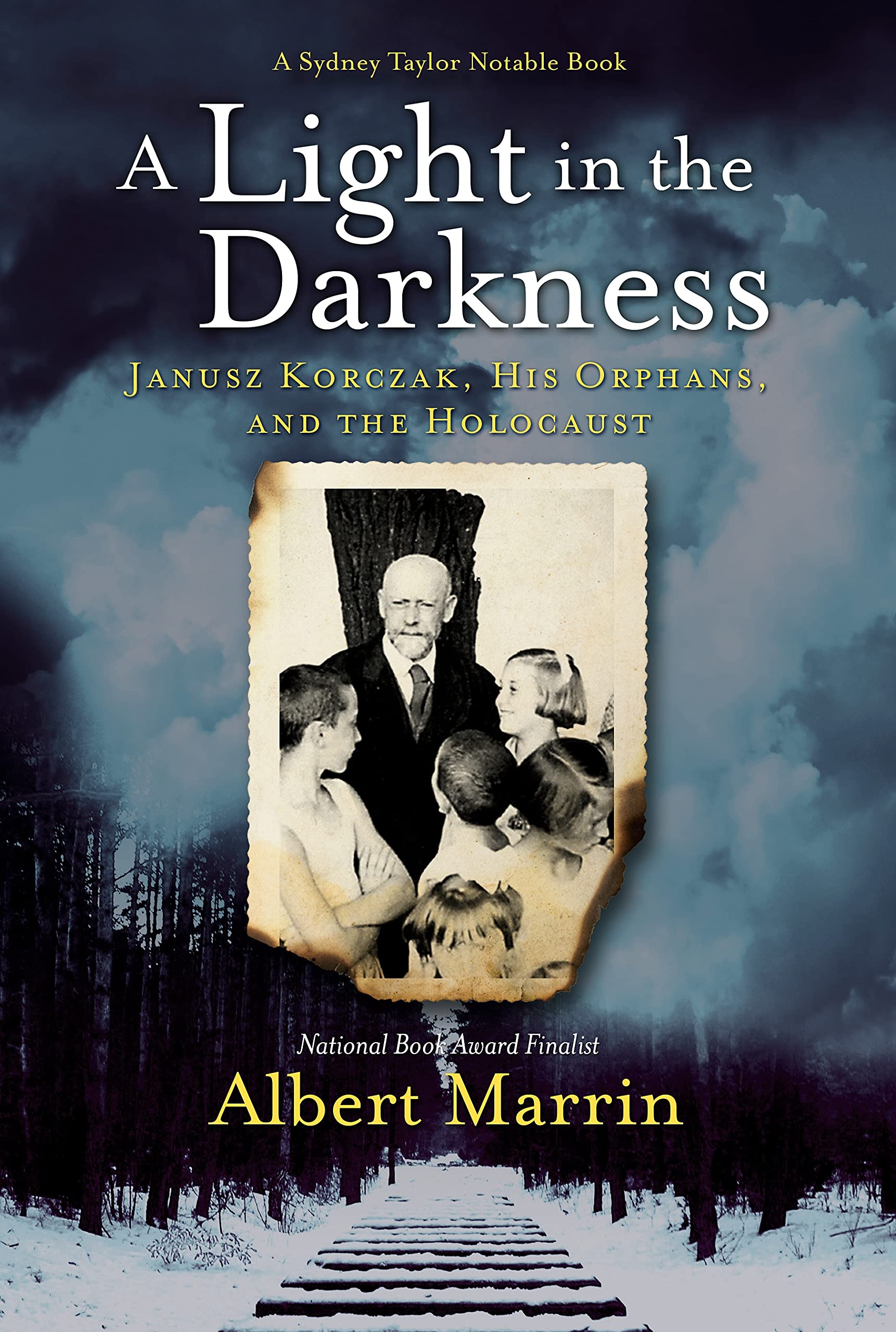
A Light in the Darkness: Part III
This biography details the life of Janusz Korczak, a Polish doctor who refused to abandon the orphaned children in his care during the Holocaust.
Here are links to our lists for the book: Prologue–Part I, Part II, Part III, Part IV, Parts V–VI
40 words
22 learners
Learn words with Flashcards and other activities
Definition First

Other learning activities
Full list of words from this list:
-
sublime
inspiring aweWarsaw symbolized all that was both sublime and tragic during the war—and the ghetto was at the heart of the tragedy.
-
swindle
the act of cheating by some fraudulent schemeThe Führer denounced the ideal of peace as a Jewish-Christian swindle, a violation of the natural order.
-
deplore
express strong disapproval ofEmboldened when Great Britain and France, allies in World War I, did nothing but “deplore” his actions, he turned his attention to Poland.
-
portly
fairly largeAs the generals cheered, Hermann Göring could not contain his joy. The official transcript states that the portly thug “jumped on a table...and made bloodthirsty promises. He danced like a wild man.”
-
subdued
restrained in style or qualityGerman and Polish civilians reacted differently to news of the war. By and large, Germans were subdued, dreading a repeat of 1914–1918.
-
peddler
someone who travels about selling waresWarsaw street peddlers sold a paper toy that looked like a pig but, if unfolded a certain way, turned into a cartoonish picture of Hitler’s face.
-
relish
derive or receive pleasure fromHitler relished newsreels of Warsaw’s agony.
-
atonement
the act of making amends for sin or wrongdoingThe severest raids took place on the two holiest days in the Jewish calendar: the first day of Rosh Hashanah (that year September 14), the Jewish New Year; and Yom Kippur (September 23), the Day of Atonement—a solemn day of prayer and fasting, when Jews ask God’s forgiveness for their sins.
-
douse
put out, as of a candle or a lightAt Dom Sierot, he and a few of the older boys and girls stood guard on the roof with buckets of sand, ready to douse incendiary bombs and windblown embers.
-
artillery
large but transportable armamentAs for Warsaw, more than 6,000 soldiers died defending the city; another 40,000 civilians died in air raids and artillery bombardments.
-
lackey
a servile or submissive followerHans Frank, Hitler’s lackey, ruled this territory from Kraków, Poland’s second-largest city.
-
livery
a uniform, especially worn by servants and chauffeursGovernor Frank relished his position. He lived with his wife and two sons in a castle, amid elegant furniture, precious antiques, and liveried servants.
-
stature
high level of respect gained by impressive achievementWith diabolical efficiency, Heydrich set out to “decapitate” Poland. In effect, he would kill its natural leaders—people with the stature, character, education, and will to challenge Nazi authority.
-
personnel
group of people willing to obey ordersWhen, for example, a Polish physician asked a nurse about the fate of psychiatric patients, she replied: “All the mentally ill were shot with machine guns, but under penalty of death, the hospital personnel were forbidden to talk about this crime.”
-
facilitate
make easierHeydrich drew a line between the Nazis’ “final goal” and the “preliminary measures” needed to “facilitate subsequent measures.”
-
stooge
an obedient follower who works for someone else's advantageAbove all, councils had to carry out every Nazi order promptly, efficiently, and without protest. Jewish Council members were not Nazi stooges. Most were practical, responsible men (never women) committed to helping their people.
-
pliable
able to adjust readily to different conditionsThe Talmud says: “Be pliable like a reed, not rigid like a cedar.” High winds topple rigid trees, so be flexible, bend, adapt to changing conditions.
-
placate
cause to be more favorably inclinedOver the centuries, Jews had devised ways of coping with their oppressors, always more numerous and violent than themselves. Coping did not involve preventive attack, armed resistance, and revenge. Instead, it involved bribing oppressors, bargaining with them, placating them, then procrastinating when it came to following through.
-
mortified
made to feel uncomfortable because of shame or wounded prideCertain Warsaw streets, they said, resembled Hollywood: “Wherever you go, you see a star.” Most, however, did not see the humor. Instead, they were mortified at having to wear the “ribbon of disgrace.” For this strip of cloth separated them from the rest of the population, making them easy to identify and, therefore, easy prey for Nazis and Polish anti-Semites.
-
interim
serving during an intermediate interval of timeAccording to historian Michael Burleigh, the Nazis had a sinister reason for establishing Jewish ghettos. They served as “interim warehousing,” pending the decision to empty them by mass murder.
-
plod
walk heavily and firmly, as when weary, or through mudLong, long rows of little carts and all sorts of makeshift vehicles heaped with household possessions, wailing children, the old, the sick, the half-dead, moved from all directions toward the ghetto, pulled or led by the stronger and healthier, who plodded along, tearful, despairing, bewildered.
-
ail
be unwellAlready ailing, he seemed less energetic than in all the years they’d known him.
-
fathom
come to understandThe author of The Senate of Madmen could not fathom—really fathom—the racist ideology that drove Hitler and the Nazi leadership.
-
sentry
a person employed to keep watch for some anticipated eventTrouble began at the entry gate. A German sentry looked very cross.
-
verboten
forbidden or prohibitedThose sacks of potatoes in the cart are verboten—forbidden.
-
dapper
marked by up-to-dateness in dress and mannersThere he faced a dapper officer sitting at a desk beneath a portrait of Hitler.
-
transitory
lasting a very short time“There are human laws which are transitory, and higher laws which are eternal,” Korczak said.
-
clamor
loud and persistent outcry from many peopleSpace was so limited that six or seven people, families and strangers, might share a small room. Often, young children shared a bed with their parents and siblings. All lived amid a “deafening clamor” that seemed to jangle every nerve.
-
destitute
poor enough to need help from othersOf the Warsaw ghetto’s 450,000 inhabitants, 150,000 were utterly destitute refugees.
-
conspicuous
obvious to the eye or mind“Often those dwellings consist of nothing but the four naked walls, without a single article of furniture or a single garment. People are often lying on the bare ground, on straw; beds are conspicuous by their absence. Whatever bedding one finds is the color of mud. Sometimes they lie on a heap of feathers, the pillowcases having been sold a long time ago [to buy food].”
-
meager
deficient in amount or quality or extentThere were two types of smugglers. Children working alone or in small groups brought in meager amounts of food. Adult gangs of professionals smuggled large quantities of food and other goods.
-
rampant
occurring or increasing in an unrestrained wayWhat is remarkable is that, despite rampant anti-Semitism, there were those who could see beyond bigotry to their common humanity.
-
connoisseur
an expert able to appreciate a fieldAnyone who didn’t know their occupation would think them deformed. But the connoisseurs of smuggling know their secret. This is an artificial, manufactured hump whose inside is filled with potatoes and onions.
-
gaudy
tastelessly showyIts patrons wore fine clothes, the women sporting gaudy makeup and dresses with plunging necklines.
-
delicacy
something considered choice to eatJewish police officials might also sit at tables nearby, meeting contacts and taking bribes. These men had a schmaltz-grub (literally, a “hole filled with chicken fat”—schmaltz is a Jewish delicacy, a yellow mixture of rendered chicken fat, often with added onions, spread on bread in place of butter), Yiddish slang for a profitable racket.
-
clad
wearing or provided with clothingThe saddest sights, however, were small children clad in rags, walking skeletons with gray, pinched faces and bulging eyes.
-
entrails
internal organs collectively“These were not human cries, nor human weeping. It was the haunted baying of creatures facing death, clinging to life with the only physical effort still left to them—the whistling howl that ripped out of their empty bellies and contracted entrails to fill the troubled night with frightful tremor.”
-
reprove
reprimand, scold, or express dissatisfaction withWith a sack over his shoulder, he knocked on the doors of likely donors. Sometimes they gave him a hard time, forcing him “to shout, reprove, beg, and lose his temper.”
-
wangle
achieve something by means of trickery or devious methodsFrom time to time, Korczak was able to wangle a barrel of tiny salted fish called “stinkies,” which were used to make soup.
-
dexterous
skillful in physical movements; especially of the hands“It is a long time since I have had a bath. Yesterday I caught on myself and killed without turning a hair—with one dexterous squeeze of a nail—a louse.”
Created on Tue Aug 24 15:03:35 EDT 2021
(updated Thu Aug 26 14:18:51 EDT 2021)
Sign up now (it’s free!)
Whether you’re a teacher or a learner,
Vocabulary.com can put you or your class
on the path to systematic vocabulary improvement.