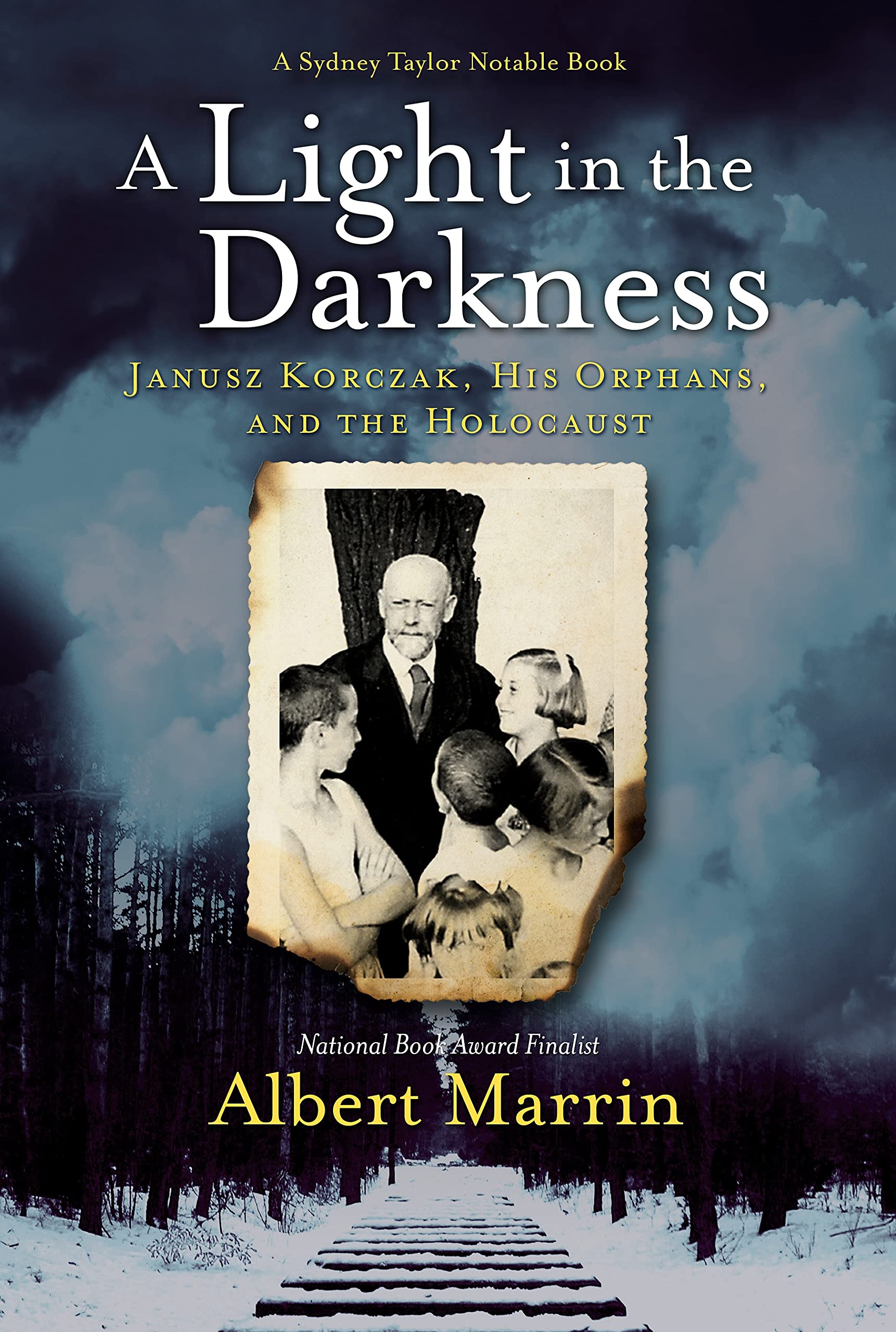
A Light in the Darkness: Part IV
This biography details the life of Janusz Korczak, a Polish doctor who refused to abandon the orphaned children in his care during the Holocaust.
Here are links to our lists for the book: Prologue–Part I, Part II, Part III, Part IV, Parts V–VI
40 words
23 learners
Learn words with Flashcards and other activities
Definition First

Other learning activities
Full list of words from this list:
-
blunder
an embarrassing mistakeThe Führer decided to attack the Soviet Union, though Germany was still at war with Great Britain and clearly not winning. The decision was an unforced error, a colossal blunder that would bring Nazi Germany to ruin.
-
raze
tear down so as to make flat with the ground“I will raze this damned city to the ground,” he swore, “and I will make an artificial lake to provide energy for an electric power station. The name of Moscow will vanish forever.”
-
pram
a baby carriage with four wheelsFighter pilot Hans Hartigs boasted: “We liked to go for women pushing prams, often with children at their sides. It was a kind of sport really.”
-
abreast
alongside each other, facing in the same directionColumns of prisoners, marching five abreast, stretched to the horizon, as far as the eye could see.
-
mince
make less severe or harshTo be sure, as Germany rearmed and Hitler grew bolder, he did not mince words in meetings with foreign diplomats. In November 1938, just days after Kristallnacht, he told a South African official that the Jews “would disappear from Europe one day.”
-
fervent
characterized by intense emotionEvidently, what troubled Himmler was not the morality of the mass-murder order; a fervent racist, he, too, wanted the Jews wiped out.
-
auxiliary
someone who acts as an assistantVolunteers also became auxiliaries, working alongside the Waffen-SS and Einsatzgruppen.
-
perverse
deviating from what is considered moral or right or properHimmler agreed, adding that Jewish children not only had “bad blood” but would seek vengeance for their parents’ deaths if allowed to live. Therefore, according to his perverse logic, “even the child in the cradle must be trampled down like a poisonous toad.”
-
absolve
grant remission of a sin toBielenberg replied, “No—no...I am not horrified, I think I pity you, for you have more on your conscience than can be absolved by your death.”
-
euphemism
an inoffensive expression substituted for an offensive oneWe use a bland term—a euphemism—rather than a harsh or direct one. Nazis routinely used euphemisms—“office talk”—to veil their crimes.
-
pacification
actions taken by a government to defeat insurgencyspecial installations = death factories
finished off = murdered
pacification = massacre of Jews in a specific area -
disorient
cause to be lost or confusedBefore mass deportations could begin, SS planners decided they needed to further terrorize, confuse, and disorient their victims. The purpose was to paralyze resistance and divide the Jews, forcing each group to look after its own interests at the expense of others.
-
prattle
idle or foolish and irrelevant talkSo, for hours he went from office to office, asking about the rumored deportation. He got the runaround: Talk of deportation was “prattle and nonsense.”
-
irrespective
in spite of everything; without regard to drawbacksAll Jews, irrespective of sex or age, with certain exceptions, will be deported to the East...[for] resettlement.
-
callousness
a lack of sympathy or regard for othersThough admired in the ghetto’s early days, Jewish policemen had long since earned residents’ scorn for their callousness and corruption.
-
ingratiate
gain favor with somebody by deliberate effortsTo save themselves and their families, they tried to ingratiate themselves with the Nazis and even identified with them, speaking of “those Jews” as if they were a race apart.
-
implore
beg or request earnestly and urgentlyOne wants to yell, but there is nobody to yell to; to implore, to argue—there is nobody to argue with; one is alone, completely alone in this multitude of people.
-
nonchalantly
in a composed and unconcerned mannerPleased with himself, the major, an eyewitness wrote, “would climb up to the top of the [hospital] and observe the people slated for deportation calmly and nonchalantly. He stayed utterly impassive to tragic scenes worthy of great writers, film directors, and painters.”
-
cesspool
a corrupt or disgusting place or stateIt’s impossible to imagine the horrors of that closed, airless boxcar. It was one big cesspool.
-
pestilential
likely to spread and cause an epidemic diseaseWhenever a German troop train bound for Russia got caught behind a trainload of maltreated Jews, the “pestilential smell” made Waffen-SS men gag and vomit.
-
abscess
a localized collection of pus surrounded by inflamed tissueComparing Jews to a ghastly infection, Hitler admitted, “I gave the order to burn out the abscesses of our inner well-poisoning and the foreign poisoning down to the raw flesh.”
-
rife
frequent, common, or widespreadFact: Anti-Semitism was rife in prewar Poland. Fact: Poles often shunned assimilated Jews, treating them as outcasts.
-
scour
examine minutelyIndeed, there were instances where entire villages took part in organized “Jew-hunts,” scouring the countryside for victims to kill or hand over to the Nazis for a reward.
-
condone
excuse, overlook, or make allowances forThus, it made sense for the Nazis to select Poland for their death camps, believing that Jew-hatred there was so intense that Poles would condone mass murder.
-
tract
an extended area of landPoland, too, had a fine railway system, and large tracts of forested countryside with small populations, ideal for masking atrocities.
-
reprisal
a retaliatory action against an enemyElsewhere, Germans wiped out entire villages in reprisal for a family’s sheltering Jews.
-
testament
strong evidence for somethingIncredibly, several rescuers were both staunch Catholics and anti-Semites. The most important of these, Zofia Kossak, is a testament to human decency in the face of evil.
-
stout
courageous and dependable“You can go free, if you drown him, or I will kill you, too. Drown him or die. I will count...1,2...” The Pole broke down, grabbed the child, and threw him into the Vistula. The soldier patted him on the shoulder, said, “Stout fellow,” and walked away.
-
indignation
a feeling of righteous angerWe protest from the bottom of our hearts filled with pity, indignation, and horror. This protest is demanded of us by God, who does not allow us to kill. It is the demand of our Christian conscience.
-
evasion
the act of physically escaping from somethingCode-named “Żegota,” it was the only organization in occupied Europe entirely devoted to helping persecuted Jews. Jointly run by Catholics and Jews, Żegota was divided into sections, each dealing with a specific need: escape and evasion, housing, finance, medical care, propaganda, and child welfare.
-
discreet
heedful of potential consequencesJan Karski, a hero of the resistance, thought women better suited to secret work than men. “They were quicker to perceive danger...more cautious and discreet, had more common sense and were less inclined to risky bluffing.”
-
imposing
impressive in appearanceMany, if not most, child-survivors of the Warsaw ghetto owed their lives to another woman. From the look of her, Irena Sendler, at four feet ten inches, was not an imposing figure.
-
ordain
order by virtue of superior authority; decree“We won’t let our children be handed over to convents for spiritual destruction,” they’d declare. “Let them share the fate that God has ordained for us.”
-
straddle
range or extend over; occupy a certain areaSendler and her group used two buildings that straddled the border between the ghetto and the Aryan side as escape routes for older children.
-
voluminous
large in capacity or bulkA woman walked out with a little girl hidden between her legs, under her voluminous skirt.
-
exploit
a notable achievementOskar Schindler, the more famous German industrialist, saved twelve hundred Polish Jews, nearly all of them adults. Hollywood made Schindler’s List, an Academy Award-winning film about his exploits. Sendler’s work was no less heroic.
-
dogma
a religious doctrine proclaimed as true without proofThis meant teaching them a lot more than they’d learned thus far: Catholic dogma, prayers, hymns, rituals. This was also necessary to keep them from standing out from the other children, who did not know they were Jewish.
-
deftly
in an agile mannerMiriam asked a nun she admired to prepare her for conversion, but Sister Bernarda deftly changed the subject.
-
feign
give a false appearance ofOther nuns quickly bandaged the heads and faces of children with Jewish features, feigning injury.
-
compel
force somebody to do something“Their tragic bodies were left hanging for several days,” wrote Ruth Altbeker Cyprys, who saw them as she passed by. “People tried desperately not to look, yet they were compelled to see them, to think about them.”
Created on Tue Aug 24 15:03:55 EDT 2021
(updated Mon Sep 27 09:25:03 EDT 2021)
Sign up now (it’s free!)
Whether you’re a teacher or a learner,
Vocabulary.com can put you or your class
on the path to systematic vocabulary improvement.