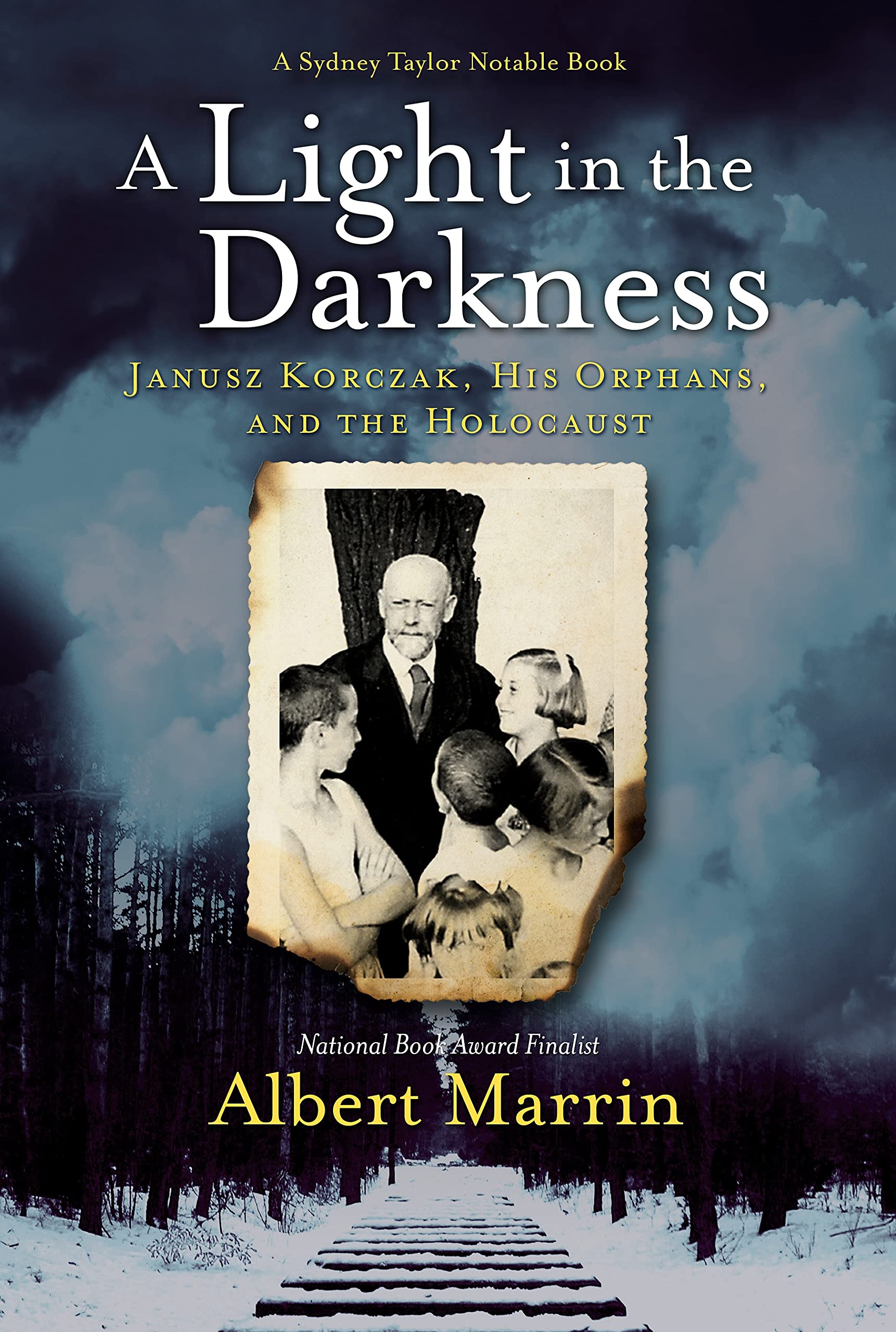
A Light in the Darkness: Part II
This biography details the life of Janusz Korczak, a Polish doctor who refused to abandon the orphaned children in his care during the Holocaust.
Here are links to our lists for the book: Prologue–Part I, Part II, Part III, Part IV, Parts V–VI
40 words
39 learners
Learn words with Flashcards and other activities
Definition First

Other learning activities
Full list of words from this list:
-
harangue
address forcefullyAn early photo shows him, hatless and wearing a raincoat, haranguing passersby while snow fell.
-
insignia
a distinguishing mark or symbolIn a propaganda masterstroke, he adopted the hooked cross, or swastika, as its insignia. An ancient sign of good luck and prosperity, the swastika appears in the art of many peoples.
-
agog
highly excitedShe wrote that it took her less than a minute “to measure the startling insignificance of the man who has set the world agog....He is the very prototype of the Little Man.”
-
aloof
distant, cold, or detached in mannerEven those closest to the Führer found him aloof and secretive. “He simply could not let anyone approach his inner being because that core was lifeless. Empty,” wrote Albert Speer, a close adviser.
-
apoplectic
pertaining to a sudden loss of consciousnessA Nazi official recalled: “He scolded in high, shrill tones, stamped his feet, and banged his fists on tables and walls. He foamed at the mouth, panting and stammering in uncontrollable fury....He was an alarming sight, his hair disheveled, his eyes fixed, and his face distorted and purple. I feared he would collapse, or have an apoplectic fit.”
-
infallible
incapable of failure or errorHe believed the Führer, “sent to us by God to save Germany,” was “simply infallible,” incapable of error.
-
uncanny
surpassing the ordinary or normalI have been asked many times what is the secret of Hitler’s extraordinary power as a speaker. I can only attribute it to his uncanny intuition, which infallibly diagnoses the ills from which his audience is suffering.
-
profusely
in very large amounts or quantities; extremelyHe sweated so profusely that the color of his uniform, he said, “invariably stained my underclothes.”
-
succumb
give in, as to overwhelming force, influence, or pressureWhile she was attending a Nazi rally, an inner voice told her, “Well, for yourself you are now dead....Everything that was I had been absorbed into the Whole!” In this way, Melita and countless others succumbed to Hitler’s ideology.
-
layman
someone who is not a clergyman or a professional personWe have no proof that Hitler read The Origin of Species. Most likely, he did not; nor did he need to. During his time in Vienna, newsstands sold cheap pamphlets explaining Darwin’s theory in simple layman’s terms.
-
tenet
a basic principle or belief that is accepted as trueNevertheless, the theory captivated him, no matter how he came by it. What is more, he interpreted it in three ominous ways: natural law, racism, and anti-Semitism. The result was a witches’ brew that turned every humane value, every tenet of morality, upside down.
-
bigotry
intolerance and prejudiceTo his mind, the idea of race embraced more than traditional justifications of bigotry, oppression, and slavery. The Führer insisted there is no “human family” to which we all belong. He held that races differed as much as flies from butterflies.
-
flunky
an underling of unquestioning obedienceHitler’s personal lawyer and faithful flunky, Frank ranked his master alongside God.
-
prudent
marked by sound judgmentPrudent people displayed it prominently in their homes; there was no telling when the police might barge in, and Mein Kampf served as proof of one’s loyalty.
-
culminate
bring to a head or to the highest pointIn April 1933, storm troopers, Nazi bruisers in brown shirts and jackboots, went on a rampage. Their “wild actions” culminated in boycotts and vandalism against Jewish businesses.
-
ordinance
an authoritative ruleEventually, more than two thousand anti-Semitic laws, decrees, orders, ordinances, edicts, rulings, rules, and regulations would fill a four-hundred-page book printed in small type.
-
edict
a legally binding command or decisionEventually, more than two thousand anti-Semitic laws, decrees, orders, ordinances, edicts, rulings, rules, and regulations would fill a four-hundred-page book printed in small type.
-
denigrate
attack the good name and reputation of someoneThese aimed at bringing “social death”—that is, denigrating, dominating, and segregating a minority so that it is no longer seen as human.
-
virulent
harsh or corrosive in toneDer Stürmer, or “The Stormer,” was a virulently anti-Semitic Nazi newspaper.
-
intrepid
invulnerable to fear or intimidationA violently active, dominating, intrepid, brutal youth—that is what I am after. Youth must be all these things. It must be indifferent to pain. There must be no weakness or tenderness in it.
-
staunch
firm and dependable especially in loyaltyErika Mann, novelist Thomas Mann’s daughter and a staunch anti-Nazi, estimated that children gave the salute from 50 to 150 times a day!
-
ditty
a short simple songSmall children recited this ditty:
Keep your Blood pure,
it is not yours alone,
it comes from far away,
it flows into the distance
laden with thousands of ancestors
and it holds the entire future!
It is your eternal life. -
incendiary
capable of causing fires or catching fire spontaneouslyA bombing plane can be loaded with one explosive bomb of 35 kilograms, three bombs of 100 kilograms, four [poison] gas bombs of 150 kilograms, and 200 incendiary bombs of one kilogram.
-
pragmatic
guided by experience and observation rather than theoryMany of the Nazi leaders, however, appeared to be total opposites of what they preached as the Nazi ideal. This discrepancy prompted skeptics to ask: “What does the ideal Aryan look like?” One pragmatic response was: “As tall as Goebbels, as slim as Göring, as blond as Hitler.”
-
asinine
devoid of intelligenceNevertheless, racists insisted that Aryan features were the animal kingdom’s standard of excellence. That “birds can talk better than other animals,” said Nazi race theorist Hermann Gauch, “is explained by the fact that their mouths are Nordic in structure.” This would be funny if it were not so asinine.
-
defile
make dirty or spottyA devil goes through the land,
It’s the Jew, well-known to us
as a murderer of peoples
a race defiler, a children’s horror in all lands! -
boorish
ill-mannered and coarse in behavior or appearanceTraditionally regarded as positive role models for the young, teachers now used boorish insults like Judenlümmel (Jewish lout) and Judensau (Jewish pig).
-
dub
give a nickname toNazis dubbed Christianity a “Jewish conspiracy” to “corrupt” the “Aryan” race and “poison” its blood.
-
denounce
accuse or condemn openly as disgracefulAt meetings, lectures, and outings, speakers denounced Jesus Christ as “this swine,” this son of a “Jewish tramp.”
-
bolster
support and strengthenTo bolster its claim to absolute power, Nazism sought to weaken the bonds between parents and children.
-
perpetrate
perform an act, usually with a negative connotationOh, they will perpetrate still worse things, and worst, most dreadful of all, they will be totally incapable of even sensing the deep degradation of their existence.
-
eugenics
the promotion of controlled breeding in human populationsSir Francis Galton, Charles Darwin’s cousin, coined the word eugenics in 1883, defining it as “the science of the improvement of the human race by better breeding”—“genetic engineering” for short.
-
sire
have offspringTo encourage baby production, Himmler created the breeding program Lebensborn (Spring of Life). In several secluded Lebensborn homes, SS men, married or not, would sire children with young women, married or not.
-
perpetuation
the act of prolonging or causing to exist indefinitelyIn 1913, former U.S. president Theodore Roosevelt declared that “society has no business to permit degenerates to reproduce their kind....Some day we will realize that the prime duty...of the good citizen of the right type is to leave his or her blood behind him in the world, and that we have no business to [aid] perpetuation of citizens of the wrong type.”
-
wayward
resistant to guidance or disciplineEugenics experts deemed many of them “bad girls” who were “passionate,” “oversexed,”or “sexually wayward”—whatever those terms meant.
-
euthanasia
the act of killing someone painlesslyThe Nazis soon took the next step: murder. Not that they used such a graphic term. They called their secret killing euthanasia, a gentle-sounding word for “good death” or “mercy killing.” The Nazis’ euthanasia program was their first large-scale effort to exterminate a group of innocent people—in this case, ill or handicapped Germans deemed undeserving of life.
-
pontificate
talk in a dogmatic and pompous mannerEminent people like English science fiction writer H. G. Wells, a self-declared “genius,” pontificated about “lethal chambers for the insane,” saying the “swarms of black, brown, and dirty-white and yellow people...have to go.”
-
wholesale
ignoring distinctionsIrish playwright and music critic George Bernard Shaw, a keen racist, urged wholesale murder. In 1910, Shaw called for “an extensive use of the lethal chamber,” since “a great many people would have to be put out of existence simply because it wastes other people’s time to look after them.”
-
revere
regard with feelings of respect“Psychologically speaking, nothing is darker or more menacing, or harder to accept, than the participation of physicians in mass murder....[For] he or she is still supposed to be a healer—and one responsible to a tradition of healing, which all cultures revere and depend upon.”
-
transgression
the violation of a law or a duty or moral principle“Woe to mankind, woe to our German nation if God’s Holy Commandment ‘Thou shalt not kill,’ which God proclaimed on Mt. Sinai amidst thunder and lightning...is not only broken, but if this transgression is actually tolerated and permitted to go unpunished.”
Created on Tue Aug 24 15:02:58 EDT 2021
(updated Thu Aug 26 14:39:17 EDT 2021)
Sign up now (it’s free!)
Whether you’re a teacher or a learner,
Vocabulary.com can put you or your class
on the path to systematic vocabulary improvement.