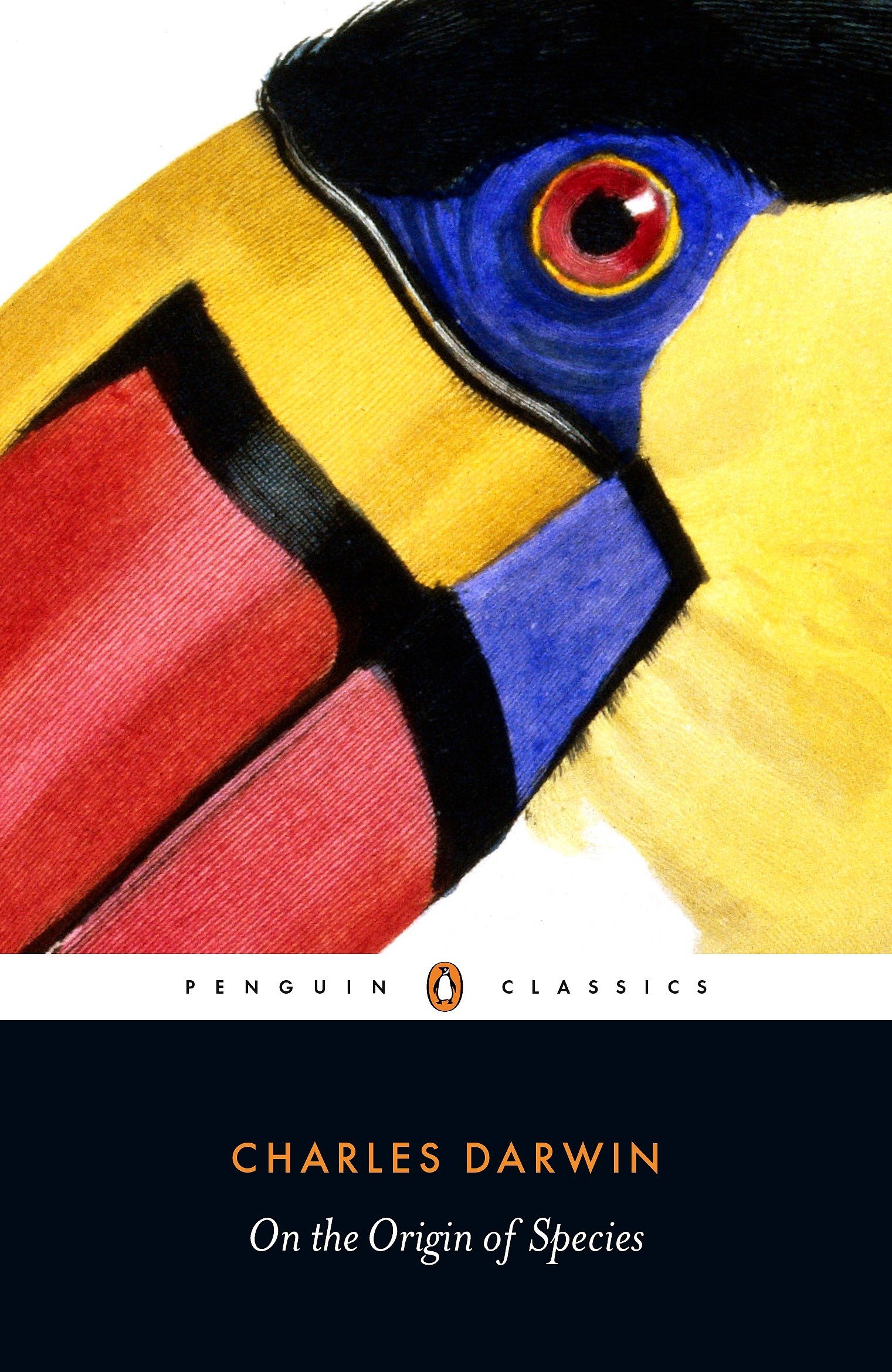
On the Origin of Species: Chapters 2–4
Darwin's groundbreaking and influential treatise on natural selection is a foundational text of evolutionary biology. Read the full text here.
Here are links to our lists for the book: Introduction–Chapter 1, Chapters 2–4, Chapters 5–6, Chapters 7–9, Chapters 10–14
45 words
316 learners
Learn words with Flashcards and other activities
Definition First

Other learning activities
Full list of words from this list:
-
brackish
slightly salty...who can say that the dwarfed condition of shells in the brackish waters of the Baltic, or dwarfed plants on Alpine summits, or the thicker fur of an animal from far northwards, would not in some cases be inherited for at least some few generations?
-
protean
taking on different formsThere is one point connected with individual differences, which seems to me extremely perplexing: I refer to those genera which have sometimes been called "protean" or "polymorphic," in which the species present an inordinate amount of variation; and hardly two naturalists can agree which forms to rank as species and which as varieties.
-
inordinate
beyond normal limitsThere is one point connected with individual differences, which seems to me extremely perplexing: I refer to those genera which have sometimes been called "protean" or "polymorphic," in which the species present an inordinate amount of variation; and hardly two naturalists can agree which forms to rank as species and which as varieties.
-
conjecture
the formation of conclusions from incomplete evidenceIn very many cases, however, one form is ranked as a variety of another, not because the intermediate links have actually been found, but because analogy leads the observer to suppose either that they do now somewhere exist, or may formerly have existed; and here a wide door for the entry of doubt and conjecture is opened.
-
arbitrary
based on or subject to individual discretion or preferenceMany years ago, when comparing, and seeing others compare, the birds from the separate islands of the Galapagos Archipelago, both one with another, and with those from the American mainland, I was much struck how entirely vague and arbitrary is the distinction between species and varieties.
-
analogical
expressing, composed of, or based on a comparisonMany of the cases of strongly-marked varieties or doubtful species well deserve consideration; for several interesting lines of argument, from geographical distribution, analogical variation, hybridism, etc., have been brought to bear on the attempt to determine their rank.
-
demarcation
a conceptual separation or distinctionCertainly no clear line of demarcation has as yet been drawn between species and sub-species—that is, the forms which in the opinion of some naturalists come very near to, but do not quite arrive at the rank of species; or, again, between sub-species and well-marked varieties, or between lesser varieties and individual differences.
-
incipient
only partly in existence; imperfectly formedHence I believe a well-marked variety may be justly called an incipient species; but whether this belief be justifiable must be judged of by the general weight of the several facts and views given throughout this work.
-
supplant
take the place or move into the position ofIf a variety were to flourish so as to exceed in numbers the parent species, it would then rank as the species, and the species as the variety; or it might come to supplant and exterminate the parent species; or both might co-exist, and both rank as independent species.
-
brevity
the use of concise expressionsThe whole subject, however, treated as it necessarily here is with much brevity, is rather perplexing, and allusions cannot be avoided to the "struggle for existence," "divergence of character," and other questions, hereafter to be discussed.
-
sagacious
acutely insightful and wiseI have also consulted some sagacious and most experienced observers, and, after deliberation, they concur in this view.
-
denomination
identifying word by which someone or something is calledVarieties generally have much restricted ranges: this statement is indeed scarcely more than a truism, for if a variety were found to have a wider range than that of its supposed parent-species, their denominations ought to be reversed.
-
repute
look on as or considerFor instance, Mr. H. C. Watson has marked for me in the well-sifted London Catalogue of plants (4th edition) 63 plants which are therein ranked as species, but which he considers as so closely allied to other species as to be of doubtful value: these 63 reputed species range on an average over 6.9 of the provinces into which Mr. Watson has divided Great Britain.
-
quadruped
an animal especially a mammal having four limbsWe see these beautiful co-adaptations most plainly in the woodpecker and missletoe; and only a little less plainly in the humblest parasite which clings to the hairs of a quadruped or feathers of a bird; in the structure of the beetle which dives through the water; in the plumed seed which is wafted by the gentlest breeze; in short, we see beautiful adaptations everywhere and in every part of the organic world.
-
dearth
an acute insufficiencyTwo canine animals in a time of dearth, may be truly said to struggle with each other which shall get food and live.
-
languish
become feebleThe missletoe is dependent on the apple and a few other trees, but can only in a far-fetched sense be said to struggle with these trees, for if too many of these parasites grow on the same tree, it will languish and die.
-
manifold
many and varied; having many features or formsIt is the doctrine of Malthus applied with manifold force to the whole animal and vegetable kingdoms; for in this case there can be no artificial increase of food, and no prudential restraint from marriage.
-
germinate
sprout; produce buds or branchesIt would suffice to keep up the full number of a tree, which lived on an average for a thousand years, if a single seed were produced once in a thousand years, supposing that this seed were never destroyed, and could be ensured to germinate in a fitting place.
-
mitigate
lessen or to try to lessen the seriousness or extent ofLighten any check, mitigate the destruction ever so little, and the number of the species will almost instantaneously increase to any amount.
-
conspicuous
obvious to the eye or mindWhen we travel from south to north, or from a damp region to a dry, we invariably see some species gradually getting rarer and rarer, and finally disappearing; and the change of climate being conspicuous, we are tempted to attribute the whole effect to its direct action.
-
prodigious
great in size, force, extent, or degreeThat climate acts in main part indirectly by favouring other species, we may clearly see in the prodigious number of plants in our gardens which can perfectly well endure our climate, but which never become naturalised, for they cannot compete with our native plants, nor resist destruction by our native animals.
-
tract
an extended area of landWhen a species, owing to highly favourable circumstances, increases inordinately in numbers in a small tract, epidemics—at least, this seems generally to occur with our game animals—often ensue: and here we have a limiting check independent of the struggle for life.
-
heath
uncultivated land with sandy soil and scrubby vegetationIn Staffordshire, on the estate of a relation where I had ample means of investigation, there was a large and extremely barren heath, which had never been touched by the hand of man; but several hundred acres of exactly the same nature had been enclosed twenty-five years previously and planted with Scotch fir.
-
trifle
something of small importanceBattle within battle must ever be recurring with varying success; and yet in the long-run the forces are so nicely balanced, that the face of nature remains uniform for long periods of time, though assuredly the merest trifle would often give the victory to one organic being over another.
-
corollary
an inference following from the proof of another propositionA corollary of the highest importance may be deduced from the foregoing remarks, namely, that the structure of every organic being is related, in the most essential yet often hidden manner, to that of all other organic beings, with which it comes into competition for food or residence, or from which it has to escape, or on which it preys.
-
pied
having sections or patches colored differently and brightlyThose who have closely attended to birds in confinement well know that they often take individual preferences and dislikes: thus Sir R. Heron has described how one pied peacock was eminently attractive to all his hen birds.
-
protuberance
something that bulges out or projects from its surroundingsYet, I would not wish to attribute all such sexual differences to this agency: for we see peculiarities arising and becoming attached to the male sex in our domestic animals (as the wattle in male carriers, horn-like protuberances in the cocks of certain fowls, etc.), which we cannot believe to be either useful to the males in battle, or attractive to the females.
-
innate
inborn or existing naturallyEven without any change in the proportional numbers of the animals on which our wolf preyed, a cub might be born with an innate tendency to pursue certain kinds of prey.
-
rudimentary
being in the earliest stages of developmentSome holly-trees bear only male flowers, which have four stamens producing rather a small quantity of pollen, and a rudimentary pistil; other holly-trees bear only female flowers; these have a full-sized pistil, and four stamens with shrivelled anthers, in which not a grain of pollen can be detected.
-
profusion
the property of being extremely abundantHaving found a female tree exactly sixty yards from a male tree, I put the stigmas of twenty flowers, taken from different branches, under the microscope, and on all, without exception, there were pollen-grains, and on some a profusion of pollen.
-
proboscis
a long flexible snout as of an elephantBearing such facts in mind, I can see no reason to doubt that an accidental deviation in the size and form of the body, or in the curvature and length of the proboscis, etc., far too slight to be appreciated by us, might profit a bee or other insect, so that an individual so characterised would be able to obtain its food more quickly, and so have a better chance of living and leaving descendants.
-
digression
a message that departs from the main subjectI must here introduce a short digression.
-
terrestrial
operating or living or growing on landAs yet I have not found a single case of a terrestrial animal which fertilises itself.
-
perpetuity
the property of being seemingly ceaselessFinally then, we may conclude that in many organic beings, a cross between two individuals is an obvious necessity for each birth; in many others it occurs perhaps only at long intervals; but in none, as I suspect, can self-fertilisation go on for perpetuity.
-
polity
a governmentally organized unitThus it will be in nature; for within a confined area, with some place in its polity not so perfectly occupied as might be, natural selection will always tend to preserve all the individuals varying in the right direction, though in different degrees, so as better to fill up the unoccupied place.
-
endemic
native to or confined to a certain regionIf we turn to nature to test the truth of these remarks, and look at any small isolated area, such as an oceanic island, although the total number of the species inhabiting it, will be found to be small, as we shall see in our chapter on geographical distribution; yet of these species a very large proportion are endemic,—that is, have been produced there, and nowhere else.
-
oscillation
the process of swinging between statesMoreover, great areas, though now continuous, owing to oscillations of level, will often have recently existed in a broken condition, so that the good effects of isolation will generally, to a certain extent, have concurred.
-
anomalous
deviating from the general or common order or typeAnd it is in fresh water that we find seven genera of Ganoid fishes, remnants of a once preponderant order: and in fresh water we find some of the most anomalous forms now known in the world, as the Ornithorhynchus and Lepidosiren, which, like fossils, connect to a certain extent orders now widely separated in the natural scale.
-
accord
be harmonious or consistent withI further believe, that this very slow, intermittent action of natural selection accords perfectly well with what geology tells us of the rate and manner at which the inhabitants of this world have changed.
-
elucidate
make clear and comprehensibleThe advantage of diversification in the inhabitants of the same region is, in fact, the same as that of the physiological division of labour in the organs of the same individual body—a subject so well elucidated by Milne Edwards.
-
encroach
impinge or infringe uponAfter the foregoing discussion, which ought to have been much amplified, we may, I think, assume that the modified descendants of any one species will succeed by so much the better as they become more diversified in structure, and are thus enabled to encroach on places occupied by other beings.
-
circuitous
deviating from a straight courseIn this case, its affinities to the other fourteen new species will be of a curious and circuitous nature.
-
hitherto
up to this point; until the present timeIn the diagram, each horizontal line has hitherto been supposed to represent a thousand generations, but each may represent a million or hundred million generations, and likewise a section of the successive strata of the earth's crust including extinct remains.
-
stratum
one of several parallel layers of materialIn the diagram, each horizontal line has hitherto been supposed to represent a thousand generations, but each may represent a million or hundred million generations, and likewise a section of the successive strata of the earth's crust including extinct remains.
-
ramify
grow and send out branches or branch-like structuresThe limbs divided into great branches, and these into lesser and lesser branches, were themselves once, when the tree was small, budding twigs; and this connexion of the former and present buds by ramifying branches may well represent the classification of all extinct and living species in groups subordinate to groups.
Created on Thu Apr 11 10:17:12 EDT 2019
(updated Thu Apr 11 10:24:38 EDT 2019)
Sign up now (it’s free!)
Whether you’re a teacher or a learner,
Vocabulary.com can put you or your class
on the path to systematic vocabulary improvement.