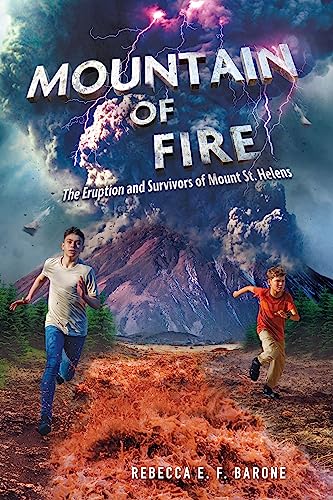
Mountain of Fire: Chapters 28–37
The historic account of Mount St. Helens’ violent volcanic eruption in 1980 is filled with real-life stories of survivors, heroes, and a devastation of nature almost beyond belief. It all started at 8:32 a.m., Sunday, May 18, 1980.
Here are links to our lists for the book: Prologue–Chapter 14, Chapters 15–27, Chapters 28–37, Chapter 38–Epilogue
15 words
59 learners
Learn words with Flashcards and other activities
Definition First

Other learning activities
Full list of words from this list:
-
suspended
supported or kept from sinking or falling by buoyancyIn “suspended ashdust like firesmoke,” Buzz described, they could now see about 150 feet in front of them.
-
dehydrated
suffering from excessive loss of water from the bodyThrough the ash and mud, dehydrated and scared, they kept moving.
-
aloft
high up in or into the airOn the third try, the pilot finally rose using his instruments alone—without being able to see anything out of the windows—to get them aloft.
-
persistence
steady determinationThe words, the reminders of persistence, kept them moving on amid so much death and destruction.
-
incredulous
not disposed or willing to believe; unbelievingWhen Sue and Bruce told the crew about Dan and Brian, the pilot immediately responded that Dan had already been picked up. But when they showed him on the map where they had left Brian, the pilot was incredulous.
-
sustained
continued at length without interruption or weakeningAn hour and twenty minutes after the mountain had first erupted, the cloud cleared enough for Don Swanson to get his first, sustained look at the top of what was left of Mount St. Helens.
-
helix
a spiral structure“A roiling, dark column pumped and convected up as a high cloud looking like dirty cauliflower but every knob moving,” he remembered. “A little knob grew to a huge one, this all over the outside of the column that rotated up to the right, a twisting helix. It looked very slow, but from its enormous size I knew it must be very fast…It towered miles above us, far larger than I’d imagined.”
-
denial
a defense mechanism that shuts out painful thoughtsLater he would remember that “the views were so brief and fuzzy, a missing summit so unexpected, we were in denial about it.”
-
herald
foreshadow or presage“I’d been measuring the mountain for weeks. We thought increased swelling and seismicity would herald a big event,” said Swanson.
-
fateful
having extremely unfortunate or dire consequencesFor a single, fateful night, Johnston had been on the mountain.
-
barren
providing no shelter or sustenance“Spirit Lake was all debris, the forested ridge just west was barren. Truman’s lodge and cabins among the firs were gone. Only horizontal [fallen] logs and gray debris [remained],” remembered Cooney.
-
churning
(of a liquid) agitated vigorously; in a state of turbulence“A churning wall of mud, trees, and debris swallowed Camp Baker, overturning bulldozers and trucks like toys,” said duBeth.
-
vegetation
all the plant life in a particular region or periodThe blast toppled trees in a 230-square-mile area north of the volcano called the blowdown zone and left vegetation standing but seared lifeless—the scorch zone—on the edges.
-
acoustic
relating to the study of the physical properties of soundAcoustic energy from the blasts was directed upward. This energy remained trapped in layers of atmosphere for twenty to thirty miles away from the volcano. This “cone of silence,” which has since been noted in other volcanic eruptions, meant that anyone close to the mountain didn’t hear the blast.
-
refract
subject to change in direction of a propagating waveEventually, the trapped sound was refracted back down to the ground, sometimes hundreds of miles away. People as far away as British Columbia reported hearing “booms” and explosions.
Created on Tue Aug 12 17:50:34 EDT 2025
(updated Thu Sep 18 13:18:38 EDT 2025)
Sign up now (it’s free!)
Whether you’re a teacher or a learner,
Vocabulary.com can put you or your class
on the path to systematic vocabulary improvement.