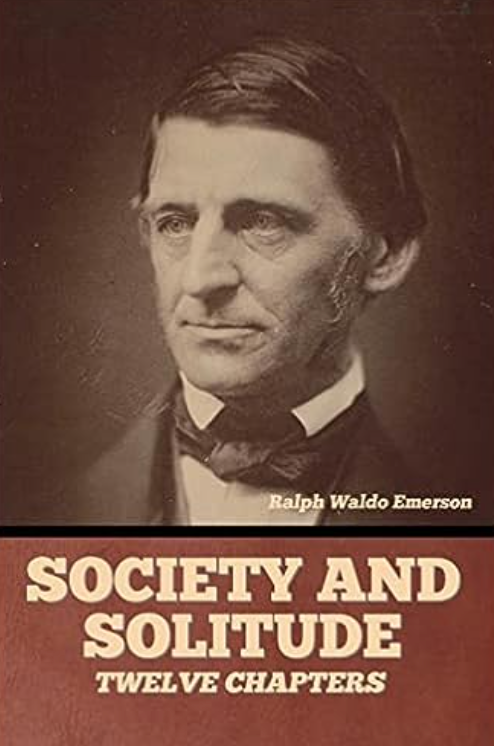
Society and Solitude: List 2
In this collection of twelve essays, the leader of New England's transcendentalist movement shares his philosophical ideas on different aspects of mid-nineteenth-century life. Read the full text here.
This list covers "Art" and "Eloquence."
Here are links to our lists for the book: List 1, List 2, List 3, List 4, List 5, List 6
40 words
601 learners
Learn words with Flashcards and other activities
Definition First

Other learning activities
Full list of words from this list:
-
sublime
of high moral or intellectual valueAll departments of life at the present day,—Trade, Politics, Letters, Science, or Religion,—seem to feel, and to labor to express, the identity of their law. They are rays of one sun; they translate each into a new language the sense of the other. They are sublime when seen as emanations of a Necessity contradistinguished from the vulgar Fate, by being instant and alive, and dissolving man, as well as his works, in its flowing beneficence.
-
importunate
making persistent or urgent requestsThe more profound the thought, the more burdensome. Always in proportion to the depth of its sense does it knock importunately at the gates of the soul, to be spoken, to be done.
-
despotism
dominance through threat of punishment and violenceFrom the first imitative babble of a child to the despotism of eloquence, from his first pile of toys or chip bridge to the masonry of Minot Rock Light-house or the Pacific Railroad, from the tattooing of the Owhyhees to the Vatican Gallery, from the simplest expedient of private prudence to the American Constitution, from its first to its last works, Art is the spirit’s voluntary use and combination of things to serve its end.
-
discretion
power of making choices unconstrained by external agenciesIt is only within narrow limits that the discretion of the architect may range: gravity, wind, sun, rain, the size of men and animals, and such like, have more to say than he.
-
intimation
an indirect suggestionHe seems to take his task so minutely from intimations of Nature, that his works become as it were hers, and he is no longer free.
-
harangue
a loud bombastic declamation expressed with strong emotionThus how much is there that is not original in every particular building, in every statue, in every tune, painting, poem, or harangue!—whatever is national or usual; as the usage of building all Roman churches in the form of a cross, the prescribed distribution of parts of a theatre, the custom of draping a statue in classical costume.
-
adventitious
associated by chance and not an integral partThe adventitious beauty of poetry may be felt in the greater delight which a verse gives in happy quotation than in the poem.
-
exalt
heighten or intensifyThe pleasure of eloquence is in greatest part owing often to the stimulus of the occasion which produces it,—to the magic of sympathy, which exalts the feeling of each by radiating on him the feeling of all.
-
circumspection
the trait of being cautious and sensibleWe grudge to Homer the wide human circumspection his commentators ascribe to him. Even Shakspeare, of whom we can believe everything, we think indebted to Goethe and to Coleridge for the wisdom they detect in his Hamlet and Antony.
-
manifestation
a clear appearanceThere is but one Reason. The mind that made the world is not one mind, but the mind. Every man is an inlet to the same, and to all of the same. And every work of art is a more or less pure manifestation of the same.
-
prolific
intellectually productiveIt differs from the works of Nature in this, that they are organically reproductive. This is not; but spiritually it is prolific by its powerful action on the intellects of men.
-
admonition
a firm rebukeNo mark is on these lofty features, of sloth, or luxury, or meanness, and they surprise you with a moral admonition, as they speak of nothing around you, but remind you of the fragrant thoughts and the purest resolutions of your youth.
-
adamantine
impervious to pleas, persuasion, requests, or reasonThis strict dependence of Art upon material and ideal Nature, this adamantine necessity which underlies it, has made all its past, and may foreshow its future history.
-
dilettante
an amateur engaging in an activity without serious intentionThe Madonnas of Raphael and Titian were made to be worshipped. Tragedy was instituted for the like purpose, and the miracles of music: all sprang out of some genuine enthusiasm, and never out of dilettanteism and holidays.
-
languish
fail to progress or succeedNow they languish, because their purpose is merely exhibition. Who cares, who knows what works of art our government have ordered to be made for the Capitol?
-
loquacity
the quality of being wordy and talkativeThe eloquence of one stimulates all the rest, some up to the speaking-point, and all others to a degree that makes them good receivers and conductors, and they avenge themselves for their enforced silence by increased loquacity on their return to the fireside.
-
phlegmatic
showing little emotionThe plight of these phlegmatic brains is better than that of those who prematurely boil, and who impatiently break silence before their time.
-
voluble
marked by a ready flow of speechWe are too much reminded of a medical experiment where a series of patients are taking nitrous-oxide gas. Each patient, in turn, exhibits similar symptoms,—redness in the face, volubility, violent gesticulation, delirious attitudes, occasional stamping, an alarming loss of perception of the passage of time, a selfish enjoyment of his sensations, and loss of perception of the sufferings of the audience.
-
apprise
inform somebody of somethingNo one can survey the face of an excited assembly, without being apprised of new opportunity for painting in fire human thought, and being agitated to agitate.
-
redress
make reparations or amends forThere is no calamity which right words will not begin to redress.
-
disposition
a natural or acquired habit or characteristic tendencyThe Koran says, “A mountain may change its place, but a man will not change his disposition” yet the end of eloquence is,—is it not?—to alter in a pair of hours, perhaps in a half-hour’s discourse, the convictions and habits of years.
-
consummate
having or revealing supreme mastery or skillThis range of many powers in the consummate speaker, and of many audiences in one assembly, leads us to consider the successive stages of oratory.
-
inundate
overwhelm or fill quickly beyond capacityWisdom and learning would be harsh and unwelcome, compared with a substantial cordial man, made of milk, as we say, who is a house-warmer, with his obvious honesty and good meaning, and a hue-and-cry style of harangue, which inundates the assembly with a flood of animal spirits, and makes all safe and secure, so that any and every sort of good speaking becomes at once practicable.
-
discourse
extended verbal expression in speech or writingAs we know, the power of discourse of certain individuals amounts to fascination, though it may have no lasting effect.
-
prudent
marked by sound judgmentI became acquainted with the genius and the prudent judgments of both.
-
superfluous
more than is needed, desired, or requiredWhen they conversed, and interweaved stories and opinions with all, Menelaus spoke succinctly,—few but very sweet words, since he was not talkative, nor superfluous in speech, and was the younger.
-
blandishment
flattery intended to persuadeThus he does not fail to arm Ulysses at first with this power of overcoming all opposition by the blandishments of speech.
-
glib
artfully persuasive in speechThere is the glib tongue and cool self-possession of the salesman in a large shop, which, as is well known, overpower the prudence and resolution of housekeepers of both sexes.
-
vituperative
marked by harshly abusive criticismA spice of malice, a ruffian touch in his rhetoric, will do him no harm with his audience. These accomplishments are of the same kind, and only a degree higher than the coaxing of the auctioneer, or the vituperative style well described in the street-word “jawing.”
-
exigency
a pressing or urgent situationWe believe that there may be a man who is a match for events,—one who never found his match,—against whom other men being dashed are broken,—one of inexhaustible personal resources, who can give you any odds and beat you. What we really wish for is a mind equal to any exigency.
-
confound
overthrow by argument, evidence, or proofA man succeeds because he has more power of eye than another, and so coaxes or confounds him.
-
impudent
improperly forward or boldThe newspapers, every week, report the adventures of some impudent swindler, who, by steadiness of carriage, duped those who should have known better.
-
abrogate
revoke formallyA greater power of carrying the thing loftily, and with perfect assurance, would confound merchant, banker, judge, men of influence and power,—poet and president,—and might head any party, unseat any sovereign, and abrogate any constitution in Europe and America.
-
penurious
excessively unwilling to spendDoes he think that not possibly a man may come to him who shall persuade him out of his most settled determination?—for example, good sedate citizen as he is, to make a fanatic of him,—or, if he is penurious, to squander money for some purpose he now least thinks of,—or, if he is a prudent, industrious person, to forsake his work, and give days and weeks to a new interest?
-
prepossession
an opinion formed beforehand without adequate evidenceThere is always a rivalry between the orator and the occasion, between the demands of the hour and the prepossession of the individual.
-
alacrity
liveliness and eagernessI have heard it reported of an eloquent preacher, whose voice is not yet forgotten in this city, that, on occasions of death or tragic disaster, which overspread the congregation with gloom, he ascended the pulpit with more than his usual alacrity, and, turning to his favorite lessons of devout and jubilant thankfulness,—“Let us praise the Lord,”—carried audience, mourners, and mourning along with him, and swept away all the impertinence of private sorrow with his hosannas and songs of praise.
-
trope
language used in a nonliteral senseWe are such imaginative creatures, that nothing so works on the human mind, barbarous or civil, as a trope. Condense some daily experience into a glowing symbol, and an audience is electrified.
-
levity
a manner lacking seriousnessBut these talents are quite something else when they are subordinated and serve him; and we go to Washington, or to Westminster Hall, or might well go round the world, to see a man who drives, and is not run away with,—a man who, in prosecuting great designs, has an absolute command of the means of representing his ideas, and uses them only to express these; placing facts, placing men; amid the inconceivable levity of human beings, never for an instant warped from his erectness.
-
cavil
a minor objection evading the point of an argumentHe has not only the documents in his pocket to answer all cavils, and to prove all his positions, but he has the eternal reason in his head.
-
obdurate
showing unfeeling resistance to tender feelingsEverything hostile is stricken down in the presence of the sentiments; their majesty is felt by the most obdurate.
Created on Fri Mar 10 11:44:54 EST 2023
(updated Mon Mar 13 14:45:14 EDT 2023)
Sign up now (it’s free!)
Whether you’re a teacher or a learner,
Vocabulary.com can put you or your class
on the path to systematic vocabulary improvement.