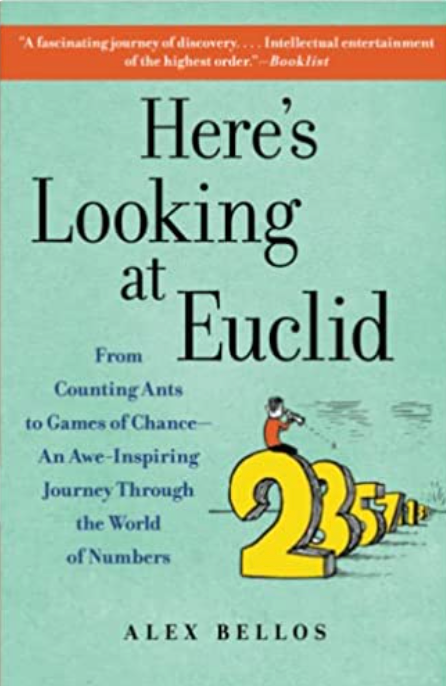
Here's Looking at Euclid: Chapters Four–Five
To illustrate his thesis that math is the foundation of human progress, Alex Bellos details achievements throughout time and cultures.
Here are links to our lists for the book: Chapters Zero–One, Chapters Two–Three, Chapters Four–Five, Chapters Six–Eight, Chapters Nine–Eleven
40 words
34 learners
Learn words with Flashcards and other activities
Definition First

Other learning activities
Full list of words from this list:
-
nonplussed
filled with bewildermentHe seems to have had some of the symptoms of high-functioning autism, for when he was taken to see the play Richard III, he was left nonplussed by the experience, although he notified his hosts that the actors had taken 5,202 steps and spoken 14,445 words.
-
backlash
an adverse reaction to some political or social occurrenceThirty years after the first cheap electronic calculators precipitated a widespread demise in mental calculation skills, a backlash is under way. Newspapers offer up daily math brainteasers, popular computer games with arithmetic puzzles sharpen our minds and—at the high end—lightning calculators compete in regular international tournaments.
-
culmination
a final climactic stageThe Mental Calculation World Cup was founded in 2004 by German computer scientist Ralf Laue and takes place every two years. It was the logical culmination of Laue’s two hobbies: mental arithmetic and collecting unusual records.
-
conspicuous
obvious to the eye or mindConspicuously absent from proceedings in Leipzig, however, was perhaps the world’s most famous mathlete, the French student Alexis Lemaire, who prefers another yardstick to measure computational power.
-
milieu
the environmental conditionThis is a matter of deep controversy in the calculation milieu, mirroring the battle almost 200 years ago between Zerah Colburn and George Bidder, both exceptional at their own type of sum.
-
divulge
make known to the public information previously kept secretLemaire has worked out algorithms, which he has not divulged, to calculate the other 14 digits in the final answer.
-
redundant
more than is needed, desired, or requiredHe was probably the last human calculator to have been employed as one. As computers developed, his skills became redundant, and in retirement he returned to showbiz, appearing frequently on TV.
-
cumbersome
difficult to handle or use, especially because of size or weightThe Greeks and the Chinese were hampered by cumbersome notation.
-
infinitesimal
immeasurably smallLeibniz had devised the formula using “the calculus,” a powerful type of mathematics in which a new understanding of infinitesimal amounts was used to calculate areas, curves and gradients.
-
gradient
the property of a line that departs from the horizontalLeibniz had devised the formula using “the calculus,” a powerful type of mathematics in which a new understanding of infinitesimal amounts was used to calculate areas, curves and gradients.
-
protege
a person who receives support from an influential patronHe encouraged his protégé William Shanks, an amateur mathematician who ran a boarding school in County Durham, to go even further.
-
diminish
lessen the authority, dignity, or reputation ofHis metaphysics was based on the belief that the world was made up of numbers and the harmonic proportions between them. The existence of a number that could not be described as a ratio diminished his position, at the very least, if it did not contradict him outright.
-
heretic
a person who holds unorthodox opinions in any fieldAccording to legend, their existence was first proved by the Pythagorean disciple Hippasus, which did not endear him to the Brotherhood; he was declared a heretic and was drowned at sea.
-
ensue
take place or happen afterward or as a resultThe early pi men may have hoped that after the initial chaos of 3.14159..., the noise would calm and a pattern ensue.
-
transcendental
existing outside of or not in accordance with natureIn the eighteenth century, they started to speculate about a special type of irrational called transcendental numbers.
-
evasive
deliberately vague or ambiguousThese were numbers so mysterious and evasive that finite mathematics could not capture them.
-
enigmatic
not clear to the understandingPi’s enigmatic attributes were, in the eighteenth and nineteenth centuries, revealed to be not only at the heart of ancient geometrical problems but also deeply rooted in new fields of science that were not always obviously related to circles.
-
ubiquity
the state of being everywhere at onceThe ubiquity of pi, however, has made it more than just a celebrity among numbers.
-
actuary
someone versed in the interpretation of numerical dataThe record is held by Mats Bergsten, an actuary in Sweden in his late 50s, who has recited 9,778 digits while juggling with three balls.
-
mnemonic
of or relating to the practice of aiding the memoryWhen Akira Haraguchi recited 100,000 digits of pi by heart, he used a mnemonic technique, assigning syllables to each number from 0 to 9 and then translating pi’s decimals into words, which in turn formed sentences.
-
cadenza
a solo passage occurring near the end of a piece of musicEntire poems—or “piems”—have been written under the constraint that the number of letters per word is determined by pi, usually with the convention that a 0 in the expansion requires a ten-letter word. The most ambitious piem is the Cadaeic Cadenza by Mike Keith, which follows pi for 3,835 digits.
-
pastiche
a work of art that imitates the style of some previous workIt begins as a pastiche of Edgar Allan Poe:
One; A poem
A Raven
Midnights so dreary, tired and weary... -
extol
praise, glorify, or honorSilently pondering volumes extolling all by-now obsolete lore.
-
tedious
so lacking in interest as to cause mental wearinessPi has gone by this name only since 1706, when the Welshman William Jones introduced the symbol π in his book, the snappily titled A New Introduction to the Mathematics, for the Use of some Friends who have neither Leisure, Convenience, nor, perhaps, Patience, to search into so many different Authors, and turn over so many tedious Volumes, as is unavoidably required to make but tolerable progress in the Mathematics.
-
prolific
intellectually productiveEuler was the most prolific mathematician of all time (he published 886 books), and he is possibly the one who most contributed to an understanding of pi.
-
erratic
liable to sudden unpredictable changeTalking to the Chudnovskys was like wearing stereo headphones with an erratically alternating connection to both ears.
-
primer
an introductory textbookIn ninth-century Baghdad, Muhammad ibn Musa al-Khwarizmi wrote a math primer entitled Hisab al-jabr w’al-muqabala, or Calculation by Restoration and Reduction.
-
rhetorical
relating to using language effectivelyBetween the fifteenth and seventeenth centuries mathematical sentences moved from rhetorical to symbolic expression. Slowly, words were replaced with letters.
-
discourse
an extended communication dealing with some particular topicWithin a few decades of Viète’s death, René Descartes published his Discourse on Method.
-
intangible
hard to pin down or identifyWere it not for issues of limited printing type, the Y-Factor could have become a phrase to describe intangible star quality and the African-American political leader might have gone by the name Malcolm Z.
-
haphazard
dependent upon or characterized by chanceWhen problems were expressed rhetorically, as in Egypt, mathematicians used ingenious, but rather haphazard, methods to solve them. These early problem solvers were like explorers stuck in a fog with few tricks to help them move about.
-
legerdemain
an illusory featThe surprise of the 1089 trick is that from a randomly chosen number we can always produce a fixed number. Algebra lets us see beyond the legerdemain, providing a way to go from the concrete to the abstract—from tracking the behavior of a specific number to tracking the behavior of any number.
-
musing
a calm, lengthy, intent considerationPierre de Fermat, a civil servant and judge living in Toulouse, was an enthusiastic amateur mathematician who filled his own copy of Arithmetica with numerical musings.
-
cheeky
offensively boldIn any case, his cheeky sentence was fantastic bait to generations of mathematicians. The proposition became known as Fermat’s Last Theorem and was the most famous unsolved problem in math until the Briton Andrew Wiles cracked it in 1995.
-
polemic
a verbal or written attack, especially of a belief or dogmaNapier wrote a best-selling Protestant polemic in which he claimed the Pope was the Antichrist and predicted that the Day of Judgment would come between 1688 and 1700.
-
affable
diffusing warmth and friendlinessHopp, a retired electrical engineer, is an extremely affable man with wispy eyebrows, blue eyes and luxuriant jowls.
-
inherent
existing as an essential constituent or characteristicYet despite their inherent imprecision, Hopp said that—for his purposes as an engineer, at least—slide rules were accurate enough for most uses.
-
dispensation
an exemption from some rule or obligationHerzstark, an Austrian whose father was Jewish, was given special dispensation to work on his calculating machine because he was known to the camp authorities as an engineering genius.
-
parameter
any factor defining a system and determining its performanceHaving a slide rule at hand means you can work out estimates very quickly, and also have a more visual understanding of the numerical parameters of the flight. Flying is safer because of pilots’ dexterity with an early-seventeenth-century calculating machine.
-
corollary
an inference following from the proof of another propositionOne of the most obvious corollaries of Descartes’s insight that equations in x and y can be written as lines was the recognition that different types of equation produce different types of line.
Created on Sun Feb 13 12:04:14 EST 2022
(updated Thu Feb 02 14:59:29 EST 2023)
Sign up now (it’s free!)
Whether you’re a teacher or a learner,
Vocabulary.com can put you or your class
on the path to systematic vocabulary improvement.