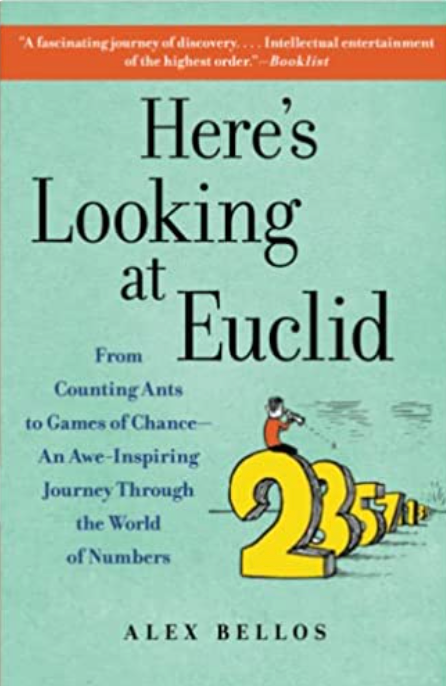
Here's Looking at Euclid: Chapters Two–Three
To illustrate his thesis that math is the foundation of human progress, Alex Bellos details achievements throughout time and cultures.
Here are links to our lists for the book: Chapters Zero–One, Chapters Two–Three, Chapters Four–Five, Chapters Six–Eight, Chapters Nine–Eleven
40 words
32 learners
Learn words with Flashcards and other activities
Definition First

Other learning activities
Full list of words from this list:
-
revere
regard with feelings of respectYet rather than seeing math merely as a tool to describe nature, he saw numbers as somehow the essence of nature—and he tutored his flock to revere them.
-
primordial
having existed from the beginningThe reason the beans were sacred, according to one ancient source, was that they sprouted from the same primordial muck as humans did.
-
esoteric
understandable only by an enlightened inner circleMaybe, in fact, as some academics now suggest, the only ideas that can be correctly attributed to him are the mystical ones. Pythagorean esotericism has been a constant presence in Western thought since antiquity, but it was especially in vogue during the Renaissance, thanks to the rediscovery of a poem of “self-help” maxims written around the fourth century B.C. called the Golden Verses of Pythagoras.
-
maxim
a saying that is widely accepted on its own meritsPythagorean esotericism has been a constant presence in Western thought since antiquity, but it was especially in vogue during the Renaissance, thanks to the rediscovery of a poem of “self-help” maxims written around the fourth century B.C. called the Golden Verses of Pythagoras.
-
portent
a sign of something about to happenNumerology is, of course, now an established dish in the buffet of modern mysticism, with no shortage of gurus willing to advise on lottery numbers or speculate on the portent of a prospective date.
-
precipitate
bring about abruptlyThe sole reason was that nine was the ruling general’s favorite number. Despite that, the new notes helped precipitate an economic crisis, which led to an uprising on August 8, 1988—the 8th of the 8th of 88, eight being the antidictatorship movement’s favorite number.
-
patrimony
an inheritance coming by right of birthIt is a pocket-size right angle-generating machine that is a jewel of our mathematical patrimony, an intellectual artifact of great power, elegance and concision.
-
vindicate
show to be right by providing justification or proofIt is not known if Pythagoras really discovered his theorem, though his name has been attached to it since classical times. Whether or not he did, it vindicates his worldview, demonstrating a remarkable harmony in the mathematical universe.
-
attribute
credit toIn his 1940 book The Pythagorean Proposition, Elisha Scott Loomis published 371 proofs of the theorem, devised by a surprisingly diverse collection of people; one dating to 1888 was attributed to E. A. Coolidge, a blind girl; another, dating to 1938, was attributed to Ann Condit, a 16-year-old high school student; others were attributed to Leonardo da Vinci and President James A. Garfield.
-
meticulously
in a manner marked by extreme care of detailsHe then meticulously progressed from proposition to proposition, revealing a host of properties of lines, triangles and circles.
-
magnum opus
a creator's greatest work of art or literatureThe Elements is a magnum opus of pedantry and rigor.
-
axiom
a proposition that is not susceptible of proof or disproofNothing is ever assumed. Every line follows logically from the line before. Yet from only a few basic axioms, Euclid amassed an impressive body of compelling results.
-
superimpose
place on top ofThere is nothing pretty about Euclid’s proof of Pythagoras’s theorem. It is long, meticulous and convoluted and requires a diagram full of lines and superimposed triangles.
-
perversity
deliberate and stubborn resistance to guidance or disciplineArthur Schopenhauer, the nineteenth-century German philosopher, said it was so unnecessarily complicated that it was a “brilliant piece of perversity.”
-
perpetuity
the property of being seemingly ceaselessThe propositions of The Elements are true in perpetuity. They do not become less certain or indeed less relevant with time (which is why Euclid is still taught at school and why Greek playwrights, poets and historians are not).
-
staggering
so surprisingly impressive as to stun or overwhelmThe heptagon (seven sides), for example, cannot be constructed with a compass and straightedge. The octagon is constructable, but then the nonagon again is not. Meanwhile the staggeringly complex regular polygon that has 65,537 sides is constructable, and in fact has been constructed.
-
plinth
an architectural support or base, as for a column or statueImagine there is a statue on a plinth in front of you. When you are too close you have to crick your neck and you have a very narrow angle to look up at it. When you are far away, you have to strain your eyes and, again, see it through a very narrow angle. Where, then, is the best place to view it?
-
fathom
come to understandThough this may be hard to fathom these days, The Elements was a literary sensation.
-
advent
arrival that has been awaitedMore than a millennium before the advent of GPS technology, the requirement to face Mecca relied on complicated astronomical calculations—which is one reason why Islamic science was unequaled for almost a thousand years.
-
epitomize
embody the essential characteristics ofIslamic art is epitomized by the ingenious geometrical mosaic arrangements on the walls, ceilings and floors of its sacred buildings, a consequence of the ban on images of people and animals in holy sites.
-
iteration
the act or process of doing or saying againAs you continue the iterations of taking out smaller and smaller cubes the volume of the sponge gets smaller and smaller, eventually becoming invisible—as though woodworms have eaten the whole lot. Yet each iteration of cube removal also makes the surface area of the sponge increase. By taking more and more iterations you can make the surface area larger than any area you want, meaning that as the number of iterations approaches infinity, the surface area of the sponge also approaches infinity.
-
sublime
of high moral or intellectual valueThis simple fold had the effect of opening the curtains on a sublime new world. Haga had created three right-angled triangles. Yet these were not any old right-angled triangles. All three were Egyptian, the most historic and iconic triangles of them all.
-
arbitrary
based on or subject to individual discretion or preferenceHaga showed me that the intersection of the two folds was always on the middle line of the paper, and that the distance from the arbitrary point to the intersection was always equal to the distance from the intersection to the opposite corners.
-
phalanx
any of the bones of the fingers or toesA yojana, he said, was equivalent to:
Four krosha, each of which was the length of
One thousand arcs, each of which was the length of
Four cubits, each of which was the length of
Two spans, each of which was the length of
Twelve phalanges of fingers, each of which was the length of
Seven grains of barley... -
feasible
capable of being done with means at handThe Buddha was by no means the only ancient Indian interested in the incredibly large and the unfeasibly small; Sanskrit literature is full of astronomically high numbers.
-
lingua franca
a common language used by speakers of different languagesBefore Arabic numerals became an international lingua franca, humans had many other ways of writing down numbers.
-
myriad
ten thousandThe highest-value number word the Greeks had was myriad, meaning ten thousand, which they wrote as a capital M.
-
tutelage
teaching pupils individuallyZero took its first tentative steps as a bona fide number under the tutelage of Indian mathematicians such as Brahmagupta, who in the seventh century showed how shunya behaved toward its number siblings.
-
intrinsic
belonging to a thing by its very natureZero would enhance mathematics in other ways too, by leading to the “invention” of concepts such as negative numbers and decimal fractions—concepts that we now learn effortlessly at school and are intrinsic to our needs in daily life, but which were in no way self-evident.
-
prosody
the study of poetic meter and the art of versificationThe names that were chosen depended on context and conformed to Sanskrit's strict rules of versification and prosody.
-
supersede
take the place or move into the position ofIn 1299 Florence banned the Arabic numerals because, it was said, the slinky symbols were easier to falsify than solid Roman Vs and Is. A 0 could easily become a 6 or 9, and 1 could morph seamlessly into 7. As a consequence, it was only around the end of the fifteenth century that Roman numerals were finally superseded...
-
aphorism
a short pithy instructive sayingVedic mathematics is based on the following list of 16 aphorisms, or sutras, which Tirthaji said were not actually written in any passage of the Vedas, instead being detectable only “on the basis of intuitive revelation.”
-
incumbent
currently holding an officeThis is the town that I was visiting, the focus of the Rath Yatra chariot festival, where I was hoping to meet the incumbent Shankaracharya, who is the current ambassador for Vedic mathematics.
-
render
cause to become“Equations are rendered much easier by these formulae,” Tirthaji commented.
-
proponent
a person who argues for a cause or puts forward an ideaIn my hotel in Puri I met up with two leading proponents of Vedic mathematics to learn more about it.
-
auspicious
indicating favorable circumstances and good luckWe hailed a motor rickshaw and set off to the Govardhan Math, an auspicious name but one which, unfortunately, has nothing to do with math. It means monastery, or temple.
-
prostrate
stretched out and lying at full length along the groundAs the session was about to begin, a man in blue robes dived in front of me, throwing himself prostrate before the throne with outstretched hands.
-
affront
a deliberately offensive actHe then became increasingly annoyed by my questions, interpreting my desire for proper scientific explanations as an affront to Indian heritage.
-
scrutiny
the act of examining something closely, as for mistakesWhile Vedic science is fantastical, occultist and barely credible, Vedic mathematics stands up to scrutiny even though the sutras are mostly so vague as to be meaningless, and to accept the story of their origin in the Vedas requires the suspension of disbelief.
-
abnegate
deny oneselfNothing was not nothing in Hindu thought. Nothing was everything. And the monastic, self- abnegating Shankaracharya was a perfect ambassador for this nothingness.
Created on Sun Feb 13 12:03:49 EST 2022
(updated Thu Feb 02 14:59:22 EST 2023)
Sign up now (it’s free!)
Whether you’re a teacher or a learner,
Vocabulary.com can put you or your class
on the path to systematic vocabulary improvement.