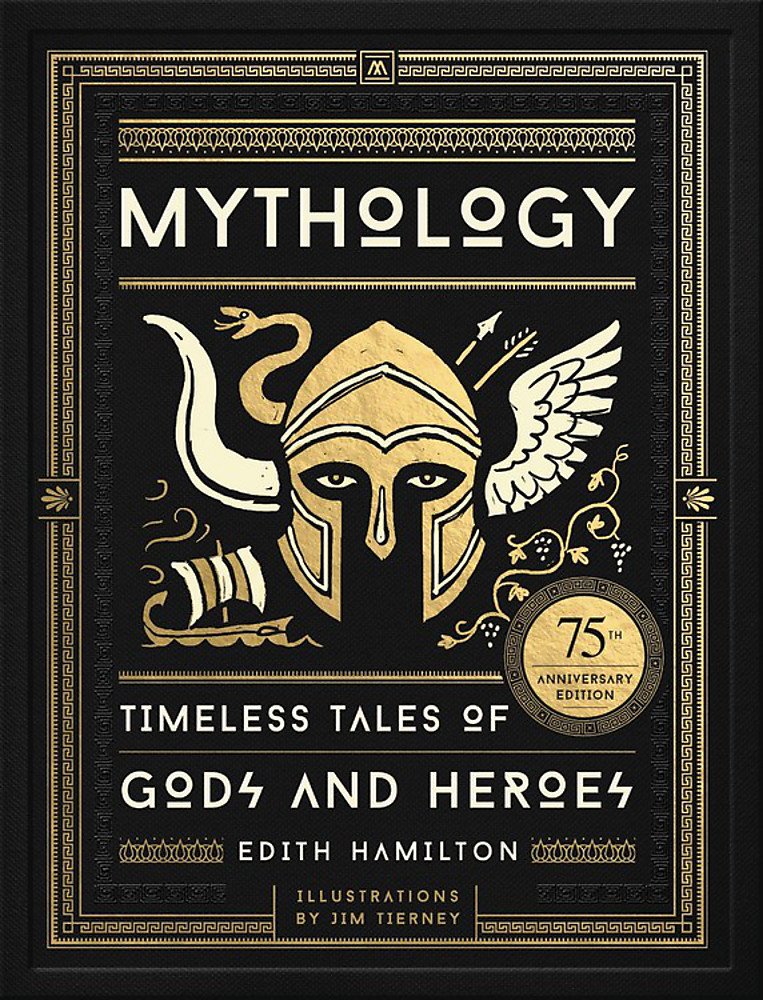
Mythology: Parts Six–Seven
Originally published in 1942, Edith Hamilton's collection of myths is an essential text for students of the ancient world.
Here are links to our lists for the text: Part One, Part Two, Part Three, Part Four, Part Five, Parts Six–Seven
40 words
423 learners
Learn words with Flashcards and other activities
Definition First

Other learning activities
Full list of words from this list:
-
guise
an artful or simulated semblanceThey bound him with rosy garlands, set a flowering wreath on his head, woke him up, and bore him in this ridiculous guise to Midas as a great joke.
-
plumage
the covering of feathers on a birdIt is said that the news was brought to him by his bird, the raven, then pure white with beautiful snowy plumage, and that Apollo in a fit of furious anger, and with the complete injustice the gods usually showed when they were angry, punished the faithful messenger by turning his feathers black.
-
incantation
a ritual reciting of words believed to have a magical effectChiron was learned in the use of herbs and gentle incantations and cooling potions.
-
malady
impairment of normal physiological functionHe was able to give aid in all manner of maladies. Whoever came to him suffering, whether from wounded limbs or bodies wasting away with disease, even those who were sick unto death, he delivered from their torment.
-
riddle
pierce with many holesAt the river’s edge they filled forever jars riddled with holes, so that the water poured away and they must return to fill them again, and again see them drained dry.
-
promontory
a natural elevationShe fled from him until she stood on a lofty promontory where she could safely watch him, wondering at the half-man, half-fish.
-
baleful
threatening or foreshadowing evil or tragic developmentsShe prepared a vial of very powerful poison and, going to the bay where Scylla bathed, she poured into it the baleful liquid.
-
procure
get by special effortOne woman had power given her to assume different shapes, power as great as Proteus had. She used it, strangely enough, to procure food for her starving father.
-
vindictive
disposed to seek revenge or intended for revengeHer story is the only one in which the good goddess, Ceres, appears cruel and vindictive.
-
audacity
aggressive or outright boldnessErysichthon had the wicked audacity to cut down the tallest oak in a grove sacred to Ceres.
-
dryad
a deity or nymph of the woodsHis servants shrank from the sacrilege when he ordered them to fell it; whereupon he seized an ax himself and attacked the mighty trunk around which the dryads used to hold their dances.
-
graft
cause parts of different plants to grow togetherShe cared for fruits and orchards and that was all she cared for. Her delight was in pruning and grafting and everything that belongs to the gardener’s art.
-
ardent
characterized by intense emotionOf all that sought her Vertumnus was the most ardent, but he could make no headway.
-
eloquence
powerful and effective languagePomona yielded to such beauty joined to such eloquence, and henceforward her orchards had two gardeners.
-
cornucopia
a horn filled with fruit and grain symbolizing prosperityShe was said to have a horn which was always full of whatever food or drink anyone wanted, the Horn of Plenty (in Latin Cornu copiae—also known as “the Cornucopia” in Latin mythology).
-
warp
yarn arranged lengthways on a loomBoth set up their looms and stretched the warp upon them.
-
skein
coils of worsted yarnHeaps of skeins of beautiful threads colored like the rainbow lay beside each, and threads of gold and silver too.
-
resolute
characterized by quickness and firmnessProteus had the power to change himself into any number of different forms. However, if his captor was resolute enough to hold him fast through all the changes, he would finally give in and answer what he was asked.
-
pine
have a desire for something or someone who is not presentShe pined away sitting on the ground out-of-doors where she could watch him, turning her face and following him with her eyes as he journeyed over the sky.
-
flay
strip the skin offMarsyas, a satyr, found it and played so enchantingly upon it that he dared to challenge Apollo to a contest. The god won, of course, and punished Marsyas by flaying him.
-
divination
the art or gift of prophecy by supernatural meansHe learned in this way the art of divination as no one ever had, and he became a famous soothsayer.
-
industrious
characterized by hard work and perseveranceThese were men created from ants on the island of Aegina, in the reign of Aeacus, Achilles’ grandfather, and they were Achilles’ followers in the Trojan War. Not only were they thrifty and industrious, as one would suppose from their origin, but they were also brave.
-
peal
a deep prolonged soundA peal of thunder seemed to answer him and that night he dreamed that he saw the ants being transformed into human shape.
-
emulate
strive to equal or match, especially by imitatingThis man was another illustration of how fatal it was for mortals to try to emulate the gods.
-
firebrand
a piece of wood that has been burned or is burningHe had a chariot made in such a way that there was a loud clanging of brass when it moved. On the day of Zeus’s festival he drove it furiously through the town, scattering at the same time firebrands and shouting to the people to worship him because he was Zeus the Thunderer.
-
unsullied
free from blemishesThe only sustaining support possible for the human spirit, the one pure unsullied good men can hope to attain, is heroism; and heroism depends on lost causes.
-
fatalistic
accepting that everything that happens is inevitableSuch an attitude toward life seems at first sight fatalistic, but actually the decrees of an inexorable fate played no more part in the Norseman’s scheme of existence than predestination did in St. Paul’s or in that of his militant Protestant followers, and for precisely the same reason.
-
predestination
the doctrine that God has foreordained every eventSuch an attitude toward life seems at first sight fatalistic, but actually the decrees of an inexorable fate played no more part in the Norseman’s scheme of existence than predestination did in St. Paul’s or in that of his militant Protestant followers, and for precisely the same reason.
-
obliterate
do away with completely, without leaving a traceEverywhere else in northwestern Europe the early records, the traditions, the songs and stories, were obliterated by the priests of Christianity, who felt a bitter hatred for the paganism they had come to destroy.
-
treatise
a formal text that treats a particular topic systematicallyThe chief part of it is a technical treatise on how to write poetry, but it also contains some prehistoric mythological material which is not in the Elder Edda.
-
aloof
distant, cold, or detached in mannerHe is a strange and solemn figure, always aloof.
-
convulsion
a violent uncontrollable contraction of musclesEven so, whenever she had to empty the cup and the poison fell on him, though but for a moment, his agony was so intense that his convulsions shook the earth.
-
repute
look on as or considerFrigga, Odin’s wife, for whom some say Friday is named, was reputed to be very wise, but she was also very silent and she told no one, not even Odin, what she knew.
-
sprite
a small, mythological creature with wings and magical powersIn the world were also dwarfs—ugly creatures, but masterly craftsmen, who lived under the earth; and elves, lovely sprites, who tended the flowers and streams.
-
allot
give outAllot their lives to the sons of men,
And assign to them their fate. -
sustenance
the act of providing a means of subsistence or survivalThis vision of a happiness infinitely remote seems a thin sustenance against despair, but it was the only hope the Eddas afforded.
-
profound
showing intellectual penetration or emotional depthThis Norse wisdom-literature is far less profound than the Hebrew Book of Proverbs; indeed it rarely deserves to have the great word “wisdom” applied to it, but the Norsemen who created it had at any rate a large store of good sense, a striking contrast to the uncompromising spirit of the hero.
-
beget
have childrenA man knows nothing if he knows not
That wealth oft begets an ape. -
shrewd
marked by practical hardheaded intelligenceSome show a shrewd knowledge of human nature...
-
paltry
not worth consideringA paltry man and poor of mind
Is he who mocks at all things.
Created on Tue Aug 27 16:54:32 EDT 2019
(updated Mon Sep 16 14:28:11 EDT 2019)
Sign up now (it’s free!)
Whether you’re a teacher or a learner,
Vocabulary.com can put you or your class
on the path to systematic vocabulary improvement.