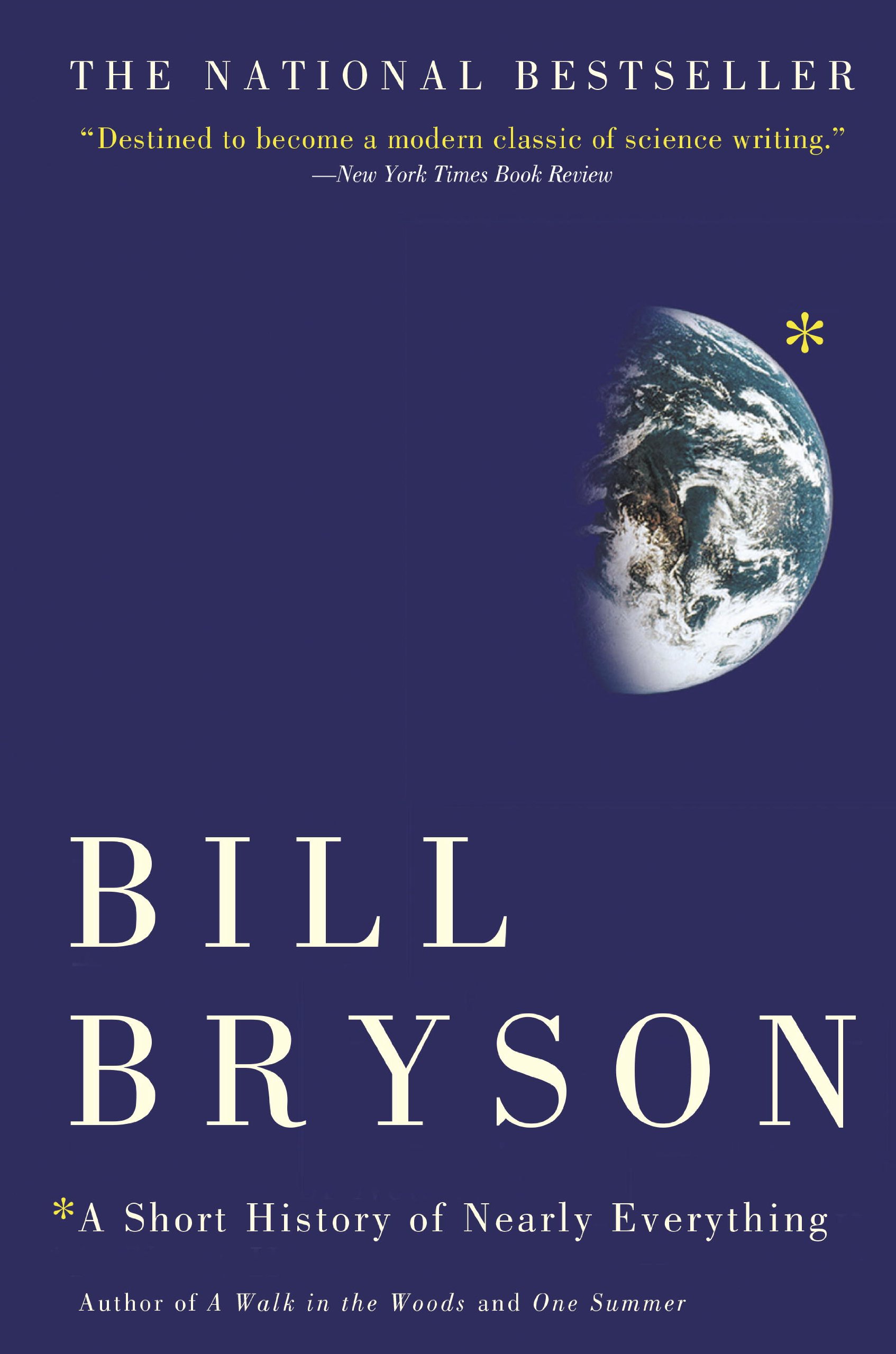
A Short History of Nearly Everything: Part III
In this engaging work of nonfiction, Bill Bryson explores profound questions about the origins of the universe, the development of life on Earth, and modern civilization.
Here are links to our lists for the book: Introduction–Part I, Part II, Part III, Part IV, Part V, Part VI
15 words
118 learners
Learn words with Flashcards and other activities
Definition First

Other learning activities
Full list of words from this list:
-
joule
a unit of electrical energyThey had discovered the X ray, the cathode ray, the electron, and radioactivity, invented the ohm, the watt, the Kelvin, the joule, the amp, and the little erg.
-
entropy
energy in a system no longer available for mechanical workHe studied theoretical physics and threw himself body and soul into work on entropy, a process at the heart of thermodynamics, which seemed to hold much promise for an ambitious young man.
-
inextricably
in a manner incapable of being disentangled or untiedIt is bound up — "inextricably interconnected," in Stephen Hawking’s expression — with the three dimensions of space in a curious dimension known as spacetime.
-
inveterate
habitualFor all his gifts, Hubble was also an inveterate liar.
-
paramecium
a freshwater ciliate protozoanA typical paramecium, for instance, is about two microns wide, 0.002 millimeters, which is really very small.
-
intractable
difficult to manage or moldConfronted with an intractable problem, he was prepared to work at it harder and longer than most people and to be more receptive to unorthodox explanations.
-
isotope
atom with same atomic number, different number of neutronsIt was just at this time that Harrison Brown of the University of Chicago developed a new method for counting lead isotopes in igneous rocks (which is to say those that were created through heating, as opposed to the laying down of sediments).
-
contrail
an artificial cloud created by an aircraftWhen he accelerated an alpha particle through the chamber to seed his make-believe clouds, it left a visible trail — like the contrails of a passing airliner.
-
postulate
maintain or assertAs physicists built bigger and more ambitious machines, they began to find or postulate particles or particle families seemingly without number: muons, pions, hyperons, mesons, K-mesons, Higgs bosons, intermediate vector bosons, baiyons, tachyons.
-
quark
fundamental subatomic particle that has a fractional chargeFears have been raised that in their enthusiasm scientists might inadvertently create a black hole or even something called "strange quarks," which could, theoretically, interact with other subatomic particles and propagate uncontrollably.
-
evanescent
short-lived; tending to vanish or disappearFinding particles takes a certain amount of concentration. They are not just tiny and swift but also often tantalizingly evanescent. Particles can come into being and be gone again in as little as 0.000000000000000000000001 second
-
galling
causing irritation or annoyanceIt is slightly galling to think that we live in a universe that for the most part we can’t even see, but there you are.
-
quintessence
the highest element after air and earth and fire and waterScientists sometimes also call it vacuum energy or, more exotically, quintessence.
-
aegis
kindly endorsement and guidanceIn what has become a famous snub, the editor of the Journal of Geophysical Research told him: "Such speculations make interesting talk at cocktail parties, but it is not the sort of thing that ought to be published under serious scientific aegis."
-
auspices
kindly endorsement and guidanceA symposium of many of the most important figures in the field was convened in London under the auspices of the Royal Society in 1964, and suddenly, it seemed, everyone was a convert.
Created on Tue Feb 21 20:07:29 EST 2017
(updated Tue Jul 01 12:18:23 EDT 2025)
Sign up now (it’s free!)
Whether you’re a teacher or a learner,
Vocabulary.com can put you or your class
on the path to systematic vocabulary improvement.