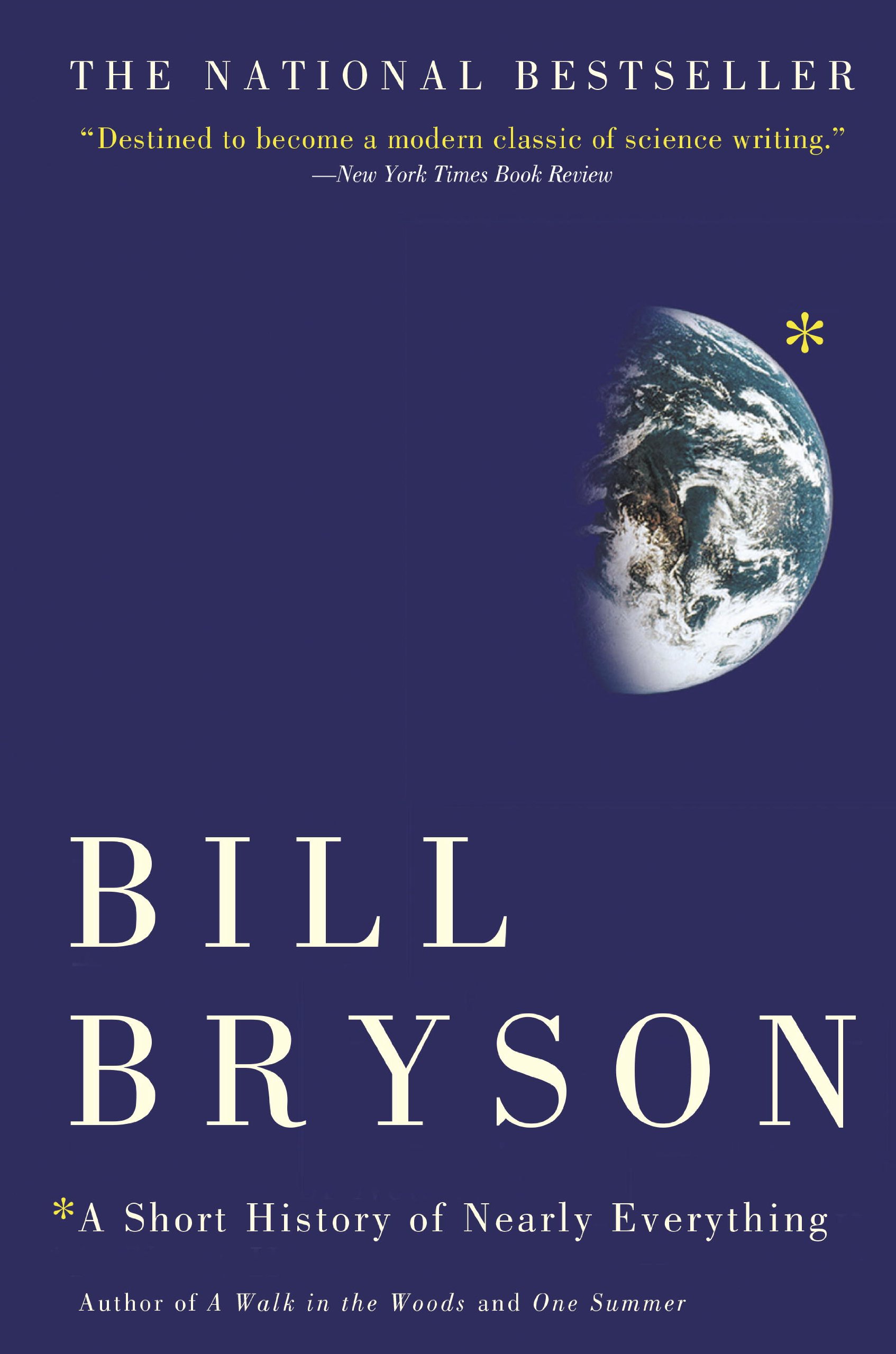
A Short History of Nearly Everything: Introduction–Part I
In this engaging work of nonfiction, Bill Bryson explores profound questions about the origins of the universe, the development of life on Earth, and modern civilization.
Here are links to our lists for the book: Introduction–Part I, Part II, Part III, Part IV, Part V, Part VI
15 words
423 learners
Learn words with Flashcards and other activities
Definition First

Other learning activities
Full list of words from this list:
-
primordial
having existed from the beginningTo get from "protoplasmal primordial atomic globule" (as Gilbert and Sullivan put it) to sentient upright modern human has required you to mutate new traits over and over in a precisely timely manner for an exceedingly long while.
-
propound
put forward, as of an ideaMost of what we know, or believe we know, about the early moments of the universe is thanks to an idea called inflation theory first propounded in 1979 by a junior particle physicist, then at Stanford, now at MIT, named Alan Guth.
-
coalesce
fuse or cause to come togetherHad it been weaker, however, nothing would have coalesced. The universe would have remained forever a dull, scattered void.
-
prolific
bearing in abundance especially offspringLower that value very slightly-from 0.007 percent to 0.006 percent, say--and no transformation could take place: the universe would consist of hydrogen and nothing else. Raise the value very slightly--to 0.008 percent--and bonding would be so wildly prolific that the hydrogen would long since have been exhausted.
-
relativity
the theory that space and time are not absolute conceptsThe reason for this is that the universe bends, in a way we can’t adequately imagine, in conformance with Einstein’s theory of relativity.
-
quasar
a starlike object that may send out radio wavesAlmost all the telescopes we have in the world are designed to peer at very tiny little pieces of the sky way off in the distance to see a quasar or hunt for black holes or look at a distant galaxy.
-
seminal
influential and providing a basis for later developmentOne nice touch about Christy’s discovery was that it happened in Flagstaff, for it was there in 1930 that Pluto had been found in the first place. That seminal event in astronomy was largely to the credit of the astronomer Percival Lowell.
-
firmament
the sphere on which celestial bodies appear to be projectedTombaugh had no formal training as an astronomer, but he was diligent and he was astute, and after a year’s patient searching he somehow spotted Pluto, a faint point of light in a glittery firmament.
-
galactic
of or relating to a star systemA lot of astronomers believe it isn’t a planet at all, but merely the largest object so far found in a zone of galactic debris known as the Kuiper belt.
-
reclusive
withdrawn from society; seeking solitudeThe more reclusive long-period comets (among them the recent visitors Hale-Bopp and Hyakutake) come from the much more distant Oort cloud
-
anomalous
deviating from the general or common order or typeThis alone makes it extremely anomalous; it means that our planetary system consists of four rocky inner planets, four gassy outer giants, and a tiny, solitary iceball.
-
supernova
a star that explodes and becomes luminous in the processIf a supernova explosion happened within five hundred light-years of us, we would be goners.
-
nebula
an immense cloud of gas and dust in interstellar spaceIf you have ever looked through popular astronomical publications, and at some time you must have, you will know that they are generally full of richly luminous color photos of distant nebulae and the like — fairy-lit clouds of celestial light of the most delicate and moving splendor.
-
conundrum
a difficult problemYou will recall the cosmological conundrum with which we ended the first chapter--that the Big Bang created lots of light gases but no heavy elements.
-
inchoate
only partly in existence; imperfectly formedAll over the inchoate solar system, the same was happening.
Created on Tue Feb 21 18:30:11 EST 2017
(updated Mon Jul 14 17:32:50 EDT 2025)
Sign up now (it’s free!)
Whether you’re a teacher or a learner,
Vocabulary.com can put you or your class
on the path to systematic vocabulary improvement.