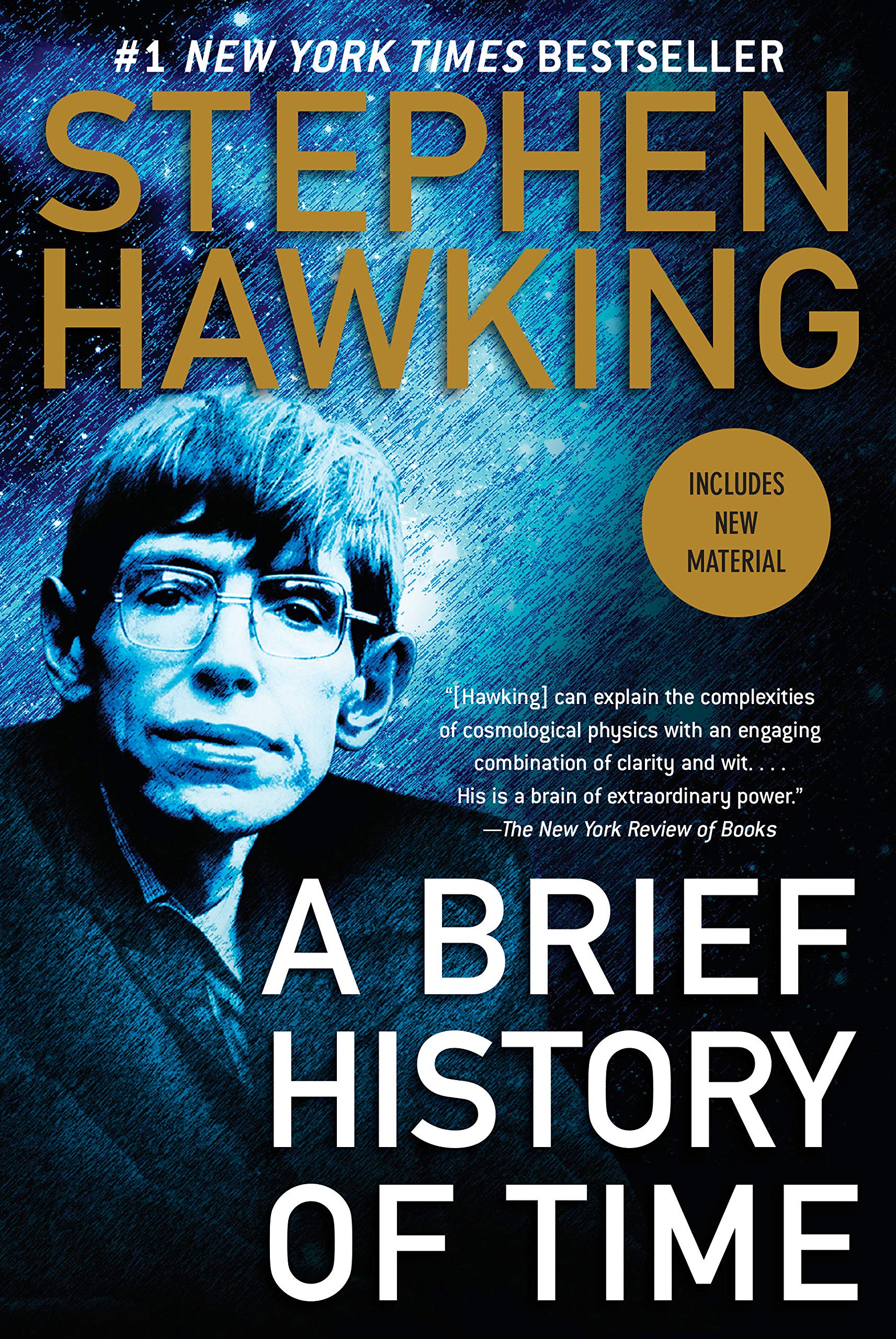
A Brief History of Time: Foreword–Chapter 2
In this groundbreaking book, renowned physicist Stephen Hawking attempts to answer some of the most formidable questions about the universe.
Here are links to our lists for the book: Foreword–Chapter 2, Chapters 3–5, Chapters 6–8, Chapters 9–12, Einstein–Newton
15 words
1832 learners
Learn words with Flashcards and other activities
Definition First

Other learning activities
Full list of words from this list:
-
rational
consistent with or based on or using reasonThis would be a revolution in our view of the unification of the laws of science but it would not change the most important point: that the universe is governed by a set of rational laws that we can discover and understand.
-
theory
a well-substantiated explanation of some aspect of the worldI shall take the simpleminded view that a theory is just a model of the universe, or a restricted part of it, and a set of rules that relate quantities in the model to observations that we make. It exists only in our minds and does not have any other reality (whatever that might mean).
-
observation
facts learned by watching attentivelyA theory is a good theory if it satisfies two requirements. It must accurately describe a large class of observations on the basis of a model that contains only a few arbitrary elements, and it must make definite predictions about the results of future observations.
-
relativity
the theory that space and time are not absolute conceptsThe general theory of relativity describes the force of gravity and the large-scale structure of the universe, that is, the structure on scales from only a few miles to as large as a million million million million (1 with twenty-four zeros after it) miles, the size of the observable universe.
-
phenomenon
any state or process known through the sensesQuantum mechanics, on the other hand, deals with phenomena on extremely small scales, such as a millionth of a millionth of an inch.
-
physics
One of the major endeavors in physics today, and the major theme of this book, is the search for a new theory that will incorporate them both—a quantum theory of gravity.
-
gravity
the force of attraction between all masses in the universeIn addition to his laws of motion, Newton discovered a law to describe the force of gravity, which states that every body attracts every other body with a force that is proportional to the mass of each body.
-
acceleration
(physics) a rate of increase of velocityOne can now see why all bodies fall at the same rate: a body of twice the weight will have twice the force of gravity pulling it down, but it will also have twice the mass. According to Newton’s second law, these two effects will exactly cancel each other, so the acceleration will be the same in all cases.
-
propagation
the movement of a wave through a mediumA proper theory of the propagation of light didn’t come until 1865, when the British physicist James Clerk Maxwell succeeded in unifying the partial theories that up to then had been used to describe the forces of electricity and magnetism.
-
postulate
a proposition accepted as true to provide a logical basisThe fundamental postulate of the theory of relativity, as it was called, was that the laws of science should be the same for all freely moving observers, no matter what their speed.
-
equivalence
a state of being essentially comparable or equally balancedPerhaps the best known are the equivalence of mass and energy, summed up in Einstein’s famous equation E=mc2 (where E is energy, m is mass, and c is the speed of light), and the law that nothing may travel faster than the speed of light. Because of the equivalence of energy and mass, the energy which an object has due to its motion will add to its mass.
-
mass
the property of a body that causes it to have weightAs an object approaches the speed of light, its mass rises ever more quickly, so it takes more and more energy to speed it up further. It can in fact never reach the speed of light, because by then its mass would have become infinite, and by the equivalence of mass and energy, it would have taken an infinite amount of energy to get it there.
-
orbit
the path of a celestial body in its revolution about anotherThe mass of the sun curves space-time in such a way that although the earth follows a straight path in four-dimensional space-time, it appears to us to move along a circular orbit in three-dimensional space. In fact, the orbits of the planets predicted by general relativity are almost exactly the same as those predicted by the Newtonian theory of gravity.
-
ellipse
a closed plane curve with an oval shapeHowever, in the case of Mercury, which, being the nearest planet to the sun, feels the strongest gravitational effects, and has a rather elongated orbit, general relativity predicts that the long axis of the ellipse should rotate about the sun at a rate of about one degree in ten thousand years.
-
dynamic
relating to the forces that cause motions of bodiesSpace and time are now dynamic quantities: when a body moves, or a force acts, it affects the curvature of space and time—and in turn the structure of space-time affects the way in which bodies move and forces act.
Created on Tue Jun 14 09:19:41 EDT 2016
(updated Thu Jul 31 12:45:04 EDT 2025)
Sign up now (it’s free!)
Whether you’re a teacher or a learner,
Vocabulary.com can put you or your class
on the path to systematic vocabulary improvement.