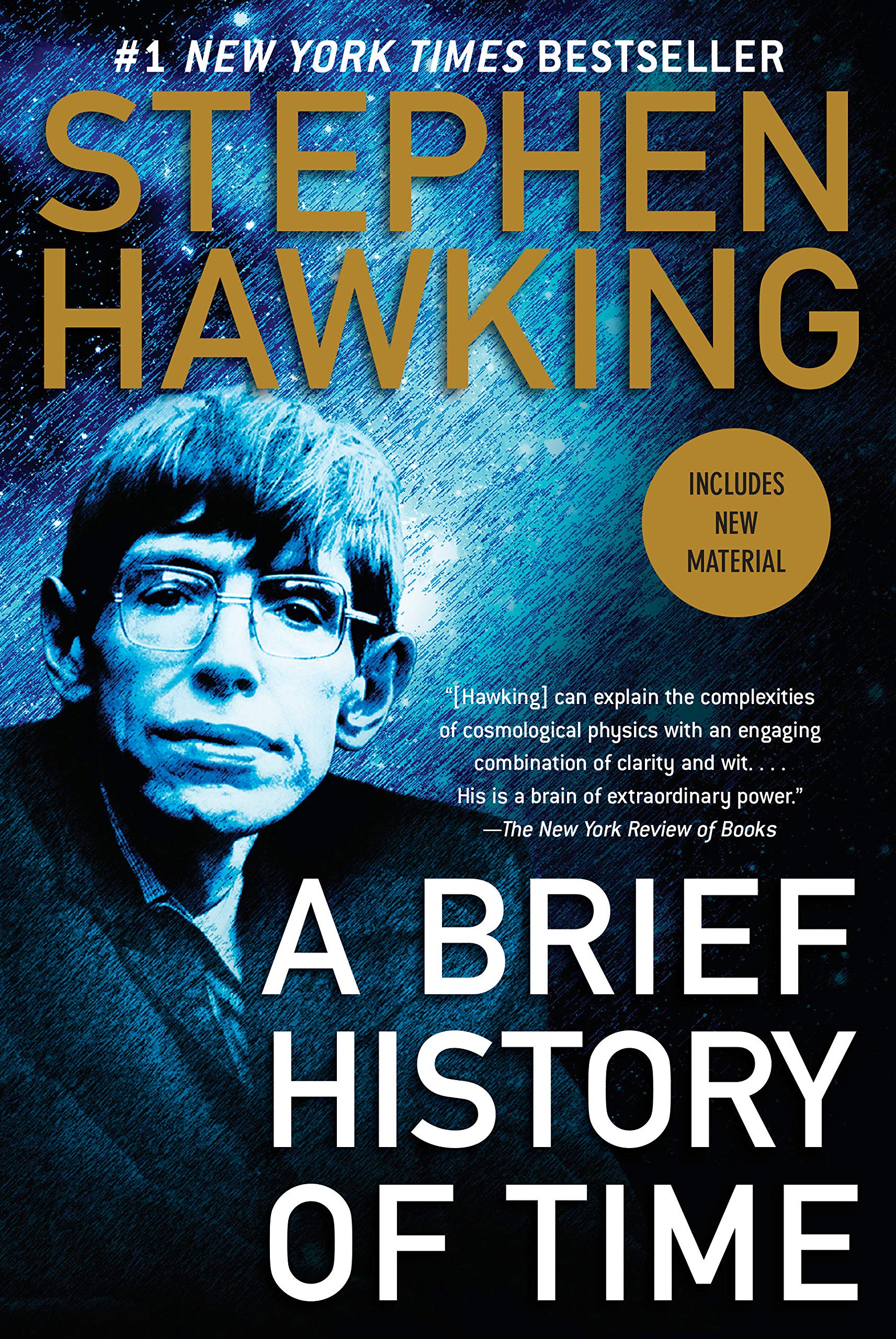
A Brief History of Time: Chapters 9–12
In this groundbreaking book, renowned physicist Stephen Hawking attempts to answer some of the most formidable questions about the universe.
Here are links to our lists for the book: Foreword–Chapter 2, Chapters 3–5, Chapters 6–8, Chapters 9–12, Einstein–Newton
15 words
101 learners
Learn words with Flashcards and other activities
Definition First

Other learning activities
Full list of words from this list:
-
dissipate
cause to separate and go in different directionsThis energy is dissipated as heat, and increases the amount of disorder in the universe.
-
subjective
taking place within the mind and modified by individual biasOur subjective sense of the direction of time, the psychological arrow of time, is therefore determined within our brain by the thermodynamic arrow of time.
-
limitation
a principle that restricts the extent of somethingLike the uncertainty principle, Godel’s incompleteness theorem may be a fundamental limitation on our ability to understand and predict the universe, but so far at least it hasn’t seemed to be an obstacle in our search for a complete unified theory.
-
distorted
so badly formed or out of shape as to be uglyThe Godel solution and the cosmic string space-time start out so distorted that travel into the past was always possible.
-
paradox
a statement that contradicts itselfThere are many versions of this paradox but they are essentially equivalent: one would get contradictions if one were free to change the past.
-
consistent
marked by an orderly and coherent relation of partsOne I shall call the consistent histories approach. It says that even if space-time is warped so that it would be possible to travel into the past, what happens in space-time must be a consistent solution of the laws of physics.
-
alternative
necessitating a choice between different possibilitiesThe other possible way to resolve the paradoxes of time travel might be called the alternative histories hypothesis. The idea here is that when time travelers go back to the past, they enter alternative histories which differ from recorded history.
-
conjecture
a hypothesis that has been formed by speculatingOne would avoid these problems if what I call the chronology protection conjecture holds. This says that the laws of physics conspire to prevent macroscopic bodies from carrying information into the past.
-
chronology
an arrangement of events in timeThe reason to believe that chronology protection operates is that when space-time is warped enough to make travel into the past possible, virtual particles moving on closed loops in space-time can become real particles traveling forward in time at or below the speed of light.
-
unification
the act of making or becoming a single entityUltimately, however, one would hope to find a complete, consistent, unified theory that would include all these partial theories as approximations, and that did not need to be adjusted to fit the facts by picking the values of certain arbitrary numbers in the theory. The quest for such a theory is known as “the unification of physics.”
-
incorporate
include or contain; have as a componentThe main difficulty in finding a theory that unifies gravity with the other forces is that general relativity is a “classical” theory; that is, it does not incorporate the uncertainty principle of quantum mechanics.
-
infinity
time without endRather similar, seemingly absurd infinities occur in the other partial theories, but in all these cases the infinities can be canceled out by a process called renormalization. This involves canceling the infinities by introducing other infinities.
-
dimension
one of three coordinates that determine a position in spaceString theories, however, have a bigger problem: they seem to be consistent only if space-time has either ten or twenty-six dimensions, instead of the usual four!
-
axiom
a proposition that is not susceptible of proof or disproofHowever, I believe there may not be any single formulation of the fundamental theory any more than, as Godel showed, one could formulate arithmetic in terms of a single set of axioms.
-
formulation
the act of inventing or contriving an idea or explanationThere really is a complete unified theory (or a collection of overlapping formulations), which we will someday discover if we are smart enough.
Created on Tue Jun 14 09:33:22 EDT 2016
(updated Thu Jul 31 13:50:31 EDT 2025)
Sign up now (it’s free!)
Whether you’re a teacher or a learner,
Vocabulary.com can put you or your class
on the path to systematic vocabulary improvement.