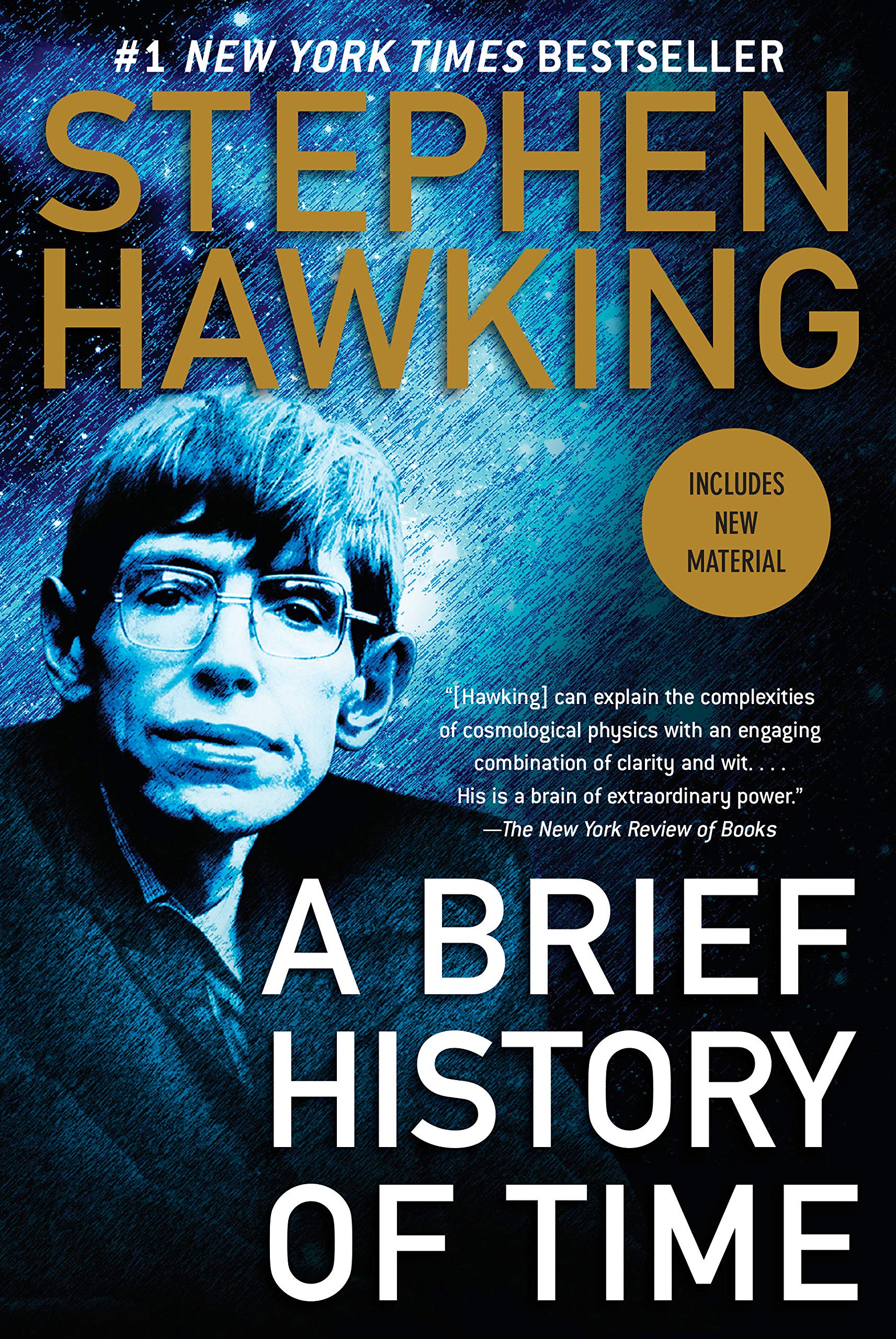
A Brief History of Time: Chapters 3–5
In this groundbreaking book, renowned physicist Stephen Hawking attempts to answer some of the most formidable questions about the universe.
Here are links to our lists for the book: Foreword–Chapter 2, Chapters 3–5, Chapters 6–8, Chapters 9–12, Einstein–Newton
15 words
137 learners
Learn words with Flashcards and other activities
Definition First

Other learning activities
Full list of words from this list:
-
rotate
turn on or around an axis or a centerWe live in a galaxy that is about one hundred thousand light-years across and is slowly rotating; the stars in its spiral arms orbit around its center about once every several hundred million years.
-
spectrum
an ordered array of the components of an emission or waveBy focusing a telescope on an individual star or galaxy, one can similarly observe the spectrum of the light from that star or galaxy. Different stars have different spectra, but the relative brightness of the different colors is always exactly what one would expect to find in the light emitted by an object that is glowing red hot. (In fact, the light emitted by any opaque object that is glowing red hot has a characteristic spectrum that depends only on its temperature—a thermal spectrum.
-
fluctuation
a wave motionAs we have seen, visible light consists of fluctuations, or waves, in the electromagnetic field.
-
emit
give off, send forth, or dischargeNow imagine a source of light at a constant distance from us, such as a star, emitting waves of light at a constant wavelength. Obviously the wavelength of the waves we receive will be the same as the wavelength at which they are emitted (the gravitational field of the galaxy will not be large enough to have a significant effect).
-
expand
become larger in size or volume or quantityThe discovery that the universe is expanding was one of the great intellectual revolutions of the twentieth century.
-
velocity
distance traveled per unit time in one directionWe can determine the present rate of expansion by measuring the velocities at which other galaxies are moving away from us, using the Doppler effect.
-
singularity
the quality of being one of a kindBecause mathematics cannot really handle infinite numbers, this means that the general theory of relativity (on which Friedmann’s solutions are based) predicts that there is a point in the universe where the theory itself breaks down. Such a point is an example of what mathematicians call a singularity.
-
implication
a logical relation between propositionsThe quantum hypothesis explained the observed rate of emission of radiation from hot bodies very well, but its implications for determinism were not realized until 1926, when another German scientist, Werner Heisenberg, formulated his famous uncertainty principle.
-
quantum
the smallest discrete quantity of some physical propertyNow, by Planck’s quantum hypothesis, one cannot use an arbitrarily small amount of light; one has to use at least one quantum. This quantum will disturb the particle and change its velocity in a way that cannot be predicted.
-
mechanics
the branch of physics concerned with the motion of bodiesThis approach led Heisenberg, Erwin Schrodinger, and Paul Dirac in the 1920s to reformulate mechanics into a new theory called quantum mechanics, based on the uncertainty principle.
-
hypothesis
a proposal intended to explain certain facts or observationsAlthough light is made up of waves, Planck’s quantum hypothesis tells us that in some ways it behaves as if it were composed of particles: it can be emitted or absorbed only in packets, or quanta.
-
probability
a measure of how likely it is that some event will occurEqually, Heisenberg’s uncertainty principle implies that particles behave in some respects like waves: they do not have a definite position but are “smeared out” with a certain probability distribution.
-
particle
a body having finite mass but negligible dimensionsThe phenomenon of interference between particles has been crucial to our understanding of the structure of atoms, the basic units of chemistry and biology and the building blocks out of which we, and everything around us, are made.
-
repulsive
possessing the ability to force or drive backA large body, such as the earth or the sun, contains nearly equal numbers of positive and negative charges. Thus the attractive and repulsive forces between the individual particles nearly cancel each other out, and there is very little net electromagnetic force.
-
implausible
having a quality that provokes disbeliefWe therefore believe that all galaxies are composed of quarks rather than antiquarks; it seems implausible that some galaxies should be matter and some antimatter.
Created on Tue Jun 14 09:20:38 EDT 2016
(updated Thu Jul 31 13:42:29 EDT 2025)
Sign up now (it’s free!)
Whether you’re a teacher or a learner,
Vocabulary.com can put you or your class
on the path to systematic vocabulary improvement.