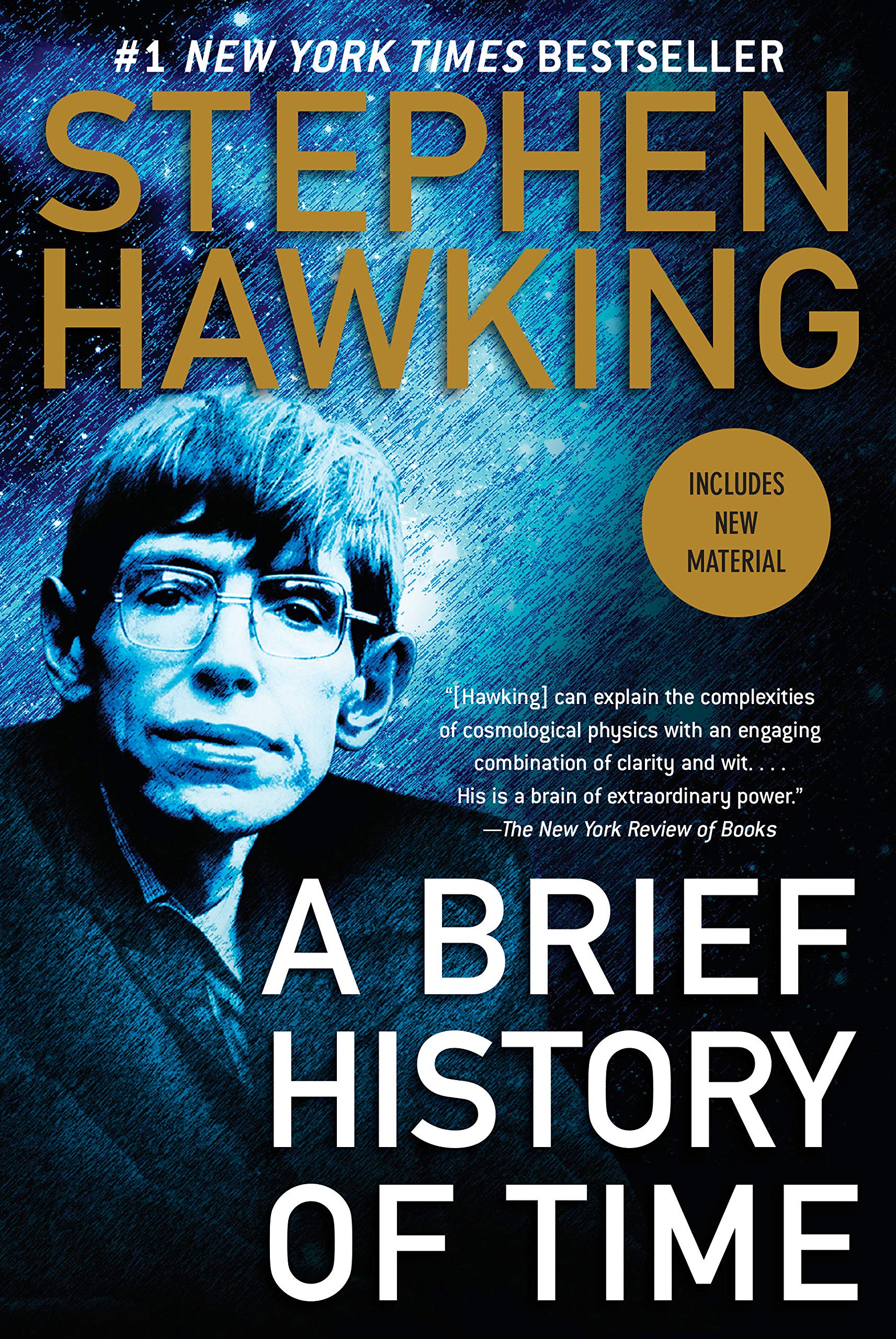
A Brief History of Time: Chapters 6–8
In this groundbreaking book, renowned physicist Stephen Hawking attempts to answer some of the most formidable questions about the universe.
Here are links to our lists for the book: Foreword–Chapter 2, Chapters 3–5, Chapters 6–8, Chapters 9–12, Einstein–Newton
15 words
120 learners
Learn words with Flashcards and other activities
Definition First

Other learning activities
Full list of words from this list:
-
coalesce
fuse or cause to come togetherEventually, the gas will be so hot that when the hydrogen atoms collide they no longer bounce off each other, but instead coalesce to form helium.
-
horizon
the range of interest or activity that can be anticipatedThis region is what we now call a black hole. Its boundary is called the event horizon and it coincides with the paths of light rays that just fail to escape from the black hole.
-
stationary
standing stillFor example, the movement of the earth in its orbit round the sun produces gravitational waves. The effect of the energy loss will be to change the orbit of the earth so that gradually it gets nearer and nearer to the sun, eventually collides with it, and settles down to a stationary state.
-
spherical
having the shape of a ballAccording to this view, any non-rotating star, however complicated its shape and internal structure, would end up after gravitational collapse as a perfectly spherical black hole, whose size would depend only on its mass.
-
entropy
a numerical measure of the uncertainty of an outcomeThe nondecreasing behavior of a black hole’s area was very reminiscent of the behavior of a physical quantity called entropy, which measures the degree of disorder of a system.
-
epithet
descriptive word or phraseSuch holes hardly deserve the epithet black: they really are white hot and are emitting energy at a rate of about ten thousand megawatts.
-
primordial
having existed from the beginningIf the early universe had been chaotic or irregular, or if the pressure of matter had been low, one would have expected it to produce many more primordial black holes than the limit already set by our observations of the gamma ray background. Only if the early universe was very smooth and uniform, with a high pressure, can one explain the absence of observable numbers of primordial black holes.
-
radiation
the emission of a stream of particles in nuclear decayIn such models one finds that as the universe expands, any matter or radiation in it gets cooler.
-
element
a substance that cannot be separated into simpler substancesSome of the heavier elements produced near the end of the star’s life would be flung back into the gas in the galaxy, and would provide some of the raw material for the next generation of stars.
-
primitive
characteristic of an earlier ancestral typeThe first primitive forms of life consumed various materials, including hydrogen sulfide, and released oxygen.
-
chaotic
completely unordered and unpredictable and confusingUnder chaotic boundary conditions, the probability of finding any particular region of space in any given configuration just after the big bang is the same, in some sense, as the probability of finding it in any other configuration: the initial state of the universe is chosen purely randomly.
-
cosmology
the study of the evolution and structure of the universeWe have developed from the geocentric cosmologies of Ptolemy and his forebears, through the heliocentric cosmology of Copernicus and Galileo, to the modern picture in which the earth is a medium-sized planet orbiting around an average star in the outer suburbs of an ordinary spiral galaxy, which is itself only one of about a million million galaxies in the observable universe.
-
expend
use up or consume fullyTwo pieces of matter that are close to each other have less energy than the same two pieces a long way apart, because you have to expend energy to separate them against the gravitational force that is pulling them together.
-
configuration
an arrangement of parts or elementsThis work on inflationary models showed that the present state of the universe could have arisen from quite a large number of different initial configurations.
-
negligible
so small as to be meaningless; insignificantUnder the “no boundary” proposal one learns that the chance of the universe being found to be following most of the possible histories is negligible, but there is a particular family of histories that are much more probable than the others.
Created on Tue Jun 14 09:32:38 EDT 2016
(updated Thu Jul 31 13:46:32 EDT 2025)
Sign up now (it’s free!)
Whether you’re a teacher or a learner,
Vocabulary.com can put you or your class
on the path to systematic vocabulary improvement.