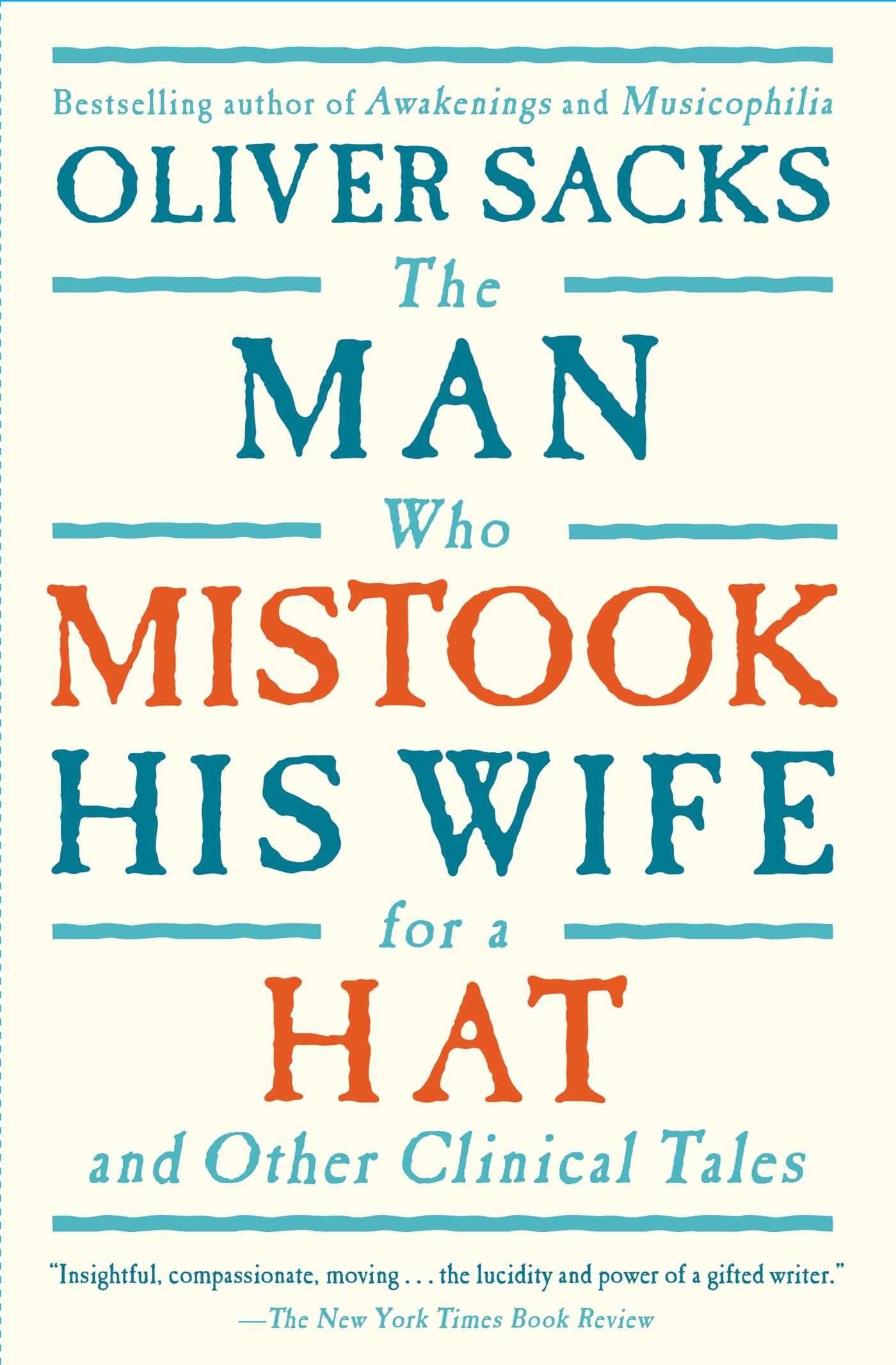
The Man Who Mistook His Wife for a Hat: “The Man Who Mistook His Wife for a Hat”
In this classic collection of "clinical tales," neurologist Oliver Sacks explores a range of neurological conditions and phenomena.
Here are links to our lists for the collection: Part One Introduction; The Man Who Mistook His Wife for a Hat; The Lost Mariner; The Disembodied Lady; The Man Who Fell out of Bed; Hands; Phantoms; On the Level; Eyes Right!; The President's Speech; Part Two Introduction; Witty Ticcy Ray; Cupid's Disease; A Matter of Identity; Yes, Father-Sister; The Possessed; Part Three Introduction; Reminiscence; Incontinent Nostalgia; A Passage to India; The Dog Beneath the Skin; Murder; The Visions of Hildegard; Part Four Introduction; Rebecca; A Walking Grove; The Twins; The Autist Artist
40 words
70 learners
Learn words with Flashcards and other activities
Definition First

Other learning activities
Full list of words from this list:
-
genial
diffusing warmth and friendlinessFor not only did Dr P. increasingly fail to see faces, but he saw faces when there were no faces to see: genially, Magoo-like, when in the street he might pat the heads of water hydrants and parking meters, taking these to be the heads of children; he would amiably address carved knobs on the furniture and be astounded when they did not reply.
-
amiably
in a friendly mannerFor not only did Dr P. increasingly fail to see faces, but he saw faces when there were no faces to see: genially, Magoo-like, when in the street he might pat the heads of water hydrants and parking meters, taking these to be the heads of children; he would amiably address carved knobs on the furniture and be astounded when they did not reply.
-
betoken
be a signal for or a symptom ofHis musical powers were as dazzling as ever; he did not feel ill—he had never felt better; and the mistakes were so ludicrous—and so ingenious—that they could hardly be serious or betoken anything serious.
-
disquiet
a feeling of mild anxiety about possible developmentsI stilled my disquiet, his perhaps, too, in the soothing routine of a neurological exam—muscle strength, coordination, reflexes, tone.
-
sotto voce
in an undertone‘Ach,’ he said, ‘I had forgotten the shoe,' adding, sotto voce, ‘The shoe? The shoe?' He seemed baffled.
-
physiognomy
the human faceHe never entered into relation with the picture as a whole—never faced, so to speak, its physiognomy. He had no sense whatever of a landscape or scene.
-
confabulate
unconsciously replace fact with fantasy in one's memoryHe was looking, if it was ‘looking’, right off the cover into mid-air and confabulating nonexistent features, as if the absence of features in the actual picture had driven him to imagine the river and the terrace and the coloured parasols.
-
diffident
showing modest reserveDiffidently, I asked him if he would sing.
-
incisive
demonstrating ability to recognize or draw fine distinctionsOn that wonderful old piano even my playing sounded right, and Dr P. was an aged but infinitely mellow Fischer-Dieskau, combining a perfect ear and voice with the most incisive musical intelligence.
-
torrid
emotionally charged and vigorously energeticWhat was more striking was that he failed to identify the expressions on her face or her partner’s, though in the course of a single torrid scene these passed from sultry yearning through passion, surprise, disgust, and fury to a melting reconciliation.
-
celluloid
artificial as if portrayed in a filmIt was just possible that some of his difficulties were associated with the unreality of a celluloid, Hollywood world; and it occurred to me that he might be more successful in identifying faces from his own life.
-
misgiving
painful expectationOn the walls of the apartment there were photographs of his family, his colleagues, his pupils, himself. I gathered a pile of these together and, with some misgivings, presented them to him.
-
farcical
broadly or extravagantly humorousWhat had been funny, or farcical, in relation to the movie, was tragic in relation to real life. By and large, he recognised nobody: neither his family, nor his colleagues, nor his pupils, nor himself.
-
abstraction
a concept or idea not associated with any specific instanceHe saw nothing as familiar. Visually, he was lost in a world of lifeless abstractions. Indeed, he did not have a real visual world, as he did not have a real visual self.
-
aphasia
inability to use language because of a brain lesionHughlings Jackson, discussing patients with aphasia and left-hemisphere lesions, says they have lost 'abstract’ and 'propositional’ thought—and compares them with dogs (or, rather, he compares dogs to patients with aphasia).
-
construe
make sense of; assign a meaning toIt wasn’t merely that he displayed the same indifference to the visual world as a computer but—even more strikingly—he construed the world as a computer construes it, by means of key features and schematic relationships.
-
indomitable
impossible to subdueBut the saddest difference between them was that Zazetsky, as Luria said, ‘fought to regain his lost faculties with the indomitable tenacity of the damned,’ whereas Dr P. was not fighting, did not know what was lost, did not indeed know that anything was lost.
-
tenacity
persistent determinationBut the saddest difference between them was that Zazetsky, as Luria said, ‘fought to regain his lost faculties with the indomitable tenacity of the damned,’ whereas Dr P. was not fighting, did not know what was lost, did not indeed know that anything was lost.
-
peremptory
not allowing contradiction or refusalSwiftly, fluently, unthinkingly, melodiously, he pulled the plates towards him and took this and that in a great gurgling stream, an edible song of food, until, suddenly, there came an interruption: a loud, peremptory rat-tat-tat at the door.
-
eloquence
powerful and effective languageI have often wondered about Helen Keller’s visual descriptions, whether these, for all their eloquence, are somehow empty as well?
-
tactile
of or relating to or proceeding from the sense of touchOr whether, by the transference of images from the tactile to the visual, or, yet more extraordinarily, from the verbal and the metaphorical to the sensorial and the visual, she achieve a power of visual imagery, even though her visual cortex had never been stimulated, directly, by the eyes?
-
titillate
stimulate or exciteHis wife poured him some coffee: the smell titillated his nose and brought him back to reality.
-
philistine
a person who is uninterested in intellectual pursuitsFinally, in the last paintings, the canvasses became nonsense, or nonsense to me—mere chaotic lines and blotches of paint. I commented on this to Mrs P.
‘Ach, you doctors, you’re such Philistines!’ she exclaimed. -
renounce
turn away from; give up‘Can you not see artistic development—how he renounced the realism of his earlier years, and advanced into abstract, nonrepresentational art?’
-
forbear
refrain from doing‘No, that’s not it,’ I said to myself (but forbore to say it to poor Mrs P.).
-
profound
far-reaching and thoroughgoing in effectHe had indeed moved from realism to nonrepresentation to the abstract, yet this was not the artist, but the pathology, advancing—advancing towards a profound visual agnosia, in which all powers of representation and imagery, all sense of the concrete, all sense of reality, were being destroyed.
-
pathological
caused by or altered by or manifesting diseaseThis wall of paintings was a tragic pathological exhibit, which belonged to neurology, not art.
-
collusion
secret agreementFor there is often a struggle, and sometimes, even more interestingly, a collusion between the powers of pathology and creation.
-
engender
call forthPerhaps, in his cubist period, there might have been both artistic and pathological development, colluding to engender an original form; for as he lost the concrete, so he might have gained in the abstract, developing a greater sensitivity to all the structural elements of line, boundary, contour—an almost Picasso-like power to see, and equally depict, those abstract organisations embedded in, and normally lost in, the concrete.
-
manifest
clearly revealed to the mind or the senses or judgmentHow should one interpret Dr P.’s peculiar inability to interpret, to judge, a glove as a glove? Manifestly, here, he could not make a cognitive judgment, though he was prolific in the production of cognitive hypotheses.
-
prolific
intellectually productiveManifestly, here, he could not make a cognitive judgment, though he was prolific in the production of cognitive hypotheses.
-
implicitly
without ever expressing so clearlyThese explanations, or modes of explanation, are not mutually exclusive—being in different modes they could coexist and both be true. And this is acknowledged, implicitly or explicitly, in classical neurology: implicitly, by Macrae, when he finds the explanation of defective schemata, or defective visual processing and integration, inadequate; explicitly, by Goldstein, when he speaks of ‘abstract attitude’.
-
render
cause to becomeAnd it was precisely this, his absurd abstractness of attitude—absurd because unleavened with anything else—which rendered him incapable of perceiving identity, or particulars, rendered him incapable of judgment.
-
empirical
derived from experiment and observation rather than theoryAnd yet, whether in a philosophic sense (Kant’s sense), or an empirical and evolutionary sense, judgment is the most important faculty we have.
-
apprehension
the cognitive condition of someone who understandsAnd, by the same token, if we delete feeling and judging, the personal, from the cognitive sciences, we reduce them to something as defective as Dr P.—and we reduce our apprehension of the concrete and real.
-
eschew
avoid and stay away from deliberatelyDr P. may therefore serve as a warning and parable—of what happens to a science which eschews the judgmental, the particular, the personal, and becomes entirely abstract and computational.
-
convalescent
returning to health after illness or debilityIn the early convalescent phase he frequently, especially when shaving, questioned whether the face gazing at him was really his own, and even though he knew it could physically be none other, on several occasions grimaced or stuck out his tongue “just to make sure.”
-
topography
the configuration of a surface and its features‘His topographical memory was strange: the seeming paradox existed that he could find his way from home to hospital and around the hospital, but yet could not name streets en route [unlike Dr P., he also had some aphasia] or appear to visualize the topography.’
-
mannerism
a behavioral attribute that is distinctive to an individualIt was also evident that visual memories of people, even from long before the accident, were severely impaired—there was memory of conduct, or perhaps a mannerism, but not of visual appearance or face.
-
conspicuous
obvious to the eye or mindWhere Dr P. might mistake his wife for a hat, Macrae’s patient, also unable to recognise his wife, needed her to identify herself by a visual marker, by ‘...a conspicuous article of clothing, such as a large hat’.
Created on Tue Sep 01 11:28:36 EDT 2020
(updated Wed Oct 28 11:32:18 EDT 2020)
Sign up now (it’s free!)
Whether you’re a teacher or a learner,
Vocabulary.com can put you or your class
on the path to systematic vocabulary improvement.