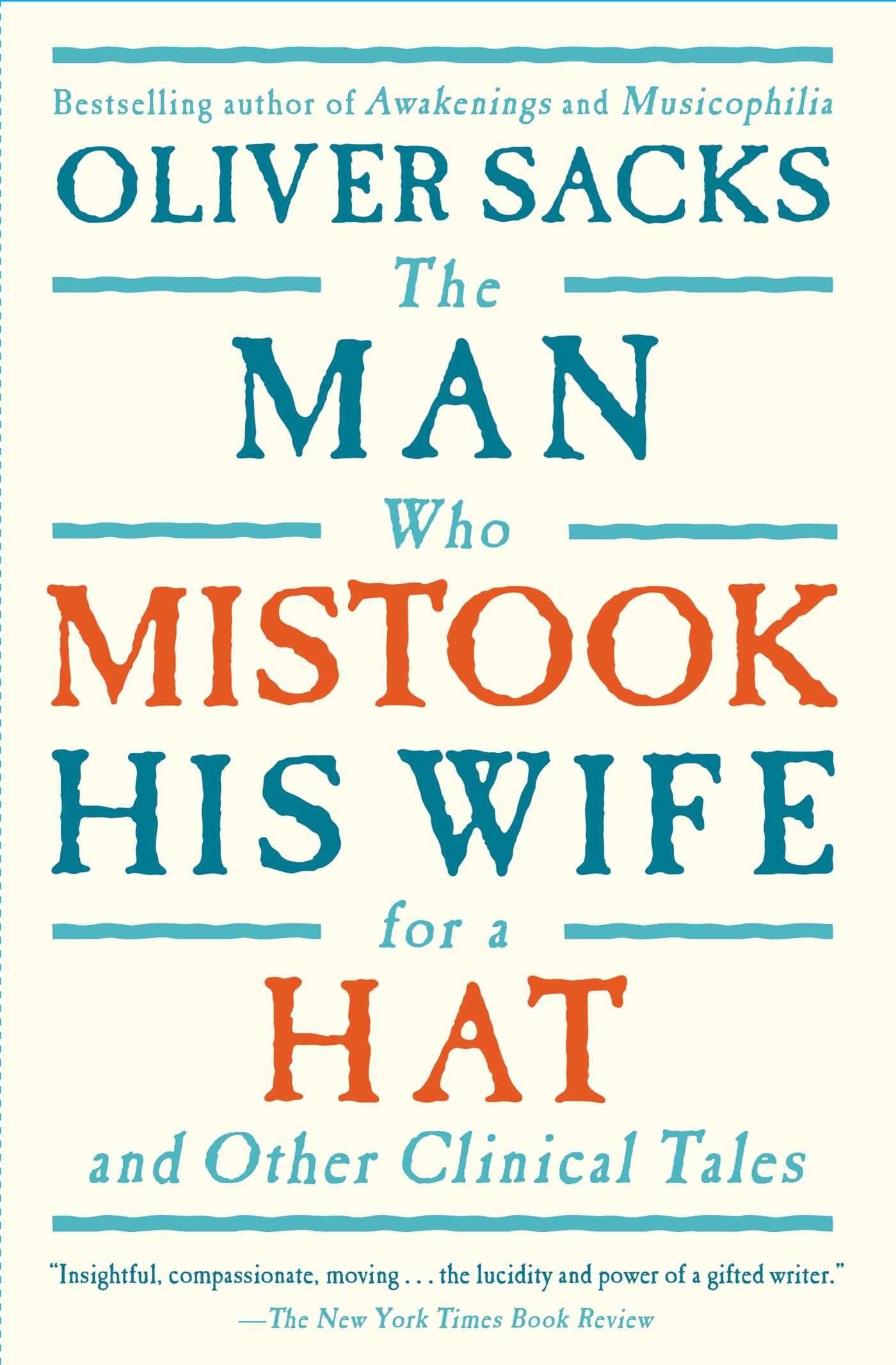
The Man Who Mistook His Wife for a Hat: "Witty Ticcy Ray"
In this classic collection of "clinical tales," neurologist Oliver Sacks explores a range of neurological conditions and phenomena.
Here are links to our lists for the collection: Part One Introduction; The Man Who Mistook His Wife for a Hat; The Lost Mariner; The Disembodied Lady; The Man Who Fell out of Bed; Hands; Phantoms; On the Level; Eyes Right!; The President's Speech; Part Two Introduction; Witty Ticcy Ray; Cupid's Disease; A Matter of Identity; Yes, Father-Sister; The Possessed; Part Three Introduction; Reminiscence; Incontinent Nostalgia; A Passage to India; The Dog Beneath the Skin; Murder; The Visions of Hildegard; Part Four Introduction; Rebecca; A Walking Grove; The Twins; The Autist Artist
35 words
4 learners
Learn words with Flashcards and other activities
Definition First

Other learning activities
Full list of words from this list:
-
antic
ludicrously odd‘Tourette's syndrome', as it was immediately dubbed, is characterised by an excess of nervous energy, and a great production and extravagance of strange motions and notions: tics, jerks, mannerisms, grimaces, noises, curses, involuntary imitations and compulsions of all sorts, with an odd elfin humour and a tendency to antic and outlandish kinds of play.
-
affective
characterized by emotionIn its ‘highest' forms, Tourette's syndrome involves every aspect of the affective, the instinctual and the imaginative life; in its ‘lower', and perhaps commoner, forms, there may be little more than abnormal movements and impulsivity, though even here there is an element of strangeness.
-
commodious
large and roomyEqually, it was clear that some people could ‘take' Tourette's, and accommodate it within a commodious personality, even gaining advantage from the swiftness of thought and association and invention which went with it, while others might indeed be 'possessed' and scarcely able to achieve real identity amid the tremendous pressure and chaos of Tourettic impulses.
-
stupor
a state of being half-awakeFirst they were ‘awakened' from stupor to health: then they were driven towards the other pole—of tics and frenzy.
-
whimsical
indulging in or influenced by the imaginationAt this point I conceived a whimsical fantasy or private joke: suppose (I said to myself) that Tourette’s is very common but fails to be recognised but once recognised is easily and constantly seen.
-
aggregation
the act of gathering something togetherCould there not come together, by such spontaneous aggregation, a whole association of New Yorkers with Tourette’s?
-
plight
a situation from which extrication is difficultThe association has been endlessly resourceful in its attempts to make known (or, in the best sense, 'publicise') the Touretter's plight.
-
repugnance
intense aversionIt has aroused responsible interest and concern in place of the repugnance, or dismissal, which had so often been the Touretter's lot, and it has encouraged research of all kinds, from the physiological to the sociological: research into the biochemistry of the Tourettic brain; on genetic and other factors which may co-determine Tourette's; on the abnormally rapid and indiscriminate associations and reactions which characterise it.
-
indiscriminate
failing to make or recognize distinctionsIt has aroused responsible interest and concern in place of the repugnance, or dismissal, which had so often been the Touretter's lot, and it has encouraged research of all kinds, from the physiological to the sociological: research into the biochemistry of the Tourettic brain; on genetic and other factors which may co-determine Tourette's; on the abnormally rapid and indiscriminate associations and reactions which characterise it.
-
unprecedented
novel; having no earlier occurrenceThe TSA's remarkably successful endeavours are an integral part of the history of Tourette's, and, as such, unprecedented: never before have patients led the way to understanding, become the active and enterprising agents of their own comprehension and cure.
-
aegis
kindly endorsement and guidanceWhat has emerged in these last ten years—largely under the aegis and stimulus of the TSA—is a clear confirmation of Gilles de la Tourette's intuition that this syndrome indeed has an organic neurological basis.
-
basal
serving as or forming a bottom layerIn chorea—which is a chaos of fragmentary quasi-actions—the disorder lies in higher levels of the basal ganglia.
-
ganglion
an encapsulated collection of nerve cell bodiesIn chorea—which is a chaos of fragmentary quasi-actions—the disorder lies in higher levels of the basal ganglia.
-
surfeit
the state of being more than fullOn the other hand, there is not just a surfeit of dopamine in the Touretter’s brain, as there is not just a deficiency of it in the Parkinsonian brain.
-
complementary
serving to fill out, enhance, or supply what is lackingComplementary to any purely medicinal, or medical, approach there must also be an ‘existential’ approach: in particular, a sensitive understanding of action, art and play as being in essence healthy and free, and thus antagonistic to crude drives and impulsions, to ‘the blind force of the subcortex’ from which these patients suffer.
-
pugnacity
a natural disposition to be hostileSince leaving college, however, he had been fired from a dozen jobs—always because of tics, never for incompetence—was continually in crises of one sort and another, usually caused by his impatience, his pugnacity, and his coarse, brilliant chutzpah...
-
virtuosity
great technical skill, fluency, or styleHe was (like many Touretters) remarkably musical, and could scarcely have survived—emotionally or economically—had he not been a weekend jazz drummer of real virtuosity, famous for his sudden and wild extemporisations, which would arise from a tic or a compulsive hitting of a drum and would instantly be made the nucleus of a wild and wonderful improvisation, so that the 'sudden intruder' would be turned to brilliant advantage.
-
frivolous
not serious in content, attitude, or behaviorHis Tourette's was also of advantage in various games, especially ping-pong, at which he excelled, partly in consequence of his abnormal quickness of reflex and reaction, but especially, again, because of 'improvisations', 'very sudden, nervous, frivolous shots' (in his own words), which were so unexpected and startling as to be virtually unanswerable.
-
quiescence
calm and inactive restfulnessThe only time he was free from tics was in post-coital quiescence or in sleep; or when he swam or sang or worked, evenly and rhythmically, and found 'a kinetic melody', a play, which was tension-free, tic-free and free.
-
ebullient
joyously unrestrainedUnder an ebullient, eruptive, clownish surface, he was a deeply serious man—and a man in despair.
-
catatonic
characterized by unresponsiveness or lack of movementFurther, many of his tics, far from disappearing, had simply become slow, and enormously extended: he might get ‘transfixed in mid-tic’, as he put it, and find himself in almost catatonic postures (Ferenczi once called catatonia the opposite of tics—and suggested these be called ‘cataclonia’).
-
inauspicious
contrary to your interests or welfareHe presented a picture, even on this minute dose, of marked Parkinsonism, dystonia, catatonia and psychomotor ‘block’: in reaction which seemed inauspicious in the extreme, suggesting, not insensitivity, but such over-sensitivity, such pathological sensitivity, that perhaps he could only be thrown from one extreme to another—from acceleration and Tourettism to catatonia and Parkinsonism, with no possibility of any happy medium.
-
witticism
a message whose ingenuity has the power to evoke laughterHe seemed, at least jokingly, to have little sense of his identity except as a ticqueur: he called himself ‘the ticcer of President’s Broadway’, and spoke of himself, in the third person, as ‘witty ticcy Ray’, adding that he was so prone to ‘ticcy witticisms and witty ticcicisms’ that he scarcely knew whether it was a gift or a curse.
-
inordinate
beyond normal limitsI was strongly reminded, at this point, of what I had encountered in some of my post-encephalitic patients, who were inordinately sensitive to L-Dopa.
-
poise
a state of being balanced in a stable equilibriumI had nevertheless observed in their case that such extreme physiological sensitivities and instabilities might be transcended if it were possible for the patient to lead a rich and full life: that the ‘existential’ balance, or poise, of such a life might overcome a severe physiological imbalance.
-
incorrigible
impervious to correction by punishmentFeeling that Ray also had such possibilities in him, that, despite his own words, he was not incorrigibly centred on his own disease, in an exhibitionistic or narcissistic way, I suggested that we meet weekly for a period of three months.
-
perverse
deviating from what is considered moral or right or properDuring this time we would try to imagine life without Tourette’s; we would explore (if only in thought and feeling) how much life could offer, could offer him, without the perverse attractions and attentions of Tourette’s; we would examine the role and economic importance of Tourette’s to him, and how he might get on without these.
-
relinquish
turn away from; give upIts initial effects were close to catastrophic: partly, no doubt, on a physiological basis; but also because any ‘cure’, or relinquishing of Tourette’s, at this time would have been premature and economically impossible.
-
impetuous
characterized by undue haste and lack of thoughtHe is slow and deliberate in his movements and judgments, with none of the impatience, the impetuosity, he showed before Haldol, but equally, none of the wild improvisations and inspirations.
-
repartee
adroitness and cleverness in replyHe is less sharp, less quick in repartee, no longer bubbling with witty tics or ticcy wit.
-
chutzpah
unbelievable gall; insolence; audacityHe has lost his obscenities, his coarse chutzpah, his spunk.
-
levity
a manner lacking seriousnessYou ‘normals’, who have the right transmitters in the right places at the right times in your brains, have all feelings, all styles, available all the time—gravity, levity, whatever is appropriate.
-
artifice
the use of deception or trickeryRay does make the best of it, and has a full life, despite Tourette’s, despite Haldol, despite the ‘unfreedom’ and the ‘artifice’, despite being deprived of that birthright of natural freedom which most of us enjoy.
-
vicissitude
a variation in circumstances or fortuneParadoxically, Ray—deprived of natural, animal physiological health—has found a new health, a new freedom, through the vicissitudes he is subject to.
-
resilience
the ability to recover readily from adversity or changeHe has achieved what Nietzsche liked to call ‘The Great Health’—rare humour, valour, and resilience of spirit: despite being, or because he is, afflicted with Tourette’s.
Created on Tue Sep 01 16:39:21 EDT 2020
(updated Wed Oct 28 13:09:31 EDT 2020)
Sign up now (it’s free!)
Whether you’re a teacher or a learner,
Vocabulary.com can put you or your class
on the path to systematic vocabulary improvement.