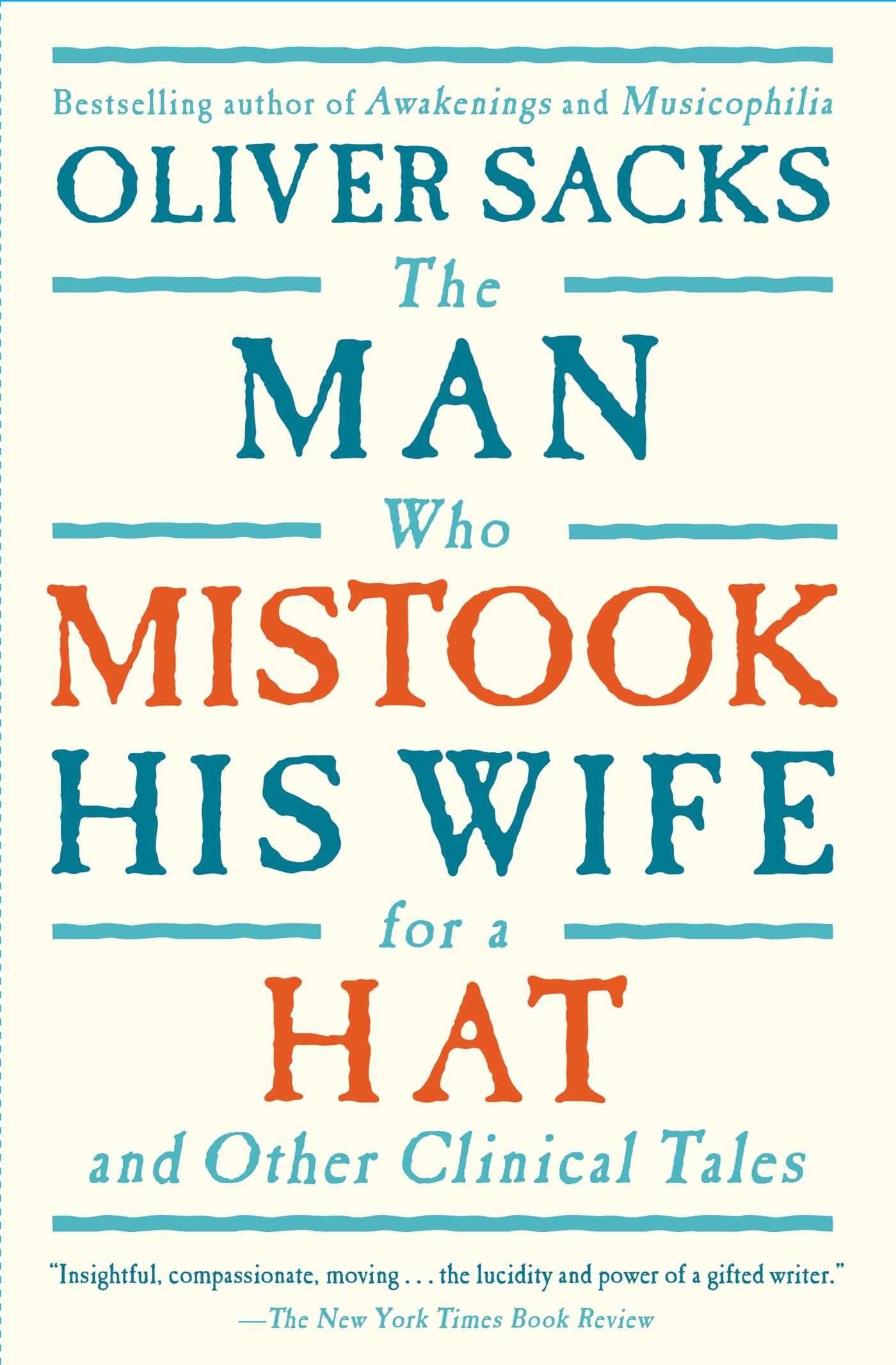
The Man Who Mistook His Wife for a Hat: Introduction to Part One
In this classic collection of "clinical tales," neurologist Oliver Sacks explores a range of neurological conditions and phenomena.
Here are links to our lists for the collection: Part One Introduction; The Man Who Mistook His Wife for a Hat; The Lost Mariner; The Disembodied Lady; The Man Who Fell out of Bed; Hands; Phantoms; On the Level; Eyes Right!; The President's Speech; Part Two Introduction; Witty Ticcy Ray; Cupid's Disease; A Matter of Identity; Yes, Father-Sister; The Possessed; Part Three Introduction; Reminiscence; Incontinent Nostalgia; A Passage to India; The Dog Beneath the Skin; Murder; The Visions of Hildegard; Part Four Introduction; Rebecca; A Walking Grove; The Twins; The Autist Artist
20 words
147 learners
Learn words with Flashcards and other activities
Definition First

Other learning activities
Full list of words from this list:
-
deficit
a failure in neurological or mental functioningNeurology’s favourite word is 'deficit’, denoting an impairment or incapacity of neurological function: loss of speech, loss of language, loss of memory, loss of vision, loss of dexterity, loss of identity and myriad other lacks and losses of specific functions (or faculties).
-
faculty
an inherent cognitive or perceptual power of the mindNeurology’s favourite word is 'deficit’, denoting an impairment or incapacity of neurological function: loss of speech, loss of language, loss of memory, loss of vision, loss of dexterity, loss of identity and myriad other lacks and losses of specific functions (or faculties).
-
ataxia
inability to coordinate voluntary muscle movementsFor all of these dysfunctions (another favourite term), we have privative words of every sort—Aphonia, Aphemia, Aphasia, Alexia, Apraxia, Agnosia, Amnesia, Ataxia—a word for every specific neural or mental function of which patients, through disease, or injury, or failure to develop, may find themselves partly or wholly deprived.
-
aphasia
inability to use language because of a brain lesionThe scientific study of the relationship between brain and mind began in 1861, when Broca, in France, found that specific difficulties in the expressive use of speech, aphasia, consistently followed damage to a particular portion of the left hemisphere of the brain.
-
cerebral
of or relating to the brainThis opened the way to a cerebral neurology, which made it possible, over the decades, to ‘map’ the human brain, ascribing specific powers—linguistic, intellectual, perceptual, etc.—to equally specific ‘centres’ in the brain.
-
physiological
relating to the study of the functioning of organismsToward the end of the century it became evident to more acute observers—above all to Freud, in his book Aphasia—that this sort of mapping was too simple, that all mental performances had an intricate internal structure, and must have an equally complex physiological basis.
-
envisage
form a mental image of something that is not presentThe new science of brain/mind which Freud envisaged came into being in the Second World War, in Russia, as the joint creation of A. R. Luria (and his father, R. A. Luria), Leontev, Anokhin, Bernstein and others, and was called by them ‘neuropsychology.’
-
appertain
be a part or attribute ofHigher Cortical Functions in Man treated only those functions which appertained to the left hemisphere of the brain; similarly, Zazetsky, subject of The Man with a Shattered World, had a huge lesion in the left hemisphere—the right was intact.
-
neurology
the branch of medicine that deals with the nervous systemIndeed, the entire history of neurology and neuropsychology can be seen as a history of the investigation of the left hemisphere.
-
lesion
any localized abnormal structural change in a bodily partOne important reason for the neglect of the right, or ‘minor', hemisphere, as it has always been called, is that while it is easy to demonstrate the effects of variously located lesions on the left side, the corresponding syndromes of the right hemisphere are much less distinct.
-
hominid
relating to a family of primate mammals that includes humansAnd in a sense this is correct: the left hemisphere is more sophisticated and specialised, a very late outgrowth of the primate, and especially the hominid, brain.
-
schematic
diagram of an electrical or mechanical systemThe left hemisphere, like a computer tacked onto the basic creatural brain, is designed for programs and schematics; and classical neurology was more concerned with schematics than with reality, so that when, at last, some of the right-hemisphere syndromes emerged, they were considered bizarre.
-
syndrome
a pattern of symptoms indicative of some diseaseAlthough right-hemisphere syndromes are as common as left-hemisphere syndromes—why should they not be?—we will find a thousand descriptions of left-hemisphere syndromes in the neurological and neuropsychological literature for every description of a right-hemisphere syndrome.
-
complement
either of two parts that create a wholeLuria thought a science of this kind would be best introduced by a story—a detailed case-history of a man with a profound right-hemisphere disturbance, a case-history which would at once be the complement and opposite of ‘the man with a shattered world.’
-
compensate
adjust forBut it must be said from the outset that a disease is never a mere loss or excess—that there is always a reaction, on the part of the affected organism or individual, to restore, to replace, to compensate for and to preserve its identity, however strange the means may be: and to study or influence these means, no less than the primary insult to the nervous system, is an essential part of our role as physicians.
-
adverse
contrary to your interests or welfareThe physician is concerned not, like the naturalist, with a wide range of different organisms theoretically adapted in an average way to an average environment, but with a single organism, the human subject, striving to preserve its identity in adverse circumstances.
-
restitution
the act of restoring something to its original stateThus, the delusions of paranoia were seen by him not as primary but as attempts (however misguided) at restitution, at reconstructing a world reduced by complete chaos.
-
pathological
caused by or altered by or manifesting diseaseThe pathological physiology of the Parkinsonian syndrome is the study of an organised chaos, a chaos induced in the first instance by destruction of important integrations, and reorganised on an unstable basis in the process of rehabilitation.
-
axiom
a proposition that is not susceptible of proof or disproofSuch cases constitute a radical challenge to one of the most entrenched axioms or assumptions of classical neurology in particular, the notion that brain damage, any brain damage, reduces or removes the 'abstract and categorical attitude’ (in Kurt Goldstein’s term), reducing the individual to the emotional and concrete.
-
categorical
relating to or included in a class or classesHere, in the case of Dr P., we see the very opposite of this—a man who has (albeit only in the sphere of the visual) wholly lost the emotional, the concrete, the personal, the ‘real’...and been reduced, as it were, to the abstract and the categorical, with consequences of a particularly preposterous kind.
Created on Tue Sep 01 10:56:55 EDT 2020
(updated Wed Oct 28 10:55:19 EDT 2020)
Sign up now (it’s free!)
Whether you’re a teacher or a learner,
Vocabulary.com can put you or your class
on the path to systematic vocabulary improvement.