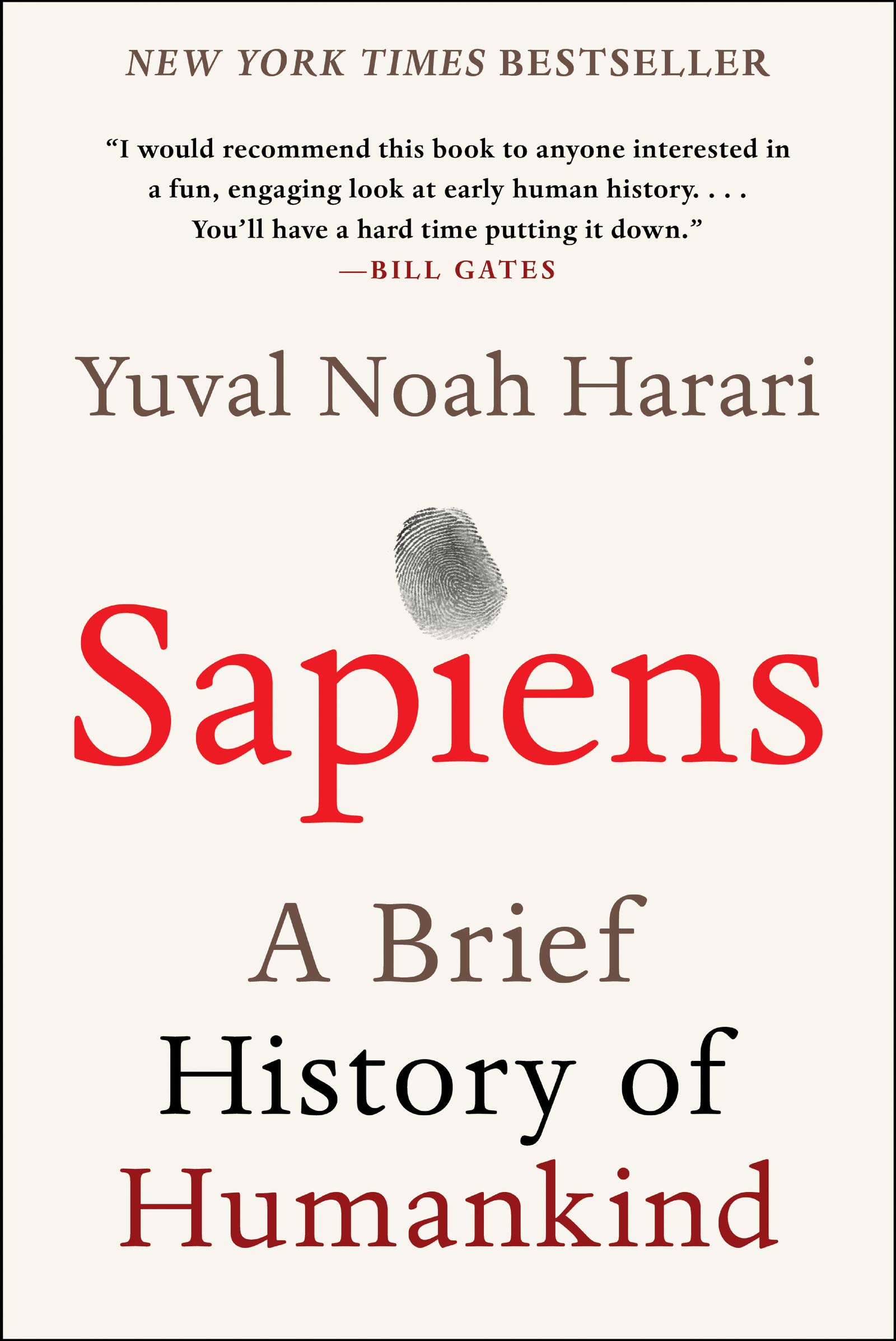
Sapiens: Chapters 12–13
Drawing on both historical and scientific research, this book traces the evolution of human beings over tens of thousands of years.
Here are links to our lists for the nonfiction text: Chapters 1–2, Chapters 3–4, Chapters 5–6, Chapters 7–8, Chapters 9–11, Chapters 12–13, Chapters 14–16, Chapter 17–Afterword
40 words
151 learners
Learn words with Flashcards and other activities
Definition First

Other learning activities
Full list of words from this list:
-
steppe
an extensive plain without treesIn the medieval market in Samarkand, a city built on a Central Asian oasis, Syrian merchants ran their hands over fine Chinese silks, fierce tribesmen from the steppes displayed the latest batch of straw-haired slaves from the far west, and shopkeepers pocketed shiny gold coins imprinted with exotic scripts and the profiles of unfamiliar kings.
-
caprice
a sudden desireReligions assert that our laws are not the result of human caprice, but are ordained by an absolute and supreme authority.
-
actuate
put in motionDespite their ability to legitimise widespread social and political orders, not all religions have actuated this potential.
-
aegis
kindly endorsement and guidanceIn order to unite under its aegis a large expanse of territory inhabited by disparate groups of human beings, a religion must possess two further qualities.
-
disparate
fundamentally different or distinct in quality or kindIn order to unite under its aegis a large expanse of territory inhabited by disparate groups of human beings, a religion must possess two further qualities.
-
espouse
choose and follow a theory, idea, policy, etc.First, it must espouse a universal superhuman order that is true always and everywhere. Second, it must insist on spreading this belief to everyone. In other words, it must be universal and missionary.
-
fecund
capable of producing offspring or vegetationFor thousands of years after the Agricultural Revolution, religious liturgy consisted mainly of humans sacrificing lambs, wine and cakes to divine powers, who in exchange promised abundant harvests and fecund flocks.
-
deign
do something that one considers to be below one's dignityHumans could appeal to these gods and the gods might, if they received devotions and sacrifices, deign to bring rain, victory and health.
-
thrall
the state of being under the control of another personIn classical Greek polytheism, Zeus, Hera, Apollo and their colleagues were subject to an omnipotent and all-encompassing power—Fate (Moira, Ananke). Nordic gods, too, were in thrall to fate, which doomed them to perish in the cataclysm of Ragnarök (the Twilight of the Gods).
-
ephemeral
lasting a very short timeThus some Hindus, known as Sadhus or Sannyasis, devote their lives to uniting with Atman, thereby achieving enlightenment. They strive to see the world from the viewpoint of this fundamental principle, to realise that from its eternal perspective all mundane desires and fears are meaningless and ephemeral phenomena.
-
morass
a soft wet area of low-lying land that sinks underfootThey are sunk deep in the morass of mundane concerns, where Atman is not much help. For assistance in such matters, Hindus approach the gods with their partial powers.
-
polytheism
belief in multiple godsThe insight of polytheism is conducive to far-reaching religious tolerance.
-
conducive
tending to bring about; being partly responsible forThe insight of polytheism is conducive to far-reaching religious tolerance.
-
efficacy
capacity or power to produce a desired resultSince polytheists believe, on the one hand, in one supreme and completely disinterested power, and on the other hand in many partial and biased powers, there is no difficulty for the devotees of one god to accept the existence and efficacy of other gods.
-
stead
the place properly occupied or served by anotherIn the Aztec Empire, subject peoples were obliged to build temples for Huitzilopochtli, but these temples were built alongside those of local gods, rather than in their stead.
-
faction
a dissenting cliqueWhen the Christians vehemently refused to do so, and went on to reject all attempts at compromise, the Romans reacted by persecuting what they understood to be a politically subversive faction.
-
quid pro quo
something given in exchange for something elseTo enter heaven, believers had to participate in church rituals and do good deeds. Protestants refused to accept this, arguing that this quid pro quo belittles God’s greatness and love.
-
fresco
a mural done with watercolors on wet plasterWhen the pope in Rome heard the news from France, he was so overcome by joy that he organised festive prayers to celebrate the occasion and commissioned Giorgio Vasari to decorate one of the Vatican’s rooms with a fresco of the massacre (the room is currently off-limits to visitors).
-
esoteric
understandable only by an enlightened inner circleThe big breakthrough came with Christianity. This faith began as an esoteric Jewish sect that sought to convince Jews that Jesus of Nazareth was their long-awaited messiah.
-
fanfare
a gaudy outward displayThe monotheist religions expelled the gods through the front door with a lot of fanfare, only to take them back in through the side window.
-
dichotomy
a classification into two opposed parts or subclassesMan, according to this view, serves as a battleground between the good soul and the evil body. From a monotheistic perspective, this is nonsense—why distinguish so sharply between body and soul, or matter and spirit? And why argue that body and matter are evil? After all, everything was created by the same good God. But monotheists could not help but be captivated by dualist dichotomies, precisely because they helped them address the problem of evil.
-
syncretism
the union of different systems of thought or beliefScholars of religion have a name for this simultaneous avowal of different and even contradictory ideas and the combination of rituals and practices taken from different sources. It’s called syncretism. Syncretism might, in fact, be the single great world religion.
-
vagabond
a wanderer with no established residence or means of supportAt the age of twenty-nine Gautama slipped away from his palace in the middle of the night, leaving behind his family and possessions. He travelled as a homeless vagabond throughout northern India, searching for a way out of suffering.
-
encapsulate
put in a short or concise form; reduce in volumeHe encapsulated his teachings in a single law: suffering arises from craving; the only way to be fully liberated from suffering is to be fully liberated from craving; and the only way to be liberated from craving is to train the mind to experience reality as it is.
-
forego
do without or cease to hold or adhere toMoreover, as time went by several Buddhist sects developed pantheons of Buddhas and bodhisattvas. These are human and non-human beings with the capacity to achieve full liberation from suffering but who forego this liberation out of compassion, in order to help the countless beings still trapped in the cycle of misery.
-
semantic
of or relating to meaning or the study of meaningThese creeds do not like to be called religions, and refer to themselves as ideologies. But this is just a semantic exercise.
-
edict
a formal or authoritative proclamationIslam is of course different from Communism, because Islam sees the superhuman order governing the world as the edict of an omnipotent creator god, whereas Soviet Communism did not believe in gods.
-
dialectic
arriving at the truth by the exchange of logical argumentsCommunism had its holidays and festivals, such as the First of May and the anniversary of the October Revolution. It had theologians adept at Marxist dialectics, and every unit in the Soviet army had a chaplain, called a commissar, who monitored the piety of soldiers and officers.
-
recourse
act of turning to for assistanceWithout recourse to eternal souls and a Creator God, it becomes embarrassingly difficult for liberals to explain what is so special about individual Sapiens.
-
postulate
maintain or assertIn particular, genetic research conducted after 1945 has demonstrated that the differences between the various human lineages are far smaller than the Nazis postulated.
-
variegate
make something more diverse and variedAt the beginning of the fourth century AD, the Roman Empire faced a wide horizon of religious possibilities. It could have stuck to its traditional and variegated polytheism.
-
fractious
stubbornly resistant to authority or controlBut its emperor, Constantine, looking back on a fractious century of civil war, seems to have thought that a single religion with a clear doctrine could help unify his ethnically diverse realm.
-
cognizant
having or showing knowledge or understanding or realizationThose who have only a superficial knowledge of a certain period tend to focus only on the possibility that was eventually realised. They offer a just-so story to explain with hindsight why that outcome was inevitable. Those more deeply informed about the period are much more cognisant of the roads not taken.
-
hegemony
the dominance or leadership of one social group over othersWill China continue growing until it becomes the leading superpower? Will the United States lose its hegemony?
-
infallible
incapable of failure or errorIf the current price of oil is $90 a barrel, and the infallible computer program predicts that tomorrow it will be $100, traders will rush to buy oil so that they can profit from the predicted price rise.
-
castigate
censure severelyMany people criticise Sovietologists for failing to predict the 1989 revolutions and castigate Middle East experts for not anticipating the Arab Spring revolutions of 2011.
-
preemptive
designed to prevent an anticipated situation or occurrenceThe pre-emptive measures work. The year comes and goes and, surprise, there is no revolution.
-
unwitting
not aware or knowingEver more scholars see cultures as a kind of mental infection or parasite, with humans as its unwitting host.
-
meme
an amusing image that spreads rapidly through social mediaThis approach is sometimes called memetics. It assumes that, just as organic evolution is based on the replication of organic information units called ‘genes’, so cultural evolution is based on the replication of cultural information units called ‘memes’. Successful cultures are those that excel in reproducing their memes, irrespective of the costs and benefits to their human hosts.
-
propagate
transmit or cause to broaden or spreadPostmodernist thinkers speak about discourses rather than memes as the building blocks of culture. Yet they too see cultures as propagating themselves with little regard for the benefit of humankind.
Created on Mon Dec 23 18:11:23 EST 2019
(updated Fri Jan 31 08:46:48 EST 2020)
Sign up now (it’s free!)
Whether you’re a teacher or a learner,
Vocabulary.com can put you or your class
on the path to systematic vocabulary improvement.