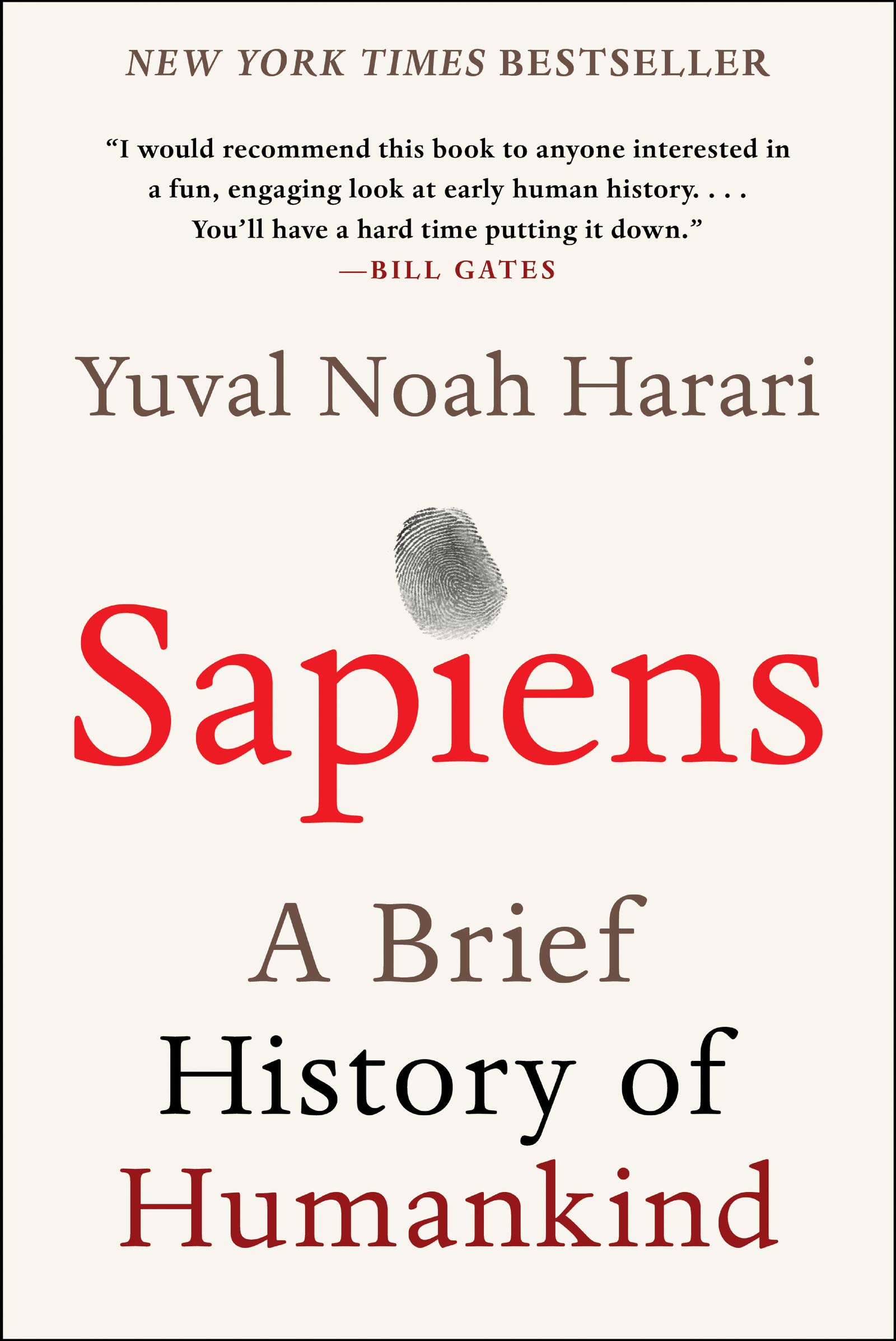
Sapiens: Chapters 9–11
Drawing on both historical and scientific research, this book traces the evolution of human beings over tens of thousands of years.
Here are links to our lists for the nonfiction text: Chapters 1–2, Chapters 3–4, Chapters 5–6, Chapters 7–8, Chapters 9–11, Chapters 12–13, Chapters 14–16, Chapter 17–Afterword
40 words
244 learners
Learn words with Flashcards and other activities
Definition First

Other learning activities
Full list of words from this list:
-
immemorial
long pastAnthropologists, historians and politicians thus referred to ‘Samoan Culture’ or ‘Tasmanian Culture’ as if the same beliefs, norms and values had characterised Samoans and Tasmanians from time immemorial.
-
reconcile
bring into consonance or accordUnlike the laws of physics, which are free of inconsistencies, every man-made order is packed with internal contradictions. Cultures are constantly trying to reconcile these contradictions, and this process fuels change.
-
pensive
deeply or seriously thoughtfulReturning home in a meek and pensive mood, the nobleman would change into his best silks and go to a banquet in his lord’s castle.
-
oscillation
the process of swinging between statesFor 12,000 years, nobody else knew the Tasmanians were there, and they didn’t know that there was anyone else in the world. They had their wars, political struggles, social oscillations and cultural developments.
-
emblazon
decorate, adorn, or inscribe with a designThese square coins made by the Christian conquerors were emblazoned with flowing Arabic script that declared: ‘There is no god except Allah, and Muhammad is Allah’s messenger.’
-
retainer
a person working in the service of anotherLand gets converted into loyalty when a baron sells property to support his retainers.
-
intrinsic
belonging to a thing by its very natureInitially, when the first versions of money were created, people didn’t have this sort of trust, so it was necessary to define as ‘money’ things that had real intrinsic value. History’s first known money—Sumerian barley money—is a good example.
-
besmirch
charge falsely or with malicious intentFor thousands of years, philosophers, thinkers and prophets have besmirched money and called it the root of all evil.
-
apogee
a final climactic stageBe that as it may, money is also the apogee of human tolerance. Money is more open-minded than language, state laws, cultural codes, religious beliefs and social habits.
-
trounce
defeat in a competition, race, or conflictBrutal warriors, religious fanatics and concerned citizens have repeatedly managed to trounce calculating merchants, and even to reshape the economy.
-
paean
a hymn of praiseNumantia later became a symbol of Spanish independence and courage. Miguel de Cervantes, the author of Don Quixote, wrote a tragedy called The Siege of Numantia which ends with the town’s destruction, but also with a vision of Spain’s future greatness. Poets composed paeans to its fierce defenders and painters committed majestic depictions of the siege to canvas.
-
paragon
a perfect embodiment of a conceptThe ancient Numantians are to this day Spain’s paragons of heroism and patriotism, cast as role models for the country’s young people.
-
extol
praise, glorify, or honorYet Spanish patriots extol the Numantians in Spanish—a romance language that is a progeny of Scipio’s Latin. The Numantians spoke a now dead and lost Celtic language.
-
consign
commit foreverMost past cultures have sooner or later fallen prey to the armies of some ruthless empire, which have consigned them to oblivion.
-
polity
a governmentally organized unitThe Athenian Empire at its zenith was much smaller in size and population than today’s Greece. The Aztec Empire was smaller than today’s Mexico. Both were nevertheless empires, whereas modern Greece and modern Mexico are not, because the former gradually subdued dozens and even hundreds of different polities while the latter have not.
-
lexicon
a language user's knowledge of wordsIn our time, ‘imperialist’ ranks second only to ‘fascist’ in the lexicon of political swear words.
-
eviscerate
remove the entrails ofFor example, when the Western Roman Empire finally fell to invading Germanic tribes in 476 AD, the Numantians, Arverni, Helvetians, Samnites, Lusitanians, Umbrians, Etruscans and hundreds of other forgotten peoples whom the Romans conquered centuries earlier did not emerge from the empire’s eviscerated carcass like Jonah from the belly of the great fish. None of them were left.
-
wherewithal
the necessary means (especially financial means)The profits and prosperity brought by Roman imperialism provided Cicero, Seneca and St Augustine with the leisure and wherewithal to think and write; the Taj Mahal could not have been built without the wealth accumulated by Mughal exploitation of their Indian subjects; and the Habsburg Empire’s profits from its rule over its Slavic, Hungarian and Romanian-speaking provinces paid Haydn’s salaries and Mozart’s commissions.
-
posterity
all future generationsNo Caledonian writer preserved Calgacus’ speech for posterity. We know of it thanks to the Roman historian Tacitus.
-
vassal
a person who owes allegiance and service to a feudal lordCyrus, on the other hand, claimed not merely to rule the whole world, but to do so for the sake of all people. ‘We are conquering you for your own benefit,’ said the Persians. Cyrus wanted the peoples he subjected to love him and to count themselves lucky to be Persian vassals.
-
approbation
official acceptance or agreementThe most famous example of Cyrus’ innovative efforts to gain the approbation of a nation living under the thumb of his empire was his command that the Jewish exiles in Babylonia be allowed to return to their Judaean homeland and rebuild their temple.
-
xenophobic
having abnormal fear or hatred of foreignersEvolution has made Homo sapiens, like other social mammals, a xenophobic creature. Sapiens instinctively divide humanity into two parts, ‘we’ and ‘they’.
-
goad
urge with or as if with a prodEvery time an empire collapsed, the dominant political theory goaded the powers that be not to settle for paltry independent principalities, but to attempt reunification.
-
paltry
contemptibly small in amount or sizeEvery time an empire collapsed, the dominant political theory goaded the powers that be not to settle for paltry independent principalities, but to attempt reunification.
-
amalgamate
bring or combine together or with something elseEmpires have played a decisive part in amalgamating many small cultures into fewer big cultures. Ideas, people, goods and technology spread more easily within the borders of an empire than in a politically fragmented region.
-
salient
conspicuous, prominent, or importantThe benefits were sometimes salient—law enforcement, urban planning, standardisation of weights and measures—and sometimes questionable—taxes, conscription, emperor worship.
-
conscription
compulsory military serviceThe benefits were sometimes salient—law enforcement, urban planning, standardisation of weights and measures—and sometimes questionable—taxes, conscription, emperor worship.
-
squalor
sordid dirtinessThe wild Germans and painted Gauls had lived in squalor and ignorance until the Romans tamed them with law, cleaned them up in public bathhouses, and improved them with philosophy.
-
dissemination
the spread of informationThe Mauryan Empire in the third century BC took as its mission the dissemination of Buddha’s teachings to an ignorant world.
-
proletariat
a social class comprising those who do manual laborThe Soviets felt duty-bound to facilitate the inexorable historical march from capitalism towards the utopian dictatorship of the proletariat.
-
penchant
a strong liking or preferenceHe indulges his wife’s penchant for elaborately ornate baubles, but is a bit embarrassed that she, like other local women, retains this relic of Celtic taste—he’d rather have her adopt the clean simplicity of the jewellery worn by the Roman governor’s wife.
-
barrister
a British lawyer who speaks in the higher courts of lawEquipped with his new manners, he travelled to England, studied law at University College London, and became a qualified barrister.
-
scion
a descendent or heirEmperor Septimius Severus (193–211) was the scion of a Punic family from Libya.
-
parvenu
a person who has suddenly risen to a higher economic statusMany of the empire’s subjects gradually adopted the Muslim faith, the Arabic language and a hybrid imperial culture. The old Arab elite looked upon these parvenus with deep hostility, fearing to lose its unique status and identity.
-
welter
a confused multitude of thingsFor more than 2,000 years, a welter of ethnic and cultural groups first termed barbarians were successfully integrated into imperial Chinese culture and became Han Chinese (so named after the Han Empire that ruled China from 206 BC to AD 220).
-
guise
an artful or simulated semblanceDuring the modern era Europeans conquered much of the globe under the guise of spreading a superior Western culture.
-
disingenuous
not straightforward or candidThese ideologies are at best naïve; at worst they serve as disingenuous window-dressing for crude nationalism and bigotry.
-
unadulterated
not mixed with impuritiesPerhaps you could make a case that some of the myriad cultures that emerged at the dawn of recorded history were pure, untouched by sin and unadulterated by other societies. But no culture since that dawn can reasonably make that claim, certainly no culture that exists now on earth.
-
divest
take away possessions from someoneHow many Indians today would want to call a vote to divest themselves of democracy, English, the railway network, the legal system, cricket and tea on the grounds that they are imperial legacies?
-
machination
a crafty and involved plot to achieve your endsStates are increasingly open to the machinations of global markets, to the interference of global companies and NGOs, and to the supervision of global public opinion and the international judicial system.
Created on Mon Dec 23 18:10:56 EST 2019
(updated Thu Jan 30 16:56:04 EST 2020)
Sign up now (it’s free!)
Whether you’re a teacher or a learner,
Vocabulary.com can put you or your class
on the path to systematic vocabulary improvement.