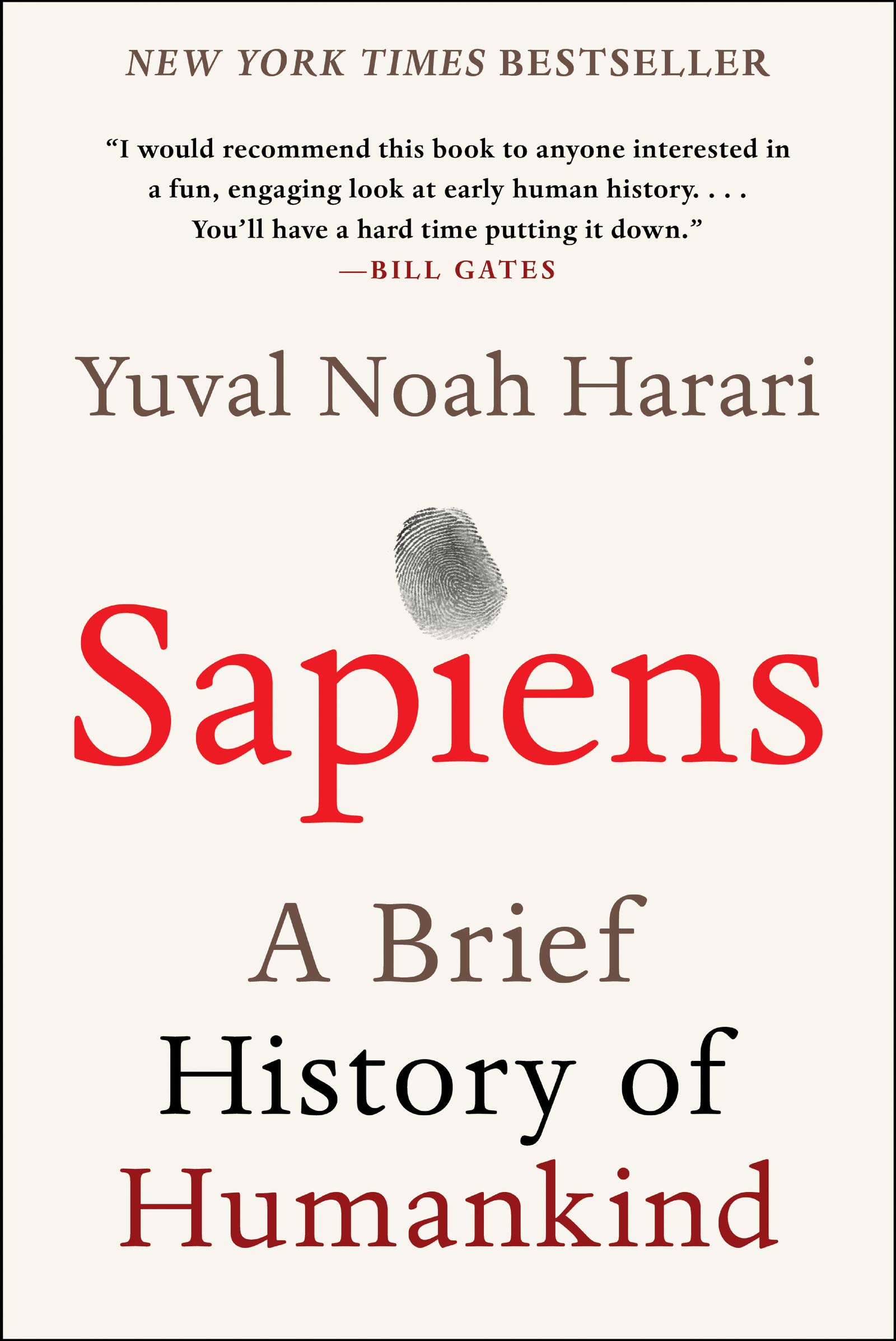
Sapiens: Chapters 5–6
Drawing on both historical and scientific research, this book traces the evolution of human beings over tens of thousands of years.
Here are links to our lists for the nonfiction text: Chapters 1–2, Chapters 3–4, Chapters 5–6, Chapters 7–8, Chapters 9–11, Chapters 12–13, Chapters 14–16, Chapter 17–Afterword
40 words
315 learners
Learn words with Flashcards and other activities
Definition First

Other learning activities
Full list of words from this list:
-
spartan
marked by simplicity, frugality, or self-denialEventually, people were so smart that they were able to decipher nature’s secrets, enabling them to tame sheep and cultivate wheat. As soon as this happened, they cheerfully abandoned the gruelling, dangerous, and often spartan life of hunter-gatherers, settling down to enjoy the pleasant, satiated life of farmers.
-
satiate
fill to satisfactionEventually, people were so smart that they were able to decipher nature’s secrets, enabling them to tame sheep and cultivate wheat. As soon as this happened, they cheerfully abandoned the gruelling, dangerous, and often spartan life of hunter-gatherers, settling down to enjoy the pleasant, satiated life of farmers.
-
herald
foreshadow or presageRather than heralding a new era of easy living, the Agricultural Revolution left farmers with lives generally more difficult and less satisfying than those of foragers.
-
blight
any plant disease resulting in withering without rottingWheat got sick, so Sapiens had to keep a watch out for worms and blight.
-
feasible
capable of being done with means at handWhen a foraging band was hard-pressed by a stronger rival, it could usually move on. It was difficult and dangerous, but it was feasible.
-
winnow
separate the chaff from by using air currentsSince it was impossible to eat wild grains without first winnowing, grinding and cooking them, people who gathered these grains carried them back to their temporary campsites for processing.
-
haphazardly
in a random mannerThey discovered that they could achieve much better results by sowing the grains deep in the ground rather than haphazardly scattering them on the surface.
-
wean
gradually deprive of mother's milkBabies were weaned at an earlier age—they could be fed on porridge and gruel.
-
depredation
a destructive actionThey did not foresee that by increasing their dependence on a single source of food, they were actually exposing themselves even more to the depredations of drought.
-
utilitarian
having a useful functionWhy would a foraging society build such structures? They had no obvious utilitarian purpose.
-
sinew
a band of tissue connecting a muscle to its bony attachmentTransportation, ploughing, grinding and other tasks, hitherto performed by human sinew, were increasingly carried out by animals.
-
boon
something that is desirable, favorable, or beneficialFrom a narrow evolutionary perspective, which measures success by the number of DNA copies, the Agricultural Revolution was a wonderful boon for chickens, cattle, pigs and sheep.
-
draught
the act of moving a load by drawing or pullingEgg-laying hens, dairy cows and draught animals are sometimes allowed to live for many years.
-
subjugation
forced submission to control by othersBut the price is subjugation to a way of life completely alien to their urges and desires.
-
yoke
stable gear that joins two draft animals at the neckIt’s reasonable to assume, for example, that bulls prefer to spend their days wandering over open prairies in the company of other bulls and cows rather than pulling carts and ploughshares under the yoke of a whip-wielding ape.
-
curtail
place restrictions onIn order for humans to turn bulls, horses, donkeys and camels into obedient draught animals, their natural instincts and social ties had to be broken, their aggression and sexuality contained, and their freedom of movement curtailed.
-
ostensible
appearing as such but not necessarily soIn the following chapters we will see time and again how a dramatic increase in the collective power and ostensible success of our species went hand in hand with much individual suffering.
-
partisan
a fervent and even militant proponent of somethingThe Agricultural Revolution is one of the most controversial events in history. Some partisans proclaim that it set humankind on the road to prosperity and progress.
-
perdition
the place or state in which one suffers eternal punishmentOthers insist that it led to perdition. This was the turning point, they say, where Sapiens cast off its intimate symbiosis with nature and sprinted towards greed and alienation.
-
symbiosis
the relation between two interdependent species of organismsOthers insist that it led to perdition. This was the turning point, they say, where Sapiens cast off its intimate symbiosis with nature and sprinted towards greed and alienation.
-
wayward
resistant to guidance or disciplineFarmer families did all they could to keep out wayward weeds and wild animals.
-
interloper
someone who intrudes on the privacy or property of anotherIf such interlopers made their way in, they were driven out. If they persisted, their human antagonists sought ways to exterminate them. Particularly strong defences were erected around the home.
-
furtive
marked by quiet and caution and secrecyFrom the dawn of agriculture until this very day, billions of humans armed with branches, swatters, shoes and poison sprays have waged relentless war against the diligent ants, furtive roaches, adventurous spiders and misguided beetles that constantly infiltrate the human domicile.
-
enclave
an enclosed territory that is culturally distinctFor most of history these man-made enclaves remained very small, surrounded by expanses of untamed nature.
-
pestilence
any epidemic disease with a high death rateSince most villages lived by cultivating a very limited variety of domesticated plants and animals, they were at the mercy of droughts, floods and pestilence.
-
trepidation
a feeling of alarm or dreadMeanwhile, in the valleys of the Euphrates, Indus and Yellow rivers, other peasants monitored, with no less trepidation, the height of the water.
-
frenetic
fast and energetic in an uncontrolled or wild wayThe anxious peasant was as frenetic and hardworking as a harvester ant in the summer, sweating to plant olive trees whose oil would be pressed by his children and grandchildren, putting off until the winter or the following year the eating of the food he craved today.
-
transpire
come about, happen, or occurMyths, it transpired, are stronger than anyone could have imagined. When the Agricultural Revolution opened opportunities for the creation of crowded cities and mighty empires, people invented stories about great gods, motherlands and joint stock companies to provide the needed social links.
-
levy
impose and collectTaxes levied on 40 million Qin subjects paid for a standing army of hundreds of thousands of soldiers and a complex bureaucracy that employed more than 100,000 officials.
-
altruistic
showing unselfish concern for the welfare of others‘Cooperation’ sounds very altruistic, but is not always voluntary and seldom egalitarian. Most human cooperation networks have been geared towards oppression and exploitation.
-
ingrained
deeply rooted; firmly fixed or heldAll these cooperation networks—from the cities of ancient Mesopotamia to the Qin and Roman empires—were ‘imagined orders’. The social norms that sustained them were based neither on ingrained instincts nor on personal acquaintances, but rather on belief in shared myths.
-
paramount
most important or impactfulHammurabi’s Code asserts that Babylonian social order is rooted in universal and eternal principles of justice, dictated by the gods. The principle of hierarchy is of paramount importance.
-
immutable
not subject or susceptible to change or variationHammurabi and the American Founding Fathers alike imagined a reality governed by universal and immutable principles of justice, such as equality or hierarchy.
-
inextricably
in a manner incapable of being disentangled or untiedThe idea of equality is inextricably intertwined with the idea of creation.
-
unalienable
incapable of being repudiated or transferred to anotherBirds fly not because they have a right to fly, but because they have wings. And it’s not true that these organs, abilities and characteristics are ‘unalienable’. Many of them undergo constant mutations, and may well be completely lost over time.
-
inherently
in an essential mannerBear in mind, though, that Hammurabi might have defended his principle of hierarchy using the same logic: ‘I know that superiors, commoners and slaves are not inherently different kinds of people. But if we believe that they are, it will enable us to create a stable and prosperous society.’
-
coercion
the act of compelling by force of authorityIn order to safeguard an imagined order, continuous and strenuous efforts are imperative. Some of these efforts take the shape of violence and coercion.
-
acquiesce
agree or express agreementWhen, in 1860, a majority of American citizens concluded that African slaves are human beings and must therefore enjoy the right of liberty, it took a bloody civil war to make the southern states acquiesce.
-
sumptuous
rich and superior in qualityA wealthy man in ancient Egypt would never have dreamed of solving a relationship crisis by taking his wife on holiday to Babylon. Instead, he might have built for her the sumptuous tomb she had always wanted.
-
dismantle
take apart into its constituent piecesIn order to dismantle Peugeot, for example, we need to imagine something more powerful, such as the French legal system. In order to dismantle the French legal system we need to imagine something even more powerful, such as the French state. And if we would like to dismantle that too, we will have to imagine something yet more powerful.
Created on Mon Dec 23 18:09:17 EST 2019
(updated Thu Jan 30 15:24:44 EST 2020)
Sign up now (it’s free!)
Whether you’re a teacher or a learner,
Vocabulary.com can put you or your class
on the path to systematic vocabulary improvement.