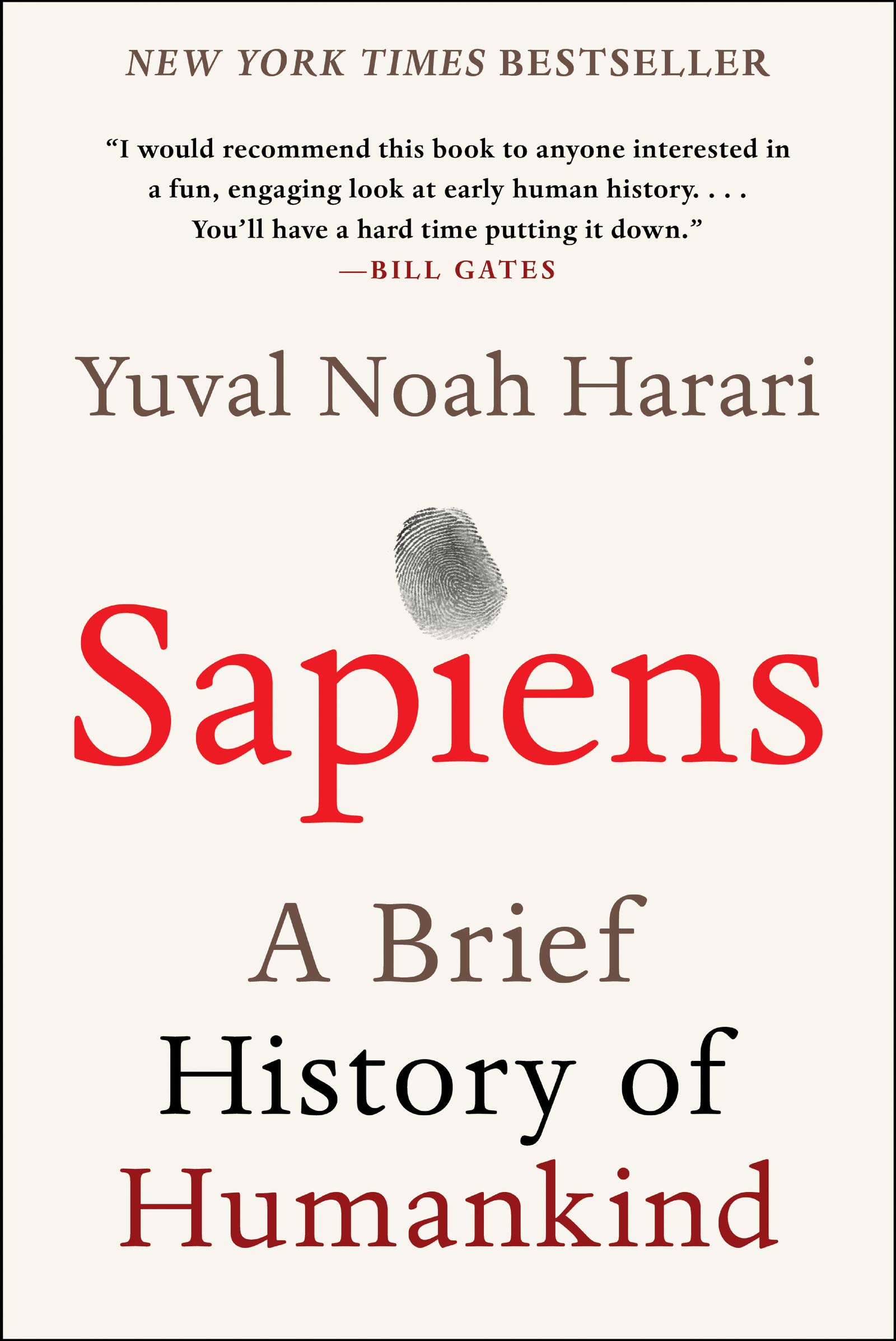
Sapiens: Chapters 1–2
Drawing on both historical and scientific research, this book traces the evolution of human beings over tens of thousands of years.
Here are links to our lists for the nonfiction text: Chapters 1–2, Chapters 3–4, Chapters 5–6, Chapters 7–8, Chapters 9–11, Chapters 12–13, Chapters 14–16, Chapter 17–Afterword
40 words
1964 learners
Learn words with Flashcards and other activities
Definition First

Other learning activities
Full list of words from this list:
-
coalesce
fuse or cause to come togetherAbout 300,000 years after their appearance, matter and energy started to coalesce into complex structures, called atoms, which then combined into molecules.
-
myriad
too numerous to be countedThere were humans long before there was history. Animals much like modern humans first appeared about 2.5 million years ago. But for countless generations they did not stand out from the myriad other organisms with which they shared their habitats.
-
chafe
feel extreme irritation or angerOn a hike in East Africa 2 million years ago, you might well have encountered a familiar cast of human characters: anxious mothers cuddling their babies and clutches of carefree children playing in the mud; temperamental youths chafing against the dictates of society and weary elders who just wanted to be left in peace; chest-thumping machos trying to impress the local beauty and wise old matriarchs who had already seen it all.
-
inkling
a slight suggestion or vague understandingNobody, least of all humans themselves, had any inkling that their descendants would one day walk on the moon, split the atom, fathom the genetic code and write history books.
-
genus
taxonomic group containing one or more speciesSpecies that evolved from a common ancestor are bunched together under the heading ‘genus’ (plural genera). Lions, tigers, leopards and jaguars are different species within the genus Panthera. Biologists label organisms with a two-part Latin name, genus followed by species.
-
banal
repeated too often; overfamiliar through overuseHomo sapiens, too, belongs to a family. This banal fact used to be one of history’s most closely guarded secrets.
-
extant
still in existence; not extinct or destroyed or lostTo clarify this point, I will often use the term ‘Sapiens’ to denote members of the species Homo sapiens, while reserving the term ‘human’ to refer to all extant members of the genus Homo.
-
beget
have childrenIt’s a common fallacy to envision these species as arranged in a straight line of descent, with Ergaster begetting Erectus, Erectus begetting the Neanderthals, and the Neanderthals evolving into us. This linear model gives the mistaken impression that at any particular moment only one type of human inhabited the earth, and that all earlier species were merely older models of ourselves.
-
atrophy
undergo weakening or degeneration as through lack of useArchaic humans paid for their large brains in two ways. Firstly, they spent more time in search of food. Secondly, their muscles atrophied.
-
lofty
of imposing height; especially standing out above othersAdjusting to an upright position was quite a challenge, especially when the scaffolding had to support an extra-large cranium. Humankind paid for its lofty vision and industrious hands with backaches and stiff necks.
-
gait
a person's manner of walkingAn upright gait required narrower hips, constricting the birth canal—and this just when babies’ heads were getting bigger and bigger.
-
supple
capable of moving or bending freelyDeath in childbirth became a major hazard for human females. Women who gave birth earlier, when the infant’s brain and head were still relatively small and supple, fared better and lived to have more children.
-
subsist
support oneselfThus humans who lived a million years ago, despite their big brains and sharp stone tools, dwelt in constant fear of predators, rarely hunted large game, and subsisted mainly by gathering plants, scooping up insects, stalking small animals, and eating the carrion left behind by other more powerful carnivores.
-
niche
status or place of an organism within its environmentOne of the most common uses of early stone tools was to crack open bones in order to get to the marrow. Some researchers believe this was our original niche. Just as woodpeckers specialise in extracting insects from the trunks of trees, the first humans specialised in extracting marrow from bones.
-
tuber
a fleshy underground stem or root, often used as foodA carefully managed fire could turn impassable barren thickets into prime grasslands teeming with game. In addition, once the fire died down, Stone Age entrepreneurs could walk through the smoking remains and harvest charcoaled animals, nuts and tubers.
-
carrion
the dead and rotting body of an animal; unfit for human foodHumans also had a far easier time chewing and digesting old favourites such as fruits, nuts, insects and carrion if they were cooked.
-
advent
arrival that has been awaitedThe advent of cooking enabled humans to eat more kinds of food, to devote less time to eating, and to make do with smaller teeth and shorter intestines.
-
constrain
restrictThe power of almost all animals depends on their bodies: the strength of their muscles, the size of their teeth, the breadth of their wings. Though they may harness winds and currents, they are unable to control these natural forces, and are always constrained by their physical design.
-
infirm
lacking bodily or muscular strength or vitalityThey used tools and fire, were good hunters, and apparently took care of their sick and infirm.
-
epitome
a standard or typical exampleOur lack of brothers and sisters makes it easier to imagine that we are the epitome of creation, and that a chasm separates us from the rest of the animal kingdom.
-
inclement
severe, of weatherAbout 100,000 years ago, some Sapiens groups migrated north to the Levant, which was Neanderthal territory, but failed to secure a firm footing. It might have been due to nasty natives, an inclement climate, or unfamiliar local parasites.
-
hitherto
up to this point; until the present timeAbout 45,000 years ago, they somehow crossed the open sea and landed in Australia—a continent hitherto untouched by humans.
-
stratification
the act of arranging persons into classes or levelsThe first objects that can reliably be called art date from this era, as does the first clear evidence for religion, commerce and social stratification.
-
unprecedented
novel; having no earlier occurrenceMost researchers believe that these unprecedented accomplishments were the product of a revolution in Sapiens’ cognitive abilities.
-
prodigious
great in size, force, extent, or degreeWe can connect a limited number of sounds and signs to produce an infinite number of sentences, each with a distinct meaning. We can thereby ingest, store and communicate a prodigious amount of information about the surrounding world.
-
quark
fundamental subatomic particle that has a fractional chargeDo you think that history professors chat about the reasons for World War One when they meet for lunch, or that nuclear physicists spend their coffee breaks at scientific conferences talking about quarks? Sometimes.
-
kowtow
bend the knees and bow in a servile mannerOther males and females exhibit their submission to the alpha male by bowing before him while making grunting sounds, not unlike human subjects kowtowing before a king.
-
overt
open and observable; not secret or hiddenThe alpha male usually wins his position not because he is physically stronger, but because he leads a large and stable coalition. These coalitions play a central part not only during overt struggles for the alpha position, but in almost all day-to-day activities.
-
incur
make oneself subject toIf he couldn’t cover the debt, he could be thrown in prison by the state or enslaved by his creditors. He was fully liable, without limit, for all obligations incurred by his workshop.
-
destitute
poor enough to need help from othersPeople were afraid to start new businesses and take economic risks. It hardly seemed worth taking the chance that their families could end up utterly destitute.
-
assiduously
with care and persistenceSeeing that the priest had properly and assiduously observed all the procedures, millions of devout French Catholics behaved as if God really existed in the consecrated bread and wine.
-
consecrate
render holy by means of religious ritesSeeing that the priest had properly and assiduously observed all the procedures, millions of devout French Catholics behaved as if God really existed in the consecrated bread and wine.
-
liturgy
a rite or body of rites prescribed for public worshipAccording to the French legislators, if a certified lawyer followed all the proper liturgy and rituals, wrote all the required spells and oaths on a wonderfully decorated piece of paper, and affixed his ornate signature to the bottom of the document, then hocus pocus—a new company was incorporated.
-
charlatan
a flamboyant deceiverSome sorcerers are charlatans, but most sincerely believe in the existence of gods and demons.
-
outstrip
go far ahead ofConsequently, ever since the Cognitive Revolution Homo sapiens has been able to revise its behaviour rapidly in accordance with changing needs. This opened a fast lane of cultural evolution, bypassing the traffic jams of genetic evolution. Speeding down this fast lane, Homo sapiens soon far outstripped all other human and animal species in its ability to cooperate.
-
autocrat
a cruel and oppressive dictatorDNA is not an autocrat. Animal behaviour is also influenced by environmental factors and individual quirks.
-
egalitarian
favoring social equalityFor example, common chimpanzees have a genetic tendency to live in hierarchical groups headed by an alpha male. Members of a closely related chimpanzee species, bonobos, usually live in more egalitarian groups dominated by female alliances.
-
canon
a collection of books accepted as holy scriptureThe Catholic Church has survived for centuries, not by passing on a ‘celibacy gene’ from one pope to the next, but by passing on the stories of the New Testament and of Catholic canon law.
-
pragmatic
concerned with practical mattersTrade may seem a very pragmatic activity, one that needs no fictive basis. Yet the fact is that no animal other than Sapiens engages in trade, and all the Sapiens trade networks about which we have detailed evidence were based on fictions.
-
parameter
any factor defining a system and determining its performanceBiology sets the basic parameters for the behaviour and capacities of Homo sapiens. The whole of history takes place within the bounds of this biological arena.
Created on Mon Dec 23 18:07:32 EST 2019
(updated Thu Jan 30 15:24:30 EST 2020)
Sign up now (it’s free!)
Whether you’re a teacher or a learner,
Vocabulary.com can put you or your class
on the path to systematic vocabulary improvement.