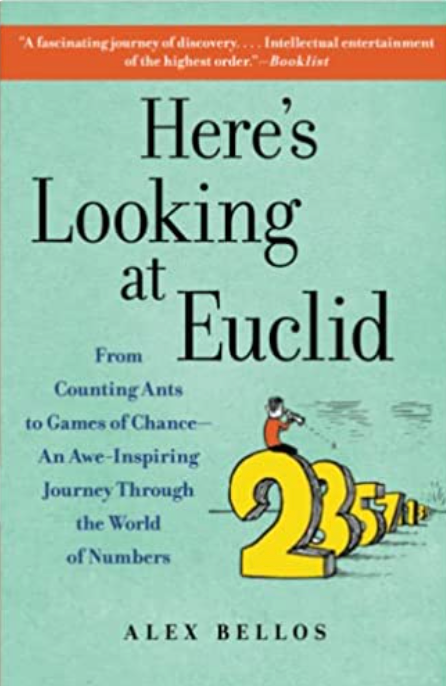
Here's Looking at Euclid: Chapters Zero–One
To illustrate his thesis that math is the foundation of human progress, Alex Bellos details achievements throughout time and cultures.
Here are links to our lists for the book: Chapters Zero–One, Chapters Two–Three, Chapters Four–Five, Chapters Six–Eight, Chapters Nine–Eleven
40 words
132 learners
Learn words with Flashcards and other activities
Definition First

Other learning activities
Full list of words from this list:
-
painstaking
characterized by extreme care and great effortPica is a linguist and, perhaps because of this, speaks slowly and carefully, with painstaking attention to individual words.
-
precarious
fraught with dangerThen he set off down the Trans-Amazon Highway, a 1970s folly of nationalistic infrastructure that has deteriorated into a precarious and often impassable muddy track.
-
demarcate
set, mark, or draw the boundaries of somethingJacareacanga is on the edge of the Munduruku’s demarcated territory.
-
intransigence
stubborn refusal to compromise or changeThe more I pushed Pica for facts and figures, the more reluctant he was to provide them. I became exasperated. It was unclear if underlying his responses was French intransigence, academic pedantry or simply a general contrariness.
-
pedantry
an ostentatious and inappropriate display of learningIt was unclear if underlying his responses was French intransigence, academic pedantry or simply a general contrariness.
-
subsistence
minimal resources for survivalThe Munduruku are only subsistence farmers and money has only recently begun to circulate in their villages, and so they never evolved counting skills.
-
prevalent
most frequent or commonNumbers are so prevalent in our lives that it is hard to imagine how people survive without them.
-
pestilence
any epidemic disease with a high death rateWhen King David counted his own people he was punished with three days of pestilence and 77,000 deaths.
-
malign
evil or harmful in nature or influenceCounting people with numbers is considered a way of singling people out, which makes them more vulnerable to malign influences.
-
logistical
of or relating to the management of an operation or eventIn the rainforest Pica conducts his research using laptops powered by solar-charged batteries. Maintaining the hardware is a logistical nightmare, because of the heat and the damp, although sometimes the trickiest challenge is assembling the participants.
-
stifle
smother or suppressYet maybe in our dependence on linearity we have gone too far in stifling our own logarithmic intuitions. Perhaps, said Pica, this is a reason why so many people find math difficult. Perhaps we should pay more attention to judging ratios rather than manipulating exact numbers.
-
repertoire
the range of skills in a particular field or occupationIn the early 1900s, crowds gathered regularly in a Berlin courtyard to watch Hans's owner, Wilhelm von Osten, a retired math instructor, set the horse simple arithmetical sums. Hans answered by stamping the ground with his hoof the correct number of times. His repertoire included addition and subtraction as well as fractions, square roots and factorization.
-
eminent
standing above others in quality or positionPublic fascination and suspicion that the horse's supposed intelligence was some kind of trick led to an investigation of his abilities by a committee of eminent scientists.
-
mundane
found in the ordinary course of eventsHer mindless gaze, the nonchalant tapping of a flashing, beeping computer and the mundanity of continual reward reminded me of an old lady doing the slots.
-
competence
the quality of being adequately or well qualifiedAi’s competence in both the cardinality and the ordinality tasks meant that Matsuzawa could reasonably say his student had learned to count.
-
predisposition
an inclination in advance to react in a particular wayAll creatures seem to be born with brains that have a predisposition for math.
-
innate
inborn or existing naturallyStudies into the limits of animals’ numerical capabilities bring us naturally to the question of innate human abilities.
-
rudimentary
being in the earliest stages of developmentStarkey argued that this extra stare-time meant the babies had noticed something different about three dots compared with two dots, and therefore had a rudimentary understanding of number.
-
savant
a learned personIt's impossible. (Unless you are an autistic savant, like the character played by Dustin Hoffman in Rain Man, who would be able to grunt in a split second, “Seventy-five.”) Our only strategy is to estimate, and we’d probably be far off the mark.
-
propensity
a natural inclinationI used to think that I was just being indecisive. I prefer to think that I am drawing on my inner number sense: an intuitive, animal propensity to deal in approximations.
-
reckoning
problem solving that involves numbers or quantitiesYet this study found a strong correlation between a talent at reckoning and success in formal math.
-
aural
of or pertaining to hearing or the earHe pointed out to me that from one to four, the number of syllables of each word is equal to the number itself. This observation really excited him. “It is as if the syllables are an aural way of counting,” he said.
-
corroborate
support with evidence or authority or make more certain“This is amazing since it seems to corroborate the idea that humans possess a number system that can only track up to four exact objects at a time,” Pica said.
-
bearing
relevant relation or interconnectionYet dyscalculia is little understood. It can be thought of as the numerical counterpart of dyslexia; the conditions are comparable in that they both affect roughly the same proportion of the population and they appear to have no bearing on overall intelligence.
-
jargon
a characteristic language of a particular groupThe words were simply the numbers five, ten and fifteen in a jargon used by shepherds when counting their sheep.
-
evocative
serving to bring to mindMuch more evocative was the sign for a million, a self-satisfied gesture of achievement and closure: the hands clasped together, fingers intertwined.
-
provenance
where something originated or startedBase ten systems have been used in the West for thousands of years. Despite their harmoniousness with our bodies, however, many people have questioned whether they are the most sensible base for counting. In fact, some have argued that their physical provenance makes them an actively bad choice.
-
rustic
awkwardly simple and provincialKing Charles XII of Sweden dismissed base ten as the product of “rustic and simple people” fumbling around with their fingers.
-
formidable
extremely impressive in strength or excellenceSo, in 1716, he ordered the scientist Emanuel Swedenborg to devise a new counting system with a base of 64. He had arrived at this formidable number due to the fact that it was derived from a cube, 4 x 4 x 4. Charles, who fought—and lost—the Great Northern War, believed that military calculations, such as measuring the volume of a box of gunpowder, would be made easier with a cube number as a base.
-
bellicose
having or showing a ready disposition to fightThe bellicose Swede was correct to ask which base best suits our scientific needs—rather than opting for the one that suits our anatomies.
-
concise
expressing much in few wordsIn fact if you look at how 100 is divided by the numbers 1 to 12, base 12 provides more concise numbers.
-
avant-garde
radically new or originalMichael’s love of avant-garde bases did not stop at 12. He has toyed with 8, which he sometimes uses when doing DIY at home. “I use bases as tools,” he said. And he has gone up to base 60.
-
assay
analyze, as a chemical substance“[It] permits the Assayer to weigh all sorts of masses with few weights and could serve in coinage to give more value with fewer pieces,” he wrote in 1703.
-
duality
a classification into two opposed parts or subclassesHe believed that the cosmos was comprised of being, or substance, and nonbeing, or nothingness. The duality was perfectly symbolized by the numbers 1 and 0.
-
profundity
intellectual depth; penetrating knowledgeWhen Leibniz was made aware of the binary nature of Fu Hsi, it gave him “a high opinion of [the I Ching’s] profundity.”
-
mysticism
a religion based on communion with an ultimate realitySince he thought that the binary system mirrored Creation, his discovery that it also underlay Taoist wisdom meant that Eastern mysticism could now be accommodated within his own Western beliefs.
-
panegyric
a formal expression of praiseLeibniz's panegyrics on base two were a rather eccentric preoccupation of the preeminent polymath of his day.
-
polymath
a person of great and varied learningLeibniz's panegyrics on base two were a rather eccentric preoccupation of the preeminent polymath of his day.
-
brevity
the use of concise expressionsThe record, however, goes to the Cantonese, whose digits are spoken with even more brevity. They can remember ten of them in a two-second period.
-
intonation
rise and fall of the voice pitchAn announcer stood at the front of the hall and dictated, with the intonation of an impatient muezzin, numbers to be added, subtracted or multiplied.
Created on Sun Feb 13 12:01:26 EST 2022
(updated Thu Feb 02 14:59:16 EST 2023)
Sign up now (it’s free!)
Whether you’re a teacher or a learner,
Vocabulary.com can put you or your class
on the path to systematic vocabulary improvement.