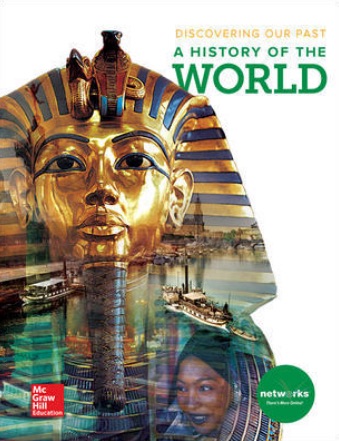
A History of the World: Chapter 8: Greek Civilization
32 words
223 learners
Learn words with Flashcards and other activities
Definition First

Other learning activities
Full list of words from this list:
-
myth
a traditional story serving to explain a world viewThe Greek people also believed many of the same myths, or traditional stories about gods and heroes. Greek myths expressed the religious beliefs of the ancient Greeks.
-
ritual
the prescribed procedure for conducting religious ceremoniesA ritual is an action that is part of a religious ceremony.
-
oracle
a shrine where a prophet is consultedTo find out about the future, many Greeks visited an oracle. This was a sacred shrine where a priest or priestess spoke for a god.
-
construct
make by combining materials and partsIn order to get into the city, the Greeks trick the Trojans and construct a huge, hollow wooden horse.
-
fable
a short moral storyA fable is a short tale that teaches a lesson. In most of Aesop's fables, animals speak and act like people. These stories are often funny and show human weaknesses and strengths. Each fable ends with a moral, or useful truth.
-
oral
using speech rather than writingFor 200 years, Aesop's fables were a part of Greek oral tradition. This means that the stories were passed from generation to generation by word of mouth.
-
drama
a work intended for performance by actors on a stageA drama is a story told mainly through the words and actions of a cast of characters.
-
tragedy
drama exciting terror or pityGreek drama can be divided into two categories: tragedy and comedy. In a tragedy, the main character struggles to overcome hardships but does not succeed.
-
comedy
light and humorous drama with a happy endingIn a comedy, the story ends happily. Today, the word comedy means a story filled with humor.
-
conflict
opposition in a work of fiction between characters or forcesThen, stories were created using action and conflicts among the characters.
-
style
a mode of expression typical of a person, group, or periodThe characteristics of Greek art became the artistic style that we now call classical.
-
sophist
someone whose reasoning is subtle and often speciousA group of philosophers known as the Sophists traveled from polis to polis. They made a living by teaching. The Sophists taught many subjects, including mathematics, science, and history.
-
rhetoric
study of the technique for using language effectivelyHowever, they were best known for teaching rhetoric, or the art of public speaking and debate.
-
reject
refuse to accept or acknowledgeSophists did not believe that the gods influenced human actions. They also rejected the idea of absolute right or wrong. For the Sophists, a way of life that was right for one person might be wrong for another.
-
reveal
make known to the public information previously kept secretThese writings reveal that Socrates was a harsh critic of the Sophists.
-
Socratic method
a method of teaching by question and answerIn his search for truth, Socrates created a new way of questioning called the Socratic method. Today, many university professors use the Socratic Method when they teach. Socrates did not lecture. Instead, he asked pointed questions and waited for his students to respond.
-
individual
a human beingThe idea of the golden mean is that people should live moderately. For example, individuals should not eat too little or too much. Instead, they should eat just enough to stay well.
-
investigate
look into scientificallyThey also investigated the natural world. They developed new ways of studying science and history.
-
oath
a solemn promise regarding your future acts or behaviorHis rules are listed in the Hippocratic Oath. The oath says that doctors should do their best to help the patient. It also says that they should protect the patient's privacy.
-
create
bring into existenceHe created a strong army.
-
voluntarily
out of your own free willHe defeated some city-states in battle, and he bribed the leaders of others to surrender. A few city-states voluntarily agreed to join with Macedonia.
-
cavalry
troops trained to fight on horsebackAlexander's cavalry, or soldiers on horseback, proved to be a stronger force.
-
pursue
follow in an effort to captureAlexander and his troops did not pursue Darius, though.
-
seek
try to locate, discover, or establish the existence ofJason and his band sail the seas seeking a ram with a golden fleece.
-
epicureanism
doctrine promoting intellectual pleasure and avoiding painEpicurus founded a philosophy known as Epicureanism. He taught his students that finding happiness was the goal of life. He believed that the way to be happy was to avoid pain.
-
stoicism
an indifference to pleasure or painInstead, he taught at a building called the "painted porch". The Greek word for porch was stoa. The term "Stoicism" thus comes from the Greek word stoa.
The Stoics claimed that people who were guided by their emotions lived unhappy lives. They believed that happiness resulted from using reason. -
community
a group of people living in a particular local areaUnlike Epicureans, Stoics thought people had a duty to serve their community.
-
circumference
the size of something as given by the distance around itHe then used his knowledge to measure Earth's circumference—the distance around Earth.
-
method
a way of doing something, especially a systematic wayUsing similar methods, he tried to determine how far it was to the sun and to the moon.
-
accurate
characterized by perfect conformity to fact or truthAlthough his measurements were not accurate, he concluded that the sun was much larger than Earth and the moon.
-
plane geometry
the mathematics of two-dimensional figuresPlane geometry is one branch of mathematics. It shows how points, lines, angles, and surfaces relate to one another.
-
solid geometry
the study and measurement of 3-dimensional spacesArchimedes worked on solid geometry. He studied ball-like shapes, called spheres, and tubelike shapes, called cylinders.
Created on Thu Jun 17 10:03:32 EDT 2021
(updated Tue Jun 22 08:57:18 EDT 2021)
Sign up now (it’s free!)
Whether you’re a teacher or a learner,
Vocabulary.com can put you or your class
on the path to systematic vocabulary improvement.