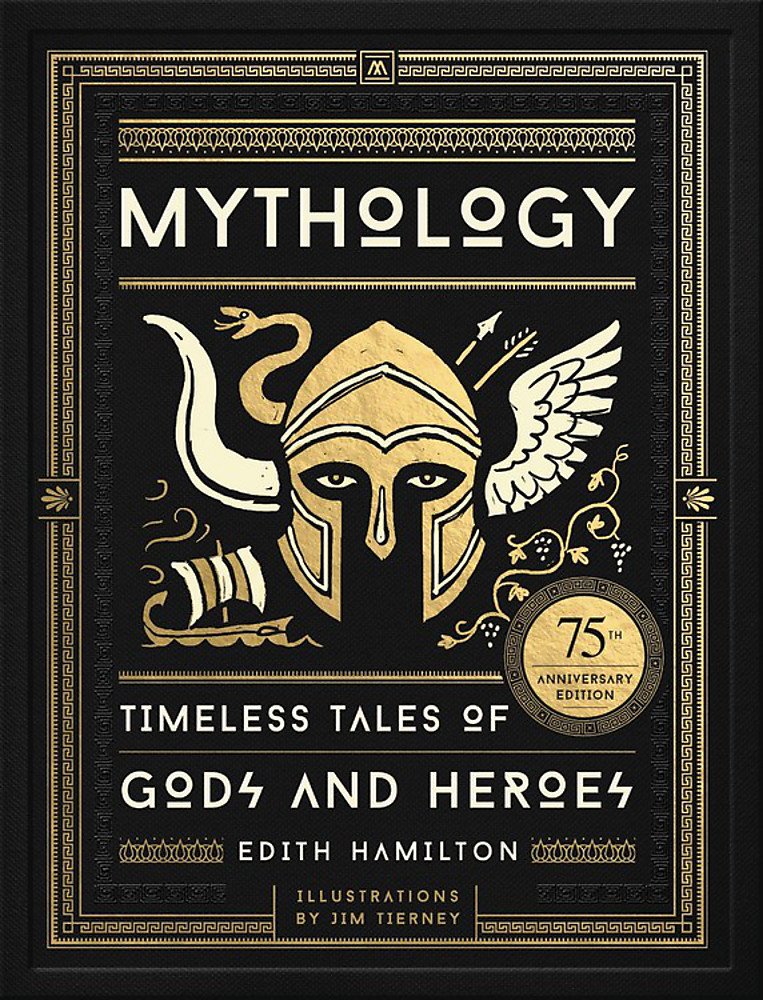
Mythology: Part Five
Originally published in 1942, Edith Hamilton's collection of myths is an essential text for students of the ancient world.
Here are links to our lists for the text: Part One, Part Two, Part Three, Part Four, Part Five, Parts Six–Seven
40 words
431 learners
Learn words with Flashcards and other activities
Definition First

Other learning activities
Full list of words from this list:
-
partake
consumeThey allowed him to eat at their table, to taste the nectar and ambrosia which except for him alone none but the immortals could partake of.
-
ambrosia
the food and drink of the godsThey allowed him to eat at their table, to taste the nectar and ambrosia which except for him alone none but the immortals could partake of.
-
condescend
do something that one considers to be below one's dignityThey did more; they came to a banquet in his palace; they condescended to dine with him.
-
laden
filled with a great quantityOver the pool fruit trees hung heavy laden with pears, pomegranates, rosy apples, sweet figs.
-
inadvertently
without knowledge or intentionOne of the goddesses, some say Demeter, some Thetis, inadvertently had eaten of the loathsome dish and when the boy’s limbs were reassembled one shoulder was wanting.
-
loathsome
physically offensive or sickeningOne of the goddesses, some say Demeter, some Thetis, inadvertently had eaten of the loathsome dish and when the boy’s limbs were reassembled one shoulder was wanting.
-
sordid
morally degradedIt was a sordid tale.
-
foreboding
a feeling of evil to comeBut in the crowd that greeted him with thanksgiving for his return there were anxious faces, and words of dark foreboding passed from one man to another.
-
tumult
a state of commotion and noise and confusionAs they wondered and feared, a tumult of noise reached them, chariots rolling, voices shouting.
-
baseless
without a foundation in reason or fact“No more blood for you and me,” Clytemnestra said to Aegisthus. “We are lords here now. We two will order all things well.” It was a baseless hope.
-
abhorrent
offensive to the mindIt was a son’s duty to kill his father’s murderers, a duty that came before all others. But a son who killed his mother was abhorrent to gods and to men. A most sacred obligation was bound up with a most atrocious crime.
-
benignant
pleasant and beneficial in nature or influenceShe persuaded the avenging goddesses also to accept it, and with this new law of mercy established they themselves were changed. From the Furies of frightful aspect they became the Benignant Ones, the Eumenides, protectors of the suppliant.
-
suppliant
one praying humbly for somethingShe persuaded the avenging goddesses also to accept it, and with this new law of mercy established they themselves were changed. From the Furies of frightful aspect they became the Benignant Ones, the Eumenides, protectors of the suppliant.
-
acquittal
a judgment of not guiltyThey acquitted Orestes, and with the words of acquittal the spirit of evil which had haunted his house for so long was banished.
-
tribunal
an assembly to conduct judicial businessOrestes went forth from Athena’s tribunal a free man.
-
abominable
unequivocally detestableThey thought about such sacrifices as we do. They were abominable.
-
consecrate
render holy by means of religious ritesBut as such it was her terrible task to conduct the sacrifices, not actually herself kill her countrymen, but consecrate them by long-established rites and deliver them over to those who would kill them.
-
galley
a crescent-shaped seagoing vessel propelled by oarsShe had been serving the goddess thus for many years when a Greek galley put in at the inhospitable shore, not under stern necessity, storm-driven, but voluntarily.
-
absolve
grant remission of a sin toDid this happen before or after Orestes had been absolved of the guilt of his mother’s murder? It was some time after. Although Athena had pronounced him clear of guilt, in this story all the Erinyes had not accepted the verdict.
-
mischance
an instance of misfortune“I will tell you what is in the letter so that even if through some mischance you lose your belongings, you will carry my message in your memory and bear it to my friends.”
-
barbarous
primitive in customs and cultureSay to him, ‘Brother, bring me back home. Free me from this murderous priesthood, this barbarous land.’
-
emphatically
in a forceful manner; with emphasisHe thought the hour for action had emphatically arrived. “We can talk,” he reminded the brother and sister, “when once we are out of this dreadful place.”
-
headway
forward movementBut at the mouth of the harbor where it opened out to the sea a heavy wind blowing landward struck them and they could make no headway against it.
-
subside
wear off or die downAnd the watchers on the shore saw the wind shift, the waves subside, and the Greek ship leave the harbor, flying under full sail to the sea beyond.
-
grotto
a small cave, usually with attractive featuresHe was out hunting and hot and thirsty entered a grotto where a little stream widened into a pool.
-
infallible
incapable of failure or errorApollo was the God of Truth. Whatever the priestess at Delphi said would happen infallibly came to pass.
-
blight
a state or condition being devastated or run-downBut when their two sons had grown to manhood Thebes was visited by a terrible plague. A blight fell upon everything.
-
acquiesce
agree or express agreementTo Ismene, shocking as it was, overwhelming her with anguish for the pitiful dead body and the lonely, homeless soul, it seemed, nevertheless, that nothing could be done except to acquiesce.
-
edict
a formal or authoritative proclamation“You knew my edict?”
“Yes,” Antigone replied. -
transgress
act in disregard of laws, rules, contracts, or promises“And you transgressed the law?”
-
guile
the use of tricks to deceive someoneCapaneus lies here, a mighty man of wealth, yet humble as a poor man always and a true friend to all. He knew no guile; upon his lips were kind words only.
-
palpitate
shake with fast, tremulous movementsHe describes in fifteen long lines (which I omit) exactly how Philomela’s tongue was cut out and what it looked like as it lay “palpitating” on the earth where Tereus had flung it.
-
arbiter
someone chosen to judge and decide a disputed issueIn return for this good gift Cecrops, who had been made arbiter, decided that Athens was hers.
-
suffrage
a legal right to voteIn one story of this contest between the two deities, woman’s suffrage plays a part. In those early days, we are told, women voted as well as men.
-
chagrin
cause to feel shameBut the men, along with Poseidon, were greatly chagrined at this female triumph; and while Poseidon proceeded to flood the land the men decided to take the vote away from the women.
-
teeming
abundantly filled with especially living thingsOr he could depict a harvest scene, a field with reapers and sheaf-binders, and a vineyard teeming with clusters of grapes which youths and maidens gathered into baskets while one of them played on a shepherd’s pipe to cheer their labors.
-
obstinate
refusing to change one's mind or ways; difficult to convinceEnraged at this obstinate devotion which none of her wiles could weaken, Aurora at last dismissed him and told him to go back to his wife, but to make sure that she had been as true to him during his absence as he to her.
-
wile
the use of tricks to deceive someoneEnraged at this obstinate devotion which none of her wiles could weaken, Aurora at last dismissed him and told him to go back to his wife, but to make sure that she had been as true to him during his absence as he to her.
-
foist
force onto anotherTo this group, Ion icily remote, Xuthus bewildered but happy, Creüsa feeling that she hated men and that she would not put up with having the son of some unknown, low woman foisted on her, there entered the aged priestess, Apollo’s prophetess.
-
preoccupation
the mental state of being obsessed by somethingIn her hands she carried two things that made Creüsa, in all her preoccupation, start and look sharply at them.
Created on Tue Aug 27 16:55:22 EDT 2019
(updated Mon Sep 16 13:10:48 EDT 2019)
Sign up now (it’s free!)
Whether you’re a teacher or a learner,
Vocabulary.com can put you or your class
on the path to systematic vocabulary improvement.