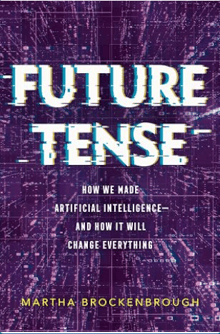
Future Tense: Chapters 1–4
This work of nonfiction discusses the past and future of artificial intelligence, from its earliest precursors to the ways it might impact society as it develops.
Here are links to our lists for the book: Chapters 1–4, Chapters 5–8, Chapters 9–12, Chapters 13–16, Chapters 17–20, Chapters 21–23
15 words
104 learners
Learn words with Flashcards and other activities
Definition First

Other learning activities
Full list of words from this list:
-
automation
equipment used to achieve independent control or operationWe’re also not talking about the kinds of robots you often see in factories, the kind blamed for job loss through automation.
-
algorithm
a precise rule specifying how to solve some problemTheir software, guided by algorithms that let it learn from you and others, can influence your behavior and your feelings.
-
pervasive
spreading or spread throughoutAI is already pervasive.
-
autonomous
free from external control and constraintFully autonomous cars aren’t widely available yet, but ones that partner with human beings are.
-
anticipation
the act of predicting, as by reasoning about the futureThe Greek philosopher Aristotle observed this more than 2,300 years ago: “There is only one condition in which we can imagine managers not needing subordinates and masters not needing slaves. This condition would be that each instrument could do its own work, at the word of command or by intelligent anticipation.”
-
formulation
the act of inventing or contriving an idea or explanationAll of this requires thinking and the formulation of theories about the rules of the world.
-
syllogism
reasoning in which a conclusion is derived from two premisesUsing Aristotelian logic, you make conclusions using syllogisms.
-
prestigious
having an excellent reputation; respectedThese human computers were usually women, because the work was not prestigious and the people who did it could be paid less.
-
ratchet
device consisting of a toothed wheel moving in one directionIn 1822, Babbage designed a model for a large, crank-operated device with gears, ratchets, and rods, which he called a Difference Engine.
-
redundancy
repetition of messages to reduce the probability of errorsThe redundancy helps ensure our messages get through.
-
formulaic
in accordance with some established rule, style, or patternIn the summer of 1956, they gathered to study a variety of aspects of AI, including how a computer could be programmed to use a language, how to arrange neurons to form concepts, how to get a computer to improve itself, and even how to explore the role of randomness that enlivens creative thinking (as opposed to mere competent thinking, which is more formulaic).
-
foible
a minor weakness or peculiarity in someone's characterBut it wasn’t all human foibles holding AI back.
-
dissertation
a treatise advancing a point of view resulting from researchIn 1982, a Taiwanese student arrived at Carnegie Mellon with plans to build a chess-playing computer for his PhD dissertation.
-
portent
a sign of something about to happenFor some observers, it wasn’t so much a chess match as a portent for the future of human beings versus machines.
-
relentless
not willing or able to stop or yieldFacing an opponent that felt cold, calculating, and relentless proved too much—even for the best human opponent in the world.
Created on Thu Jun 25 07:58:43 EDT 2026
(updated Tue Jul 28 11:41:43 EDT 2026)
Sign up now (it’s free!)
Whether you’re a teacher or a learner,
Vocabulary.com can put you or your class
on the path to systematic vocabulary improvement.