Vocabulary.com Blog
Articles about Language
Dept. of Word Lists
The Return of Braggadocious, and More!
Words Heard at the First Presidential Debate
 The first presidential debate between former Secretary of State Hillary Clinton and Donald J. Trump was held on September 26, 2016. Whatever your political affiliation, from a vocabulary perspective it was an intriguing contest.
Continue reading...
The first presidential debate between former Secretary of State Hillary Clinton and Donald J. Trump was held on September 26, 2016. Whatever your political affiliation, from a vocabulary perspective it was an intriguing contest.
Continue reading...
Dog EaredBooks we love
A Descriptive Prescriber's Useful Usage Guide
Bryan A. Garner's big book makes the little nuts and bolts of English easier to handle.
 Garner's Modern English Usage, which just released its fourth edition, is potentially a damn useful thing to me. And after looking through Bryan A. Garner's latest, I can report that the potential is realized: this is an extremely useful and sensible guide. I don't know if I would sleep with it under my pillow, but I won't keep it far from my desk.
Continue reading...
Garner's Modern English Usage, which just released its fourth edition, is potentially a damn useful thing to me. And after looking through Bryan A. Garner's latest, I can report that the potential is realized: this is an extremely useful and sensible guide. I don't know if I would sleep with it under my pillow, but I won't keep it far from my desk.
Continue reading...
Language LoungeA Monthly Column for Word Lovers
Fractious Compounds: How Should Dictionaries Treat Words Like "Heart-Shaped"?
Dictionaries often ignore seemingly straightforward compound words. But should they?
One of the ways in which massive corpora (databases of natural language examples) have revolutionized lexicography is by providing access to a level of statistical analysis of language that was never before possible. The data in a corpus can tell us, with the effort of a few keystrokes—and backed by the effort of hundreds of person-hours of software development—all we need to know about the most frequent uses and collocations of words.
Continue reading...
Behind the DictionaryLexicographers Talk About Language
It's an Adjective! It's an Adverb! It's "Super"!
Are you super curious about how the word "super" gets used these days?
 With what advertisers are coyly calling the "big game" looming this weekend, I decided it was time to follow up on a feeling that had been growing on me for a while: That I was hearing more and more people using super as an intensifier for adjectives, as in "I'm super excited!"
Continue reading...
With what advertisers are coyly calling the "big game" looming this weekend, I decided it was time to follow up on a feeling that had been growing on me for a while: That I was hearing more and more people using super as an intensifier for adjectives, as in "I'm super excited!"
Continue reading...
Language LoungeA Monthly Column for Word Lovers
Whether You Can Make Words Mean So Many Things
Some deep thoughts on picking Words of the Year.
 A time-honored ritual around the world at year's end is to nominate Words of the Year, originally inspired by TIME magazine's Person of the Year. But words can be much more different from each other than people are. People of the Year are normally distinguished by their great influence. Words of the Year bear myriad relationships to the things they represent and because of this, the ways in which they distinguish themselves are extremely divergent.
Continue reading...
A time-honored ritual around the world at year's end is to nominate Words of the Year, originally inspired by TIME magazine's Person of the Year. But words can be much more different from each other than people are. People of the Year are normally distinguished by their great influence. Words of the Year bear myriad relationships to the things they represent and because of this, the ways in which they distinguish themselves are extremely divergent.
Continue reading...
Topics:
Language
 If you've been keeping your head down, just doing your job and paying the bills, it may have escaped your notice that we live in exciting times. Yes, really! We're excited about things! We're excited by things! We're excited to do things! And, increasingly, we're excited for things, events, and experiences.
Continue reading...
If you've been keeping your head down, just doing your job and paying the bills, it may have escaped your notice that we live in exciting times. Yes, really! We're excited about things! We're excited by things! We're excited to do things! And, increasingly, we're excited for things, events, and experiences.
Continue reading...
Word RoutesExploring the pathways of our lexicon
"They" Won! Gender-Neutral Pronoun is 2015 Word of the Year
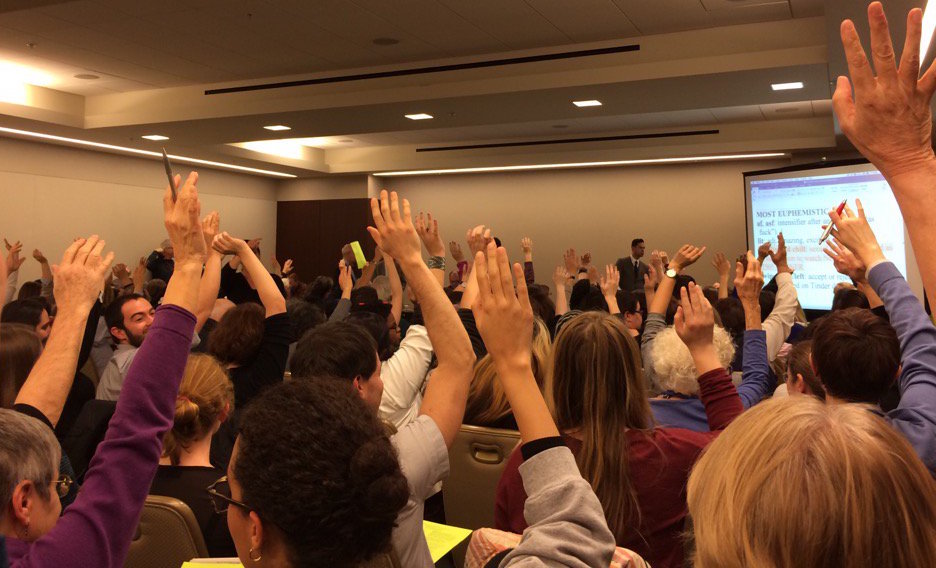 Gathering in Washington D.C. for its annual meeting, the American Dialect Society has made its 26th annual selection for Word of the Year. And as predicted in this space last month, the winner is a lowly pronoun: they used as a gender-neutral alternative to he and she, with special attention paid to its use as an expression of "non-binary" gender identity.
Continue reading...
Gathering in Washington D.C. for its annual meeting, the American Dialect Society has made its 26th annual selection for Word of the Year. And as predicted in this space last month, the winner is a lowly pronoun: they used as a gender-neutral alternative to he and she, with special attention paid to its use as an expression of "non-binary" gender identity.
Continue reading...
Sign up now (it’s free!)
Whether you’re a teacher or a learner,
Vocabulary.com can put you or your class
on the path to systematic vocabulary improvement.