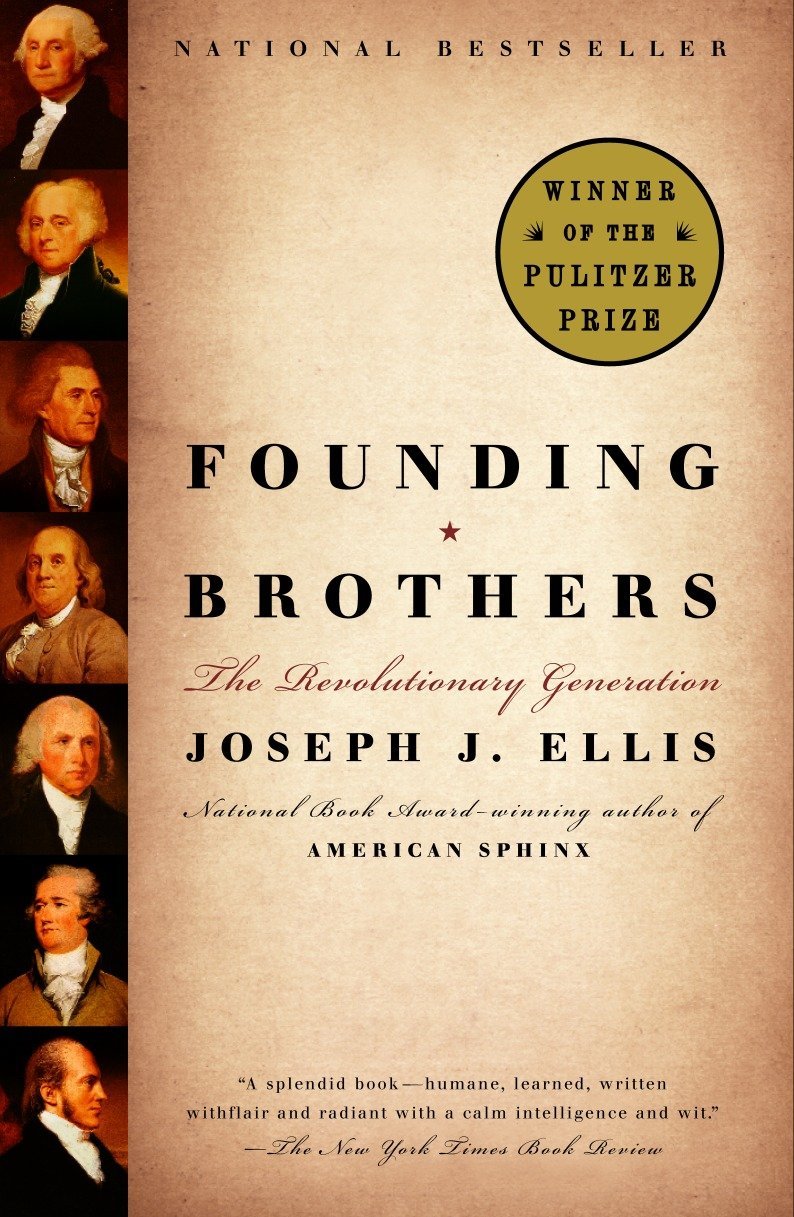
Founding Brothers: Preface
This nonfiction account explores the lives and ideas of six "Founding Fathers" of the United States: George Washington, Alexander Hamilton, Thomas Jefferson, Benjamin Franklin, John Adams, and James Madison.
Here are links to our lists for the book: Preface, Chapter One, Chapter Two, Chapter Three, Chapter Four, Chapter Five, Chapter Six
40 words
484 learners
Learn words with Flashcards and other activities
Definition First

Other learning activities
Full list of words from this list:
-
render
give an interpretation ofTom Paine, for example, claimed that it was simply a matter of common sense that an island could not rule a continent. And Thomas Jefferson’s lyrical rendering of the reasons for the entire revolutionary enterprise emphasized the self-evident character of the principles at stake.
-
intimation
a slight suggestion or vague understandingIn his old age, John Adams recalled his youthful intimations of the providential forces at work: “There is nothing...more ancient in my memory,” he wrote in 1807, “than the observation that arts, sciences, and empire had always travelled westward. And in conversation it was always added, since I was a child, that their next leap would be over the Atlantic into America.”
-
vestige
an indication that something has been presentThroughout Asia, Africa, and Latin America, former colonies of European powers have won their independence with such predictable regularity that colonial status has become an exotic vestige of bygone days, a mere way station for emerging nations.
-
despotism
a form of government in which the ruler is unconstrainedThe republican experiment launched so boldly by the revolutionary generation in America encountered entrenched opposition in the two centuries that followed, but it thoroughly vanquished the monarchical dynasties of the nineteenth century and then the totalitarian despotisms of the twentieth, just as Jefferson predicted it would.
-
providential
peculiarly fortunate or appropriateDespite the confident and providential statements of leaders like Paine, Jefferson, and Adams, the conclusions that look so foregone to us had yet to congeal for them.
-
adage
a condensed but memorable saying embodying an important factThe old adage applies: Men make history, and the leading members of the revolutionary generation realized they were doing so, but they can never know the history they are making.
-
transient
lasting a very short timeRush recalled that the comment “procured a transient smile, but it was soon succeeded by the solemnity with which the whole business was conducted.”
-
hegemony
the dominance or leadership of one social group over othersTaken together, the British army and navy constituted the most powerful military force in the world, destined in the course of the succeeding century to defeat all national competitors for its claim as the first hegemonic power of the modern era.
-
paradigm
the generally accepted perspective of a disciplineThough the republican paradigm—representative government bottomed on the principle of popular sovereignty—has become the political norm in the twentieth century, no republican government prior to the American Revolution, apart from a few Swiss cantons and Greek city-states, had ever survived for long, and none had ever been tried over a landmass as large as the thirteen colonies.
-
contingency
a possible event or occurrence or resultWe need a historical perspective that frames the issues with one eye on the precarious contingencies felt at the time, while the other eye looks forward to the more expansive consequences perceived dimly, if at all, by those trapped in the moment.
-
felicity
state of well-being characterized by contentmentThey are, from this period, to be considered as Actors on a most conspicuous Theatre, which seems to be peculiarly designed by Providence for the display of human greatness and felicity.
-
intractable
difficult to manage or moldCombine the long-range and short-range perspectives and the result becomes the central paradox of the revolutionary era, which was also the apparently intractable dilemma facing the revolutionary generation.
-
prosaic
not fanciful or imaginativeThere is also truth in the opposite claim: that the Constitutional Convention should be called “the miracle at Philadelphia,” not in the customary, quasi-religious sense, whereby a gathering of demigods received divine inspiration, but in the more profane and prosaic sense that the Constitution professed to solve what was an apparently insoluble political problem.
-
purport
propose or intendFor it purported to create a consolidated federal government with powers sufficient to coerce obedience to national laws—in effect, to discipline a truly continental union—while remaining true to the republican principles of 1776.
-
plausible
apparently reasonable, valid, or truthfulHistorians have emphasized the several compromises the delegates in Philadelphia brokered to produce the constitutional consensus: the interest of large versus small states; federal versus state jurisdiction; the sectional bargain over slavery. The most revealing feature in this compromise motif is that on each issue, both sides could plausibly believe they had gotten the best of the bargain.
-
epithet
a defamatory or abusive word or phraseThe term American, like the term democrat, began as an epithet, the former referring to an inferior, provincial creature, the latter to one who panders to the crude and mindless whims of the masses.
-
pander
yield to; give satisfaction toThe term American, like the term democrat, began as an epithet, the former referring to an inferior, provincial creature, the latter to one who panders to the crude and mindless whims of the masses.
-
repudiate
refuse to acknowledge, ratify, or recognize as valid...the overwhelming judgment of the most respected authorities was that it could not be done; second, the dominant intellectual legacy of the Revolution, enshrined in the Declaration of Independence, stigmatized all concentrated political power and even, its most virulent forms, depicted any energetic expression of governmental authority as an alien force that all responsible citizens ought to repudiate and, if possible, overthrow...
-
sporadic
recurring in scattered or unpredictable instances...third, apart from the support for the Continental Army during the war, which was itself sporadic, uneven, and barely adequate to assure victory, the states and regions comprising the new nation had no common history as a nation and no common experience behaving as a coherent collective...
-
propitious
presenting favorable circumstances...(for example, while drafting the Declaration in Philadelphia in June of 1776, Jefferson had written back to friends in Virginia that it was truly disconcerting to find himself deployed at that propitious moment nearly three hundred miles from “my country”)...
-
fledgling
young and inexperienced...fourth, and finally, according to the first census, commissioned by the Congress in 1790, nearly 700,000 inhabitants of the fledgling American republic were black slaves, the vast majority, over 90 percent, concentrated in the Chesapeake region and points south, their numbers also growing exponentially in a kind of demographic defiance of all the republican rhetoric uttered since the heady days of 1776.
-
rhetoric
using language effectively to please or persuade...fourth, and finally, according to the first census, commissioned by the Congress in 1790, nearly 700,000 inhabitants of the fledgling American republic were black slaves, the vast majority, over 90 percent, concentrated in the Chesapeake region and points south, their numbers also growing exponentially in a kind of demographic defiance of all the republican rhetoric uttered since the heady days of 1776.
-
implicit
suggested though not directly expressedAnd the same principle also explains the parallel urge to demonize them, since any discussion of their achievement is also an implicit conversation about the distinctive character of American imperialism, both foreign and domestic.
-
manifest
reveal its presence or make an appearanceA kind of electromagnetic field, therefore, surrounds this entire subject, manifesting itself as a golden haze or halo for the vast majority of contemporary Americans, or as a contaminated radioactive cloud for a smaller but quite vocal group of critics unhappy with what America has become or how we have gotten here.
-
languish
become feebleAll of its members, not just those like Benjamin Franklin and Alexander Hamilton with famously impoverished origins, would have languished in obscurity in England or France.
-
exigency
a pressing or urgent situationThe pressures and exigencies generated by the American Revolution called out and gathered together their talents; no titled and hereditary aristocracy was in place to block their ascent; and no full-blown democratic culture had yet emerged to dull their elitist edge.
-
faction
a clique that seeks power usually through intrigueThere are two long-established ways to tell the story, both expressions of the political factions and ideological camps of the revolutionary era itself, and each first articulated in the earliest histories of the period, written while several members of the revolutionary generation were still alive.
-
incipient
only partly in existence; imperfectly formedIt sees the American Revolution as an incipient national movement with deep, if latent, origins in the colonial era.
-
relegate
refer to another person for decision or judgmentIn its more extreme forms it relegates personal rights and liberties to the higher authority of the state, which is “us” and not “them,” and it therefore has both communal and despotic implications.
-
salient
conspicuous, prominent, or importantWhile we might be able to forestall intellectual embarrassment by claiming that the underlying values at stake are timeless, and the salient questions classical in character, the awkward truth is that we have been chasing our own tails in an apparently endless cycle of partisan pleading.
-
partisan
devoted to a cause or political groupWhile we might be able to forestall intellectual embarrassment by claiming that the underlying values at stake are timeless, and the salient questions classical in character, the awkward truth is that we have been chasing our own tails in an apparently endless cycle of partisan pleading.
-
oscillation
the process of swinging between statesAnd the subsequent political history of the United States then became an oscillation between new versions of the old tension, which broke out in violence only on the occasion of the Civil War.
-
intransigence
stubborn refusal to compromise or changePrevious historians have labeled it “the Age of Passion” for good reason, for in terms of shrill accusatory rhetoric, flamboyant displays of ideological intransigence, intense personal rivalries, and hyperbolic claims of imminent catastrophe, it has no equal in American history.
-
echelon
level of authority in a hierarchyThe political dialogue within the highest echelon of the revolutionary generation was a decade-long shouting match.
-
iconography
the system or use of familiar images as symbolsWhy is it that there is a core of truth to the distinctive iconography of the American Revolution, which does not depict dramatic scenes of mass slaughter, but, instead, a gallery of well-dressed personalities in classical poses?
-
infallible
incapable of failure or errorTheir interactions and juxtapositions generated a dynamic form of balance and equilibrium, not because any of them was perfect or infallible, but because their mutual imperfections and fallibilities, as well as their eccentricities and excesses, checked each other in much the way that Madison in Federalist 10 claimed that multiple factions would do in a large republic.
-
cadence
a recurrent rhythmical seriesFourth, the faces that look down upon us with such classical dignity in those portraits by John Trumbull, Gilbert Stuart, and Charles Willson Peale, the voices that speak to us across the ages in such lyrical cadences, seem so mythically heroic, at least in part, because they knew we would be looking and listening.
-
posterity
all future generationsThey began posing for posterity, writing letters to us as much as to one another, especially toward the end of their respective careers.
-
irreverent
showing lack of due respect or veneration(John Adams is one of my favorite characters, as you will see, because he was congenitally incapable of holding the pose. His refreshing and often irreverent candor provides the clearest window into the deeper ambitions and clashing vanities that propelled them all.)
-
complicit
associated with or involved in some crime or wrongdoingIf they sometimes behave like actors in a historical drama, that is often how they regarded themselves. In a very real sense, we are complicitous in their achievement, since we are the audience for which they were performing; knowing we would be watching helped to keep them on their best behavior.
Created on Tue Nov 17 14:50:38 EST 2020
(updated Tue Dec 01 10:27:49 EST 2020)
Sign up now (it’s free!)
Whether you’re a teacher or a learner,
Vocabulary.com can put you or your class
on the path to systematic vocabulary improvement.