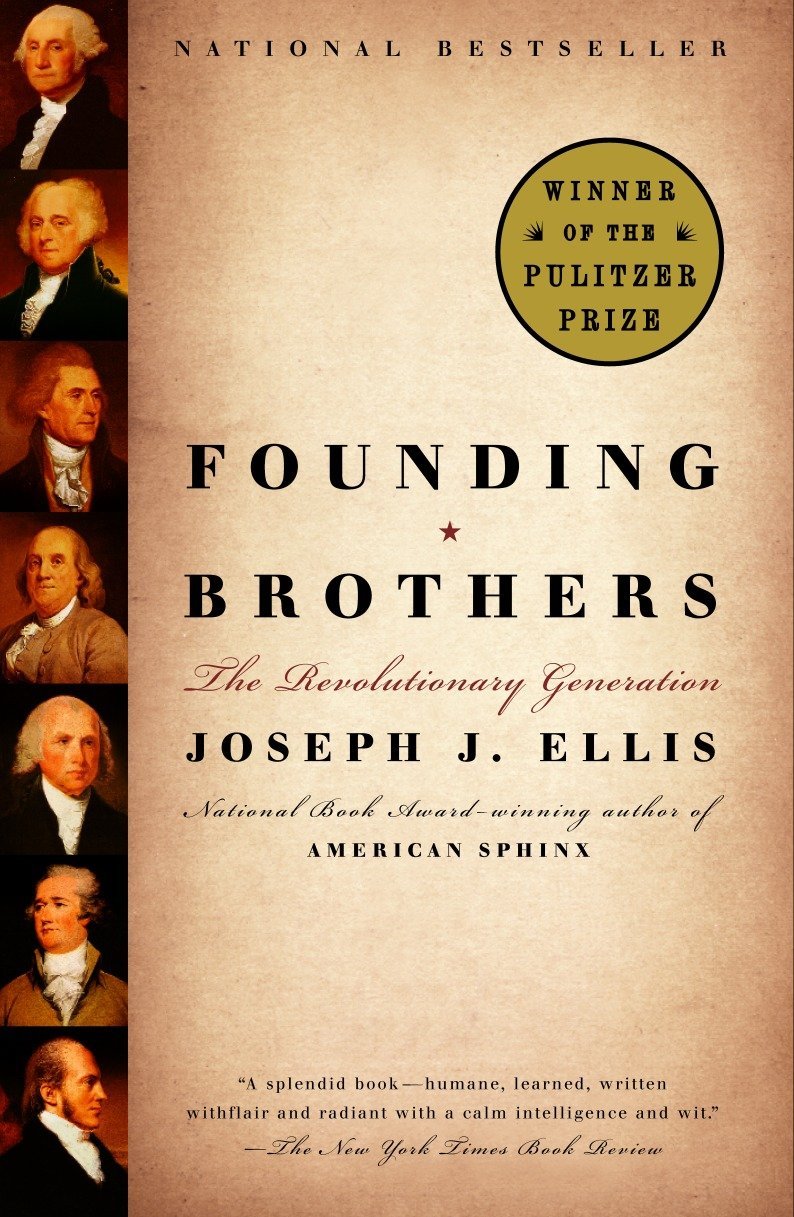
Founding Brothers: Chapter Two
This nonfiction account explores the lives and ideas of six "Founding Fathers" of the United States: George Washington, Alexander Hamilton, Thomas Jefferson, Benjamin Franklin, John Adams, and James Madison.
Here are links to our lists for the book: Preface, Chapter One, Chapter Two, Chapter Three, Chapter Four, Chapter Five, Chapter Six
40 words
36 learners
Learn words with Flashcards and other activities
Definition First

Other learning activities
Full list of words from this list:
-
inextricably
in a manner incapable of being disentangled or untiedIf his financial plan were rejected, as now seemed certain, then “he could be of no use, and was determined to resign.” And without his plan and his leadership—these two items seemed inextricably connected in his own mind—the government and inevitably the national union itself must collapse.
-
conciliation
mediation whereby disputes are settled short of arbitrationJefferson suggested that perhaps he could help. “On considering the situation of things,” he recalled, “I thought the first step towards some conciliation of views would be to bring Mr. Madison and Colo. Hamilton to a friendly discussion of the subject.”
-
acquiescence
agreement with a statement or proposal to do somethingIt ended in Mr. Madison’s acquiescence in a proposition that the question [i.e., assumption of the state debts] should be again brought before the house by way of amendment from the Senate, that he would not vote for it, nor entirely withdraw his opposition, yet he would not be strenuous, but leave it to its fate.
-
palatable
acceptable to the taste or mind“Without descending to talk about bargains,” Jefferson wrote—suggesting that making such deals work required not talking about them publicly—a negotiation was in the works that would make assumption more palatable to Virginians of Monroe’s persuasion: a trade of assumption for the Potomac location of the permanent capital.
-
phalanx
any closely ranked crowd of peopleThe ever-agile Hamilton had outmaneuvered him to support assumption, which had then become “a principal ground whereon was reared up that Speculating phalanx,” which had subsequently conspired so insidiously, as Jefferson put it, “to change the political complexion of the government of the U.S.”
-
overarching
including, affecting, or dominating everythingJefferson’s version of the story to the contrary notwithstanding, what was going on here?
As might be expected, the answer the various participants gave to such an overarching question depended a great deal on the ground on which they were standing. -
erudition
profound scholarly knowledge...he was so reserved that he conveyed the off-putting impression of someone with an infinite reservoir of additional information, all hidden away, the speaker not wishing to burden you with excessively conspicuous erudition...
-
affectation
a deliberate pretense or exaggerated displayHis physical deficiencies meant that a Madisonian argument lacked all the usual emotional affectations and struck with the force of pure, unencumbered thought.
-
ardent
characterized by intense emotionKnowing as we do that Madison would soon become one of the most ardent and potent Jeffersonians of all time, it is all the more instructive to note that, prior to 1790, they had drifted to different sides of the constitutional divide.
-
speculator
one who makes risky investments in the hopes of high profitsBut many original holders of the securities, mainly veterans of the American Revolution who had received them as pay for their service in the war, had then sold them at a fraction of their original value to speculators.
-
unscrupulous
without principlesMadison observed the buying frenzy and complained that unscrupulous speculators “are still exploring the interior & distant parts of the Union in order to take advantage of the holders.”
-
nascent
being born or beginningOr perhaps it was a slightly different picture, this one of the nascent national government, which he had visualized as an exalted arena where only the ablest and most intellectually talented officials would congregate, the finest fruits plucked from the more motley state governments, now replaced by an obnoxious collection of financiers and money changers, the kind of social parasites whom Jesus had symbolically driven from the temple.
-
guise
an artful or simulated semblanceUnder the guise of doing the states a favor by assuming their debts, the federal government was implicitly, even covertly, assuming sovereign authority over the economies of all the states.
-
elliptical
expressing oneself in an overly concise or indirect wayAs Madison put it to Jefferson in his most typically elliptical style, assumption “would be peculiarly hard on Virginia,” but was “further objectionable as augmenting a trust already sufficiently great for the virtue and number of the federal Legislature.”
-
insolent
not held back by conventional ideas of behaviorThe radical rhetoric of the 1760s and 1770s, now hallowed by its association with the successful war for independence, came pouring out of Madison’s correspondents in Virginia, equating assumption with the Stamp Act, the federal Congress with Parliament, the so-called “fixed insolent northern majority” with Great Britain.
-
buffet
strike against forcefullyAnd Madison, who had a justifiable reputation for making himself the calm center in the midst of all political storms, was being buffeted by shrill accusations from both sides.
-
unencumbered
not burdened with cares or responsibilitiesAll this was to be achieved with a keen and shrewd appreciation for the dynamic potential of America’s latent commercial energies, but unencumbered by even the slightest concern with how the resultant system might appear to those not sharing his nationalist vision.
-
venerable
profoundly honoredBut who was Madison to lecture him about the venerable sacrifice made by American soldiers, Madison having never fired a shot in anger, now wrapping himself in some rhetorical rendition of the bloodstained uniform he had never worn?
-
semblance
the outward or apparent appearance or form of somethingBut friends did not make ominous charges that the whole assumption proposal was a plot to lure the states into some Faustian bargain in which they lost the political semblance of childlike innocence, an innocence in fact already abandoned, wisely so, when the Constitution was ratified.
-
superimpose
place on top ofIn fact, once one steps back from the specific provisions for calculating and funding the various state and federal debts, perhaps the best way to understand the grand design of Hamilton’s Report, and the implicit presumptions that animated its visionary sense of where the new American republic was heading, is to see it as Hamilton’s distinctive temperament and cast of mind superimposed on the fluid conditions of an emergent nation.
-
ethos
the distinctive spirit of a culture or an eraFirst, there is the implication, floating between the lines of the entire Report, that an authoritative new presence has appeared on the scene and taken charge. The command ethos went beyond matters of personality (though Hamilton was certainly auditioning for the part), and it even went beyond questions of constitutionality (though the Report certainly announced the unequivocal sovereignty of the federal government).
-
unequivocal
admitting of no doubt or misunderstandingFirst, there is the implication, floating between the lines of the entire Report, that an authoritative new presence has appeared on the scene and taken charge. The command ethos went beyond matters of personality (though Hamilton was certainly auditioning for the part), and it even went beyond questions of constitutionality (though the Report certainly announced the unequivocal sovereignty of the federal government).
-
repository
a facility where things can be deposited for safekeepingHamilton was hardly unique in his recognition that the vast resources of the North American continent constituted a repository of riches that, once unlocked, offered prospects of unparalleled prosperity and national destiny.
-
idyllic
excellent and delightful in all respectsHe wrote no idyllic testimonials to merchants and moneymen comparable to Jefferson’s hymns to the bucolic splendor of America’s yeomen farmers, but his entire financial plan was an implicit endorsement of commerce as America’s economic lifeblood and of men of trade and commerce as its chief beneficiaries and silent heroes.
-
bucolic
idyllically rusticHe wrote no idyllic testimonials to merchants and moneymen comparable to Jefferson’s hymns to the bucolic splendor of America’s yeomen farmers, but his entire financial plan was an implicit endorsement of commerce as America’s economic lifeblood and of men of trade and commerce as its chief beneficiaries and silent heroes.
-
gentry
people having high social status or power in a societyThe Virginia gentry were psychologically incapable of sharing Hamilton’s affinity with men who made their living manipulating interest rates. Land, not fluid forms of capital, was their ultimate measure of wealth.
-
beleaguer
surround so as to force to give upOne cannot help but suspect that the beleaguered aristocracy of Virginia saw in Hamilton and his beloved commercial elite of the northern cities the American replicas of British bankers who were bleeding them to death.
-
lofty
of high moral or intellectual valueThe temporary capital in New York was hardly heaven, but he had agreed to go there in the spring of 1790 with his allegiances undeclared and his own lofty political principles uncontaminated by the kind of infighting that Madison and Hamilton had perfected to an art.
-
reticence
the trait of being uncommunicativeThis was part of a lifelong pattern of reticence, dating back to the prerevolutionary years in Virginia, when he had first emerged from the mists of the Blue Ridge Mountains to attend William and Mary, study law with George Wythe, and win marginal acceptance by the Tidewater elite.
-
encroachment
entry to another's property without right or permissionHe gained his reputation as an effective writer against British encroachments but was a reclusive non-presence in debates.
-
staunch
firm and dependable especially in loyaltyIn the Continental Congress, John Adams had described him as a staunch advocate of independence who never uttered more than two or three sentences, even in committees.
-
ensconce
fix firmlyThe hurly-burly of politics did not suit his temperament, which was only comfortable when ensconced on his mountaintop and redesigning his mansion at Monticello.
-
caprice
a sudden desireOne newspaper editor had sagely, if cynically, observed that “the usual custom is for the capital of new empires to be selected by the whim or caprice of a despot.”
-
recourse
act of turning to for assistanceJefferson was particularly clear on this point: “if the present occasion of securing the Federal seat on the Patowmack should be lost, it could never more be regained [and therefore] it would be dangerous to rely on any aids from Congress or the assemblies of Virginia or Maryland, and that therefore measures should be adopted to carry the residence bill into execution without recourse to those bodies.”
-
expediency
the quality of being suited to the end in viewIn late fall of 1790, Jefferson wrote Washington about the political urgency of starting construction as soon as possible: “Mr. Madison and myself have endeavored to press...the expediency of their undertaking to build ten good private dwellings a year, for ten years, in the new city....Should they do this...it will be one means of ensuring the removal of government thither.”
-
prostration
abject submissionLike the previous attempts by Parliament, assumption was described as a threat to Virginia’s independence and “a measure which...must in the course of human events, produce one or other of two evils, the prostration of agriculture at the feet of commerce, or a change in the present form of federal government, fatal to the existence of American liberty.”
-
caustic
harsh or corrosive in toneAs Jefferson and Madison arrived in Philadelphia for the first session of Congress in the new but merely temporary capital, the newspapers were filled with caustic commentary on the defiant tone of the Virginia resolution...
-
mainstay
a central cohesive source of support and stabilityOr if, like Jefferson, one believed that cities were sores on the body politic, and agrarian values were the mainstay of American virtue, then Washington, D.C., must have seemed the perfect capital for the new republic, since it was really not a city at all.
-
stultify
deprive of strength or efficiency; make useless or worthlessThe pervasive emptiness and stultifying summer heat were only minor deterrents when compared with the more elemental consideration that all the banking and commercial institutions were based elsewhere, chiefly in Philadelphia and New York.
-
nexus
a connected series or groupThe exciting synergy of institutional life in an all-purpose national metropolis was deemed less important than the dangerous corruptions likely to afflict a nexus of politicians and financiers.
Created on Tue Nov 17 14:52:20 EST 2020
(updated Tue Dec 01 10:25:00 EST 2020)
Sign up now (it’s free!)
Whether you’re a teacher or a learner,
Vocabulary.com can put you or your class
on the path to systematic vocabulary improvement.