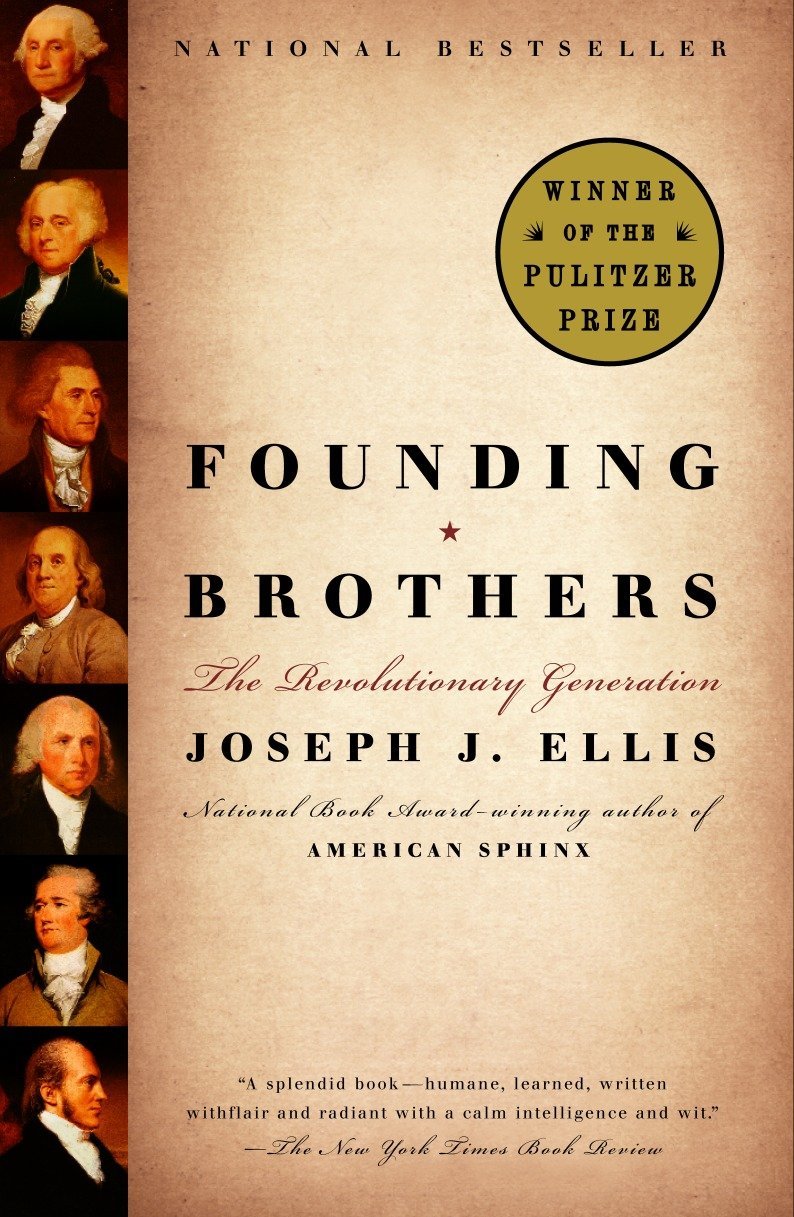
Founding Brothers: Chapter Six
This nonfiction account explores the lives and ideas of six "Founding Fathers" of the United States: George Washington, Alexander Hamilton, Thomas Jefferson, Benjamin Franklin, John Adams, and James Madison.
Here are links to our lists for the book: Preface, Chapter One, Chapter Two, Chapter Three, Chapter Four, Chapter Five, Chapter Six
40 words
51 learners
Learn words with Flashcards and other activities
Definition First

Other learning activities
Full list of words from this list:
-
begotten
generated by procreationWhen commenting on his other enemies, Adams displayed considerable flair. Tom Paine, for example, came off as “the Satyr of the Age...a mongrel between Pig and Puppy, begotten by a wild Boar on a Butch Wolf.”
-
probity
complete and confirmed integrityIn both instances his posture of public probity—slavery should be ended and political parties were evil agents that corrupted republican values—was at odds with his personal behavior and political interest.
-
bandy
discuss lightlyBut he was not a mover-and-shaker, only a draftsman; the words he wrote were merely the lyrical expression of ideas that had been bandied about in the Congress and the various colonial legislatures for years.
-
catharsis
purging of emotional tensions...twitching in and out of control as he attempted to compose his autobiography, which turned into a series of salvos at his political enemies (Hamilton, no surprise, was the chief target) and ended, literally in midsentence, when he realized that it was all catharsis and no coherence...
-
captious
tending to find and call attention to faultsWarren concluded with a scathing diagnosis of the Adams correspondence with her as a scattered series of verbal impulses and “the most captious, malignant, irrelevant compositions that have ever been seen.”
-
litany
a prayer consisting of a series of invocations by the priest with responses from the congregationInstead, they were all “inhabitants of the royal menagerie,” including lions, elephants, wildcats, rats, squirrels, whales, sharks—the litany went on for several paragraphs—who then proceeded to tear one another to pieces as he tried to lecture them on the advantages of “the unadulterated principles of liberty, equality and fraternity among all living creatures.”
-
unadulterated
not mixed with impuritiesInstead, they were all “inhabitants of the royal menagerie,” including lions, elephants, wildcats, rats, squirrels, whales, sharks—the litany went on for several paragraphs—who then proceeded to tear one another to pieces as he tried to lecture them on the advantages of “the unadulterated principles of liberty, equality and fraternity among all living creatures.”
-
deprecate
cause to seem or feel unimportant; belittleThen, ever playful with Rush, Adams signed off with the following self- deprecating joke: “I must tell you that my wife, who took a fancy to read this letter upon my table, bids me tell you that she ‘thinks my head, too, a little crack,’ and I am half of that mind myself.”
-
inexorably
in a manner impervious to change or persuasionJefferson’s drafting of the Declaration of Independence was a perfect example of such dramatic distortions. The Revolution in this romantic rendering became one magical moment of inspiration, leading inexorably to the foregone conclusion of American independence.
-
piebald
having sections or patches colored differently and brightly“It was patched and piebald policy then, as it is now, ever was, and ever will be, world without end." The real drama of the American Revolution, which was perfectly in accord with Adams's memory as well as with the turbulent conditions of his own soul, was its inherent messiness.
-
vacuous
devoid of intelligenceFranklin, for example, was a superb scientist and masterful prose stylist, to be sure, but also a vacuous political thinker and diplomatic fraud, who spent the bulk of his time in Paris flirting with younger women of the salon set.
-
sang-froid
great coolness and composure under strainAs he told Rush, “Deceive not thyself. There is not an old friar in France, not in Europe, who looks on a blooming young virgin with sang-froid."
-
panegyric
a formal expression of praise“I have reason to remember it,” Adams recalled, “because my opinion of the French Revolution produced a coldness towards me in all my Revolutionary friends, and an inclination towards Mr. Jefferson, which broke out in violent invectives and false imputations upon me and in flattering panegyrics upon Mr. Jefferson.”
-
precipitate
done with very great haste and without due deliberation“This is enough for me,” he wrote Rush, adding that he knew Adams to be “always an honest man, often a great one, but sometimes incorrect and precipitate in his judgments.”
-
accost
approach and speak to someone aggressively or insistently“It was only as if one sailor had met a brother sailor, after twenty-five years’ absence,” Adams joked, “and had accosted him, how fare you, Jack?”
-
elegiac
expressing sorrow often for something pastThe dialogue they sustained from 1812 to 1826 can be read at several levels, but the chief source of its modern appeal derives from its elegiac tone: the image of two American icons, looking back with seasoned serenity at the Revolution they have wrought, delivering eloquent soliloquies on all the timeless topics, speaking across their political differences to each other and across the ages to us.
-
beseech
ask for or request earnestly“Be assured, my dear Sir,” Jefferson wrote Adams, “that I am incapable of receiving the slightest impression from the effort now made to plant thorns on the pillow of age, worth, and wisdom, and to sow tares between friends who have been such for nearly half a century. Beseeching you then not to suffer your mind to be disquieted by this wicked attempt to poison its peace, and praying you to throw it by.”
-
garrulous
full of trivial conversationThird, the correspondence can be read as an extended conversation between two gods on Mount Olympus because both men were determined to project that impression: “But wither is senile garrulity leading me?” Jefferson asked rhetorically.
-
pinion
a gear designed to mesh with a larger wheelThus, Jefferson waxed eloquent on the aging process and their mutual intimations of mortality: “But our machines have now been running for 70 or 80 years,” he observed stoically, “and we must expect that, worn as they are, here a pivot, there a wheel, now a pinion, next a spring, will be giving way, and however we may tinker with them for awhile, all will at length surcease motion.”
-
caveat
a warning against certain actsAdams responded in kind but with a caveat: “I am sometimes afraid that my ‘Machine’ will not ‘surcease motion’ soon enough; for I dread nothing so much as ‘dying at the top,’” meaning becoming senile and a burden to his family.
-
exegesis
an explanation or critical interpretationFor example, after Jefferson produced a lengthy exegesis on the origins of the Native American population of North America, Adams dismissed all the current theories about the original occupants of the continent...
-
prodigal
recklessly wasteful“I should as soon suppose that the Prodigal Son, in a frolic with one of his Girls, made a trip to America in one of Mother Carey’s Eggsels, and left the fruits of their amours here.”
-
pedant
a person who is preoccupied with rules and learningBy what right did Samuel Johnson deny him, John Adams, the freedom to fashion his own vocabulary? “I have as good a right to make a Word," he insisted, “as that Pedant Bigot Cynic and Monk.”
-
epigrammatic
terse and wittyWhile the Adams style generated a host of memorable epigrammatic flashes, it was the worst-possible vehicle for sustaining the diplomatic niceties.
-
retrograde
moving or directed or tending in a backward directionIn that letter Jefferson had mentioned Adams in passing as a retrograde thinker opposed to all forms of progress, one of the “ancients” rather than “moderns.”
-
wanton
not restrained or controlled“I have no thought, in this correspondence, but to satisfy you and myself,” Adams observed, adding, “My Reputation has been so much the Sport of the public for fifty years and will be with Posterity, that I hoped it a bubble a Gossameur, that idles in the wanton Summer Air.”
-
bellwether
a predictor or indicator of future trendsThe best bellwether of the Adams psyche was always Abigail, and on July 15, 1813, she appended a note to her husband’s letter, her first communication with Jefferson since the lacerating letters she had written him nine years earlier.
-
verity
an enduring or necessary ethical or aesthetic truthHe now wanted to go on record as agreeing with Adams that, while the progress of science was indisputable, certain political principles were eternal verities that the ancients understood as well as the moderns: “The same political parties which now agitate the U.S. have existed thro’ all time,” he observed.
-
impute
attribute or credit to“If your objects and opinions have been misunderstood," Jefferson noted, "if the measures and principles of others have been wrongly imputed to you, as I believe they have been, that you should leave an explanation of them, would be an act of justice to yourself.”
-
goodly
large in size, amount, or degreeThough precisely the same situation obtained for Jefferson, as well—he owned about two hundred slaves and ten thousand acres, a goodly portion inherited from his father-in-law—Adams never confronted him so directly.
-
vindicate
show to be right by providing justification or proofAdams loved to bring the subject up in his correspondence with others, especially Benjamin Rush, because events had tended to vindicate his early apprehensions, which had produced the first fissures in his relationship with Jefferson in the early 1790s and then became central ingredients in the Republican polemic against Adams in the presidential campaign of 1800.
-
broach
bring up a topic for discussionBut it was Jefferson who first broached the subject in the correspondence, and he did so in a wholly conciliatory way: “Your prophecies...proved truer than mine; and yet fell short of the fact, for instead of a million, the destruction of 8 or 10 millions of human beings has probably been the effect of these convulsions..."
-
consummation
the act of bringing to completion or fruition“I have most carefully avoided every public act or manifestation on that subject,” he announced, explaining that the abolition of slavery was a task for the next generation, “who can follow it up, and bear it through to its consummation.”
-
rapture
a state of elated blissAdams agreed that memories of the past were all that was left, and he too preferred to remember only the good ones: "I look back with rapture to those golden days when Virginia and Massachusetts lived and acted together like a band of brothers,” he recalled, and though the end was near, “While I breath I shall be your friend.”
-
foible
a minor weakness or peculiarity in someone's characterAdams concurred that the reunion in heaven would permit them to laugh at their human follies and foibles, though he would talk with Franklin only after the great man did proper penance for his sins.
-
mundane
found in the ordinary course of eventsBut the more mundane truth is that they never faced and therefore never fully resolved all their political differences; they simply outlived them.
-
rarefied
of high moral or intellectual valueBut the borrowed rhetoric was only one small feature of a uniquely Jeffersonian message that was inherently rhetorical in character—that is, it framed the issues at a rarefied altitude, where all answers were self-evident and no real choices had to be made.
-
epoch
a period marked by distinctive characterHe conceded that the era of the American Revolution had been “a memorable epoch in the annals of the human race,” but the jury was still out on its significance.
-
annals
a chronological account of events in successive yearsHe conceded that the era of the American Revolution had been “a memorable epoch in the annals of the human race,” but the jury was still out on its significance.
-
founder
break down, literally or metaphoricallyWithout a sanctioned central government to steer the still-fragile American republic, the new crew was certain to founder on that huge rock called slavery, which was lurking dead ahead in the middle distance and that even Jefferson acknowledged to be “a breaker.”
Created on Tue Nov 17 14:53:47 EST 2020
(updated Tue Dec 01 10:39:27 EST 2020)
Sign up now (it’s free!)
Whether you’re a teacher or a learner,
Vocabulary.com can put you or your class
on the path to systematic vocabulary improvement.