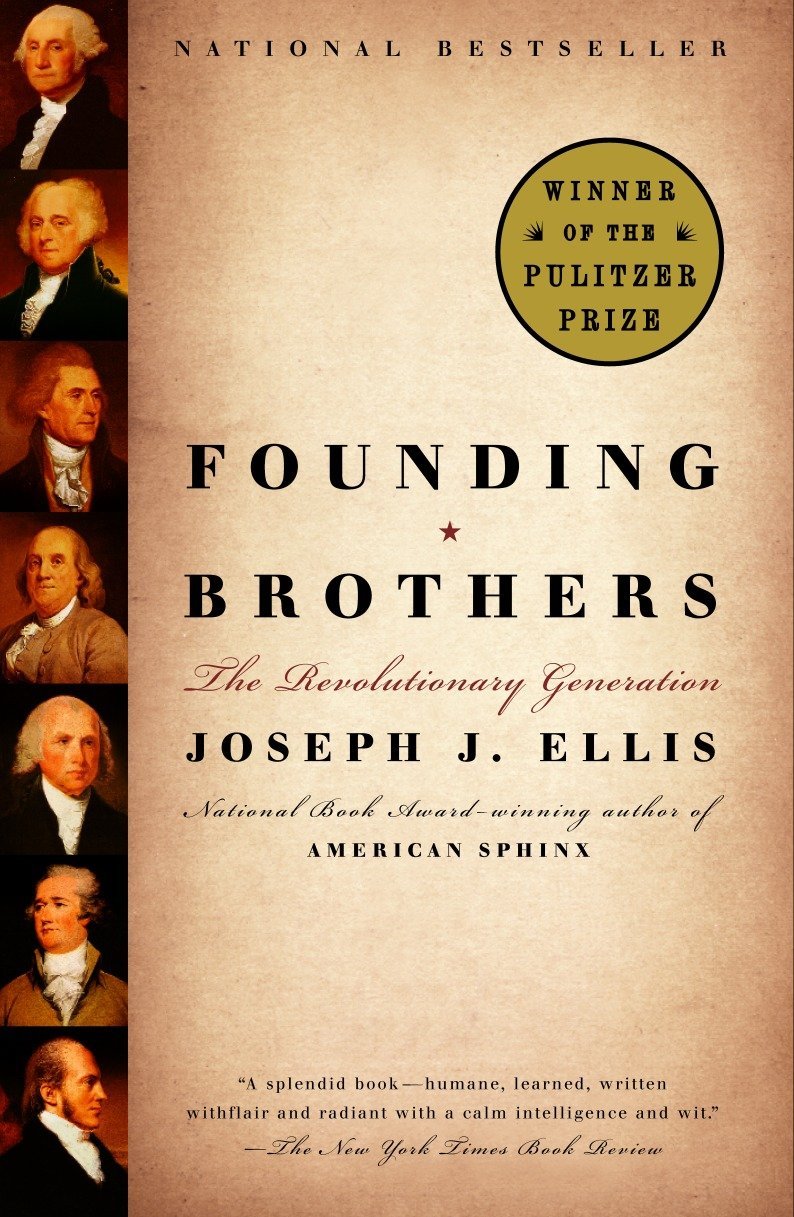
Founding Brothers: Chapter Three
This nonfiction account explores the lives and ideas of six "Founding Fathers" of the United States: George Washington, Alexander Hamilton, Thomas Jefferson, Benjamin Franklin, John Adams, and James Madison.
Here are links to our lists for the book: Preface, Chapter One, Chapter Two, Chapter Three, Chapter Four, Chapter Five, Chapter Six
40 words
40 learners
Learn words with Flashcards and other activities
Definition First

Other learning activities
Full list of words from this list:
-
apoplectic
marked by extreme angerRepresentative James Jackson from Georgia was positively apoplectic that such a petition would even be considered by any serious deliberative body.
-
reprehensible
bringing or deserving severe rebuke or censureThe problematic patriotism of the Quaker petitioners was, Smith agreed, reprehensible.
-
overwrought
deeply agitated especially from emotionOn the other hand, Jackson’s own overwrought opposition, much like airbursts in a night battle, actually called attention to the issues the Quakers wished to raise.
-
evince
give expression to“I apprehend, if through the interference of the general government, the slave-trade was abolished,” he observed, “it would evince to the people a general disposition toward a total emancipation."
-
exacerbate
make worseWhat’s more, this new petition made two additional points calculated to exacerbate the fears of men like Jackson: First, it claimed that both slavery and the slave trade were incompatible with the values for which the American Revolution had been fought...
-
countenance
consent to, give permissionSecond, it challenged the claim that the Constitution prohibited any legislation by the federal government against the slave trade for twenty years, suggesting instead that the “general welfare” clause of the Constitution empowered the Congress to take whatever action it deemed “necessary and proper” to eliminate the stigma of traffic in human beings and to “Countenance the Restoration of Liberty for all Negroes.”
-
sedition
an illegal action inciting resistance to lawful authorityAedanus Burke, for example, warned that the petitioners were “blowing the trumpet of sedition” and demanded that the galleries be cleared of all spectators and newspaper reporters.
-
patently
unmistakablyJackson then launched into a sermon on God's will, which he described as patently proslavery, based on several passages in the Bible and the pronouncements of every Christian minister in Georgia.
-
chattel
personal property, as opposed to real estateJohn Laurance of New York wondered how any Christian could read the Sermon on the Mount and believe it was compatible with chattel slavery.
-
anomaly
deviation from the normal or common order, form, or ruleBut the larger understanding, as Laurance saw it, was that slavery was an anomaly in the American republic, a condition that could be tolerated in the short run precisely because there was a clear consensus that it would be ended in the long run.
-
seminal
influential and providing a basis for later developmentThe core of the disagreement in the debate of 1790 revolved around different versions of what has come to be called America’s “original intentions,” more specifically what the Revolution meant for the institution of slavery. One’s answer, it turned out, depended a great deal on which founding moment, 1776 or 1787, seemed most seminal.
-
egalitarian
favoring social equalityAt least at the rhetorical level, the egalitarian principles on which the American revolutionaries had based their war for independence from Great Britain placed slavery on the permanent defensive and gave what seemed at the time a decisive advantage to the antislavery side of any debate.
-
mores
the conventions embodying the fundamental values of a groupAnd however utopian and excessive the natural rights section of the Declaration ("We hold these truths to be self-evident”) might appear later on, in the crucible of the revolutionary moment it gave lyrical expression to a widespread belief that a general emancipation of slaves was both imminent and inevitable, the natural consequence and fitting capstone of a glorious liberation from medieval mores historically associated with the very British government that Americans were rejecting.
-
paragon
model of excellence or perfection of a kindToward the end of the war, Lafayette, that paragon of the Franco-American alliance who was always eager to join the parade when history was on the march, urged Washington to declare a general emancipation for all slaves in Virginia and resettle them in the western region of the state as tenant farmers.
-
recalcitrant
stubbornly resistant to authority or controlNew York and New Jersey, which contained the largest slave populations north of the Chesapeake, proved more recalcitrant for that very reason.
-
beachhead
an initial accomplishment that opens the way for advancementThe slave trade was generally recognized as a criminal activity; slavery was dead or dying throughout the northern states; the expansion of the institution into the West looked uncertain; Virginia appeared to be the beachhead for an antislavery impulse destined to sweep through the South; the time seemed ripe to reconcile America's republican rhetoric with a new postrevolutionary reality.
-
obfuscate
make obscure or unclearIn fact, the very presumptiveness of the revolutionary rhetoric served to obfuscate the quite palpable reality that slavery, no matter how anomalous in purely ideological terms, was still deeply imbedded in the very structure of American society at multiple levels or layers that remained impervious to wishful thinking and revolutionary expectations.
-
superfluous
more than is needed, desired, or requiredThe passionate conviction that the Revolution was like a mighty wave fated to sweep slavery off the American landscape actually created false optimism and fostered a misguided sense of inevitability that rendered human action or agency superfluous. (Why bother with specific schemes when history would soon arrive with all the answers?)
-
surreptitious
conducted with or marked by hidden aims or methodsThere were, to be sure, radical implications latent in the “principles of ’76” capable of challenging privileged appeals to property rights, but the secret of their success lay in their latency—that is, the gradual and surreptitious ways they revealed their egalitarian implications over the course of the nineteenth century.
-
ordinance
a statute enacted by a city governmentOne of the last and most consequential acts of the Congress was to pass the Northwest Ordinance in July of 1787. Article Six of the ordinance forbade slavery in the territory north of the Ohio River, a decision that could plausibly be interpreted as the first step toward a more general exclusion of slavery in all incoming states (the Jefferson proposal of 1784).
-
tacit
implied by or inferred from actions or statementsOn the other hand, the ordinance could also be read as a tacit endorsement of slavery in the southwestern region (which eventually proved to be the case).
-
vehement
marked by extreme intensity of emotions or convictionsMason’s vehement opposition to the slave trade rested cheek by jowl with his demand for a constitutional guarantee to protect what he described as “the property of that kind which we have already.”
-
tirade
a speech of violent denunciationJames Jackson actually made menacing faces at the Quakers in the gallery, called them outright lunatics, then launched into a tirade so emotional and incoherent that reporters in the audience had difficulty recording his words.
-
itinerant
traveling from place to place to workWhereas Jackson tended toward a more volatile and pulpit-thumping style reminiscent of an itinerant Presbyterian minister in the revivalistic mode, Smith preferred the more measured cadences of the South Carolina aristocrat steeped in Ciceronian formalities.
-
brazen
not held back by conventional ideas of behaviorBut the brazen claim that slavery must be accepted unconditionally as a permanent feature of the national confederation was, if not wholly new, at least an interpretive clarification never made before in a national forum.
-
modicum
a small or moderate or token amountThe flaw in such reasoning, however, would have been obvious to any accountant or investment banker with a modicum of Hamiltonian wisdom.
-
construe
make sense of; assign a meaning toHistorians have not studied the feasibility of this feature as much as the compensation issue, preferring instead to focus on the racial prejudices that required its inclusion, apparently fearing that their very analysis of the problem might be construed as an endorsement of the racist and segregationist attitudes prevalent at the time.
-
auspices
kindly endorsement and guidanceTo top it all off, and add yet another layer of armament to the institution of slavery, any comprehensive plan for gradual emancipation could only be launched at the national level under the auspices of a federal government fully empowered to act on behalf of the long-term interests of the nation as a whole.
-
diametrically
in a contrasting or opposing mannerEnding slavery was a challenge on the same gigantic scale as these earlier achievements. Whether even a heroic level of leadership stood any chance was uncertain because—and here was the cruelest irony—the effort to make the Revolution truly complete seemed diametrically opposed to remaining a united nation.
-
protean
taking on different formsIn addition to seeming eternal, ubiquitous, protean, and endlessly quotable, Franklin had the most sophisticated sense of timing among all the prominent statesmen of the revolutionary era.
-
dint
force or effortBut he had leapt back across the Atlantic and onto the American side of the imperial debate in the nick of time, a convert to the cause, who, by the dint of his international reputation, was quickly catapulted into the top echelon of the political leadership.
-
indemnify
make amends for; pay compensation forAll the same practical objections to ending slavery were also raised: “But who is to indemnify their Masters for the Loss?..."
-
superannuated
too old to be useful...Smith of South Carolina attempted to discredit his views by observing that “even great men have their senile moments.” This prompted rebuttals from the Pennsylvania delegation: “Instead of proving him superannuated,” Franklin’s antislavery views showed that “the qualities of his soul, as well as those of his mind, are yet in their vigour”...
-
stymie
hinder or prevent the progress or accomplishment ofAlexander Hamilton, who was a founding member of the New York Manumission Society and a staunch antislavery advocate, also regretted the whole debate in the House, since it stymied his highest priority, which was approval of his financial plan.
-
grovel
show submission or fearIf Franklin’s great gift was an uncanny knack for levitating above political camps, operating at an altitude that permitted him to view the essential patterns and then comment with great irony and wit on the behavior of those groveling about on the ground, Madison’s specialty was just the opposite.
-
decorum
propriety in manners and conductOn the one hand, he found the blatantly proslavery arguments “shamefully indecent” and described his colleagues from South Carolina and Georgia as “intemperate beyond all example and even all decorum.”
-
strident
conspicuously and offensively loudHe claimed to be genuinely embarrassed at the stridently proslavery rhetoric of the delegates from the Deep South and much more comfortable on the high moral ground of his northern friends.
-
moratorium
suspension of an ongoing activityIn keeping with the compromise character of the committee report, it gave the Deep South the protection it had demanded by denying congressional authority to pass any gradual emancipation legislation. But it also set a chronological limit to this moratorium.
-
manumit
free from slavery or servitudeDuring the debate over this language, Madison provided the clearest gloss on its fresh meaning by explaining that, instead of imposing an eighteen-year moratorium on congressional action against slavery, the amendment made it unconstitutional “to attempt to manumit them at any time.”
-
foreclose
keep from happening or arising; make impossibleAs noted earlier, perhaps the window, if in fact there ever was a window, had already closed by 1790, so the debate and decision in the House merely sealed shut what the formidable combination of racial demography, Anglo-Saxon presumptions, and entrenched economic interests had already foreclosed.
Created on Tue Nov 17 14:52:41 EST 2020
(updated Tue Dec 01 10:30:02 EST 2020)
Sign up now (it’s free!)
Whether you’re a teacher or a learner,
Vocabulary.com can put you or your class
on the path to systematic vocabulary improvement.