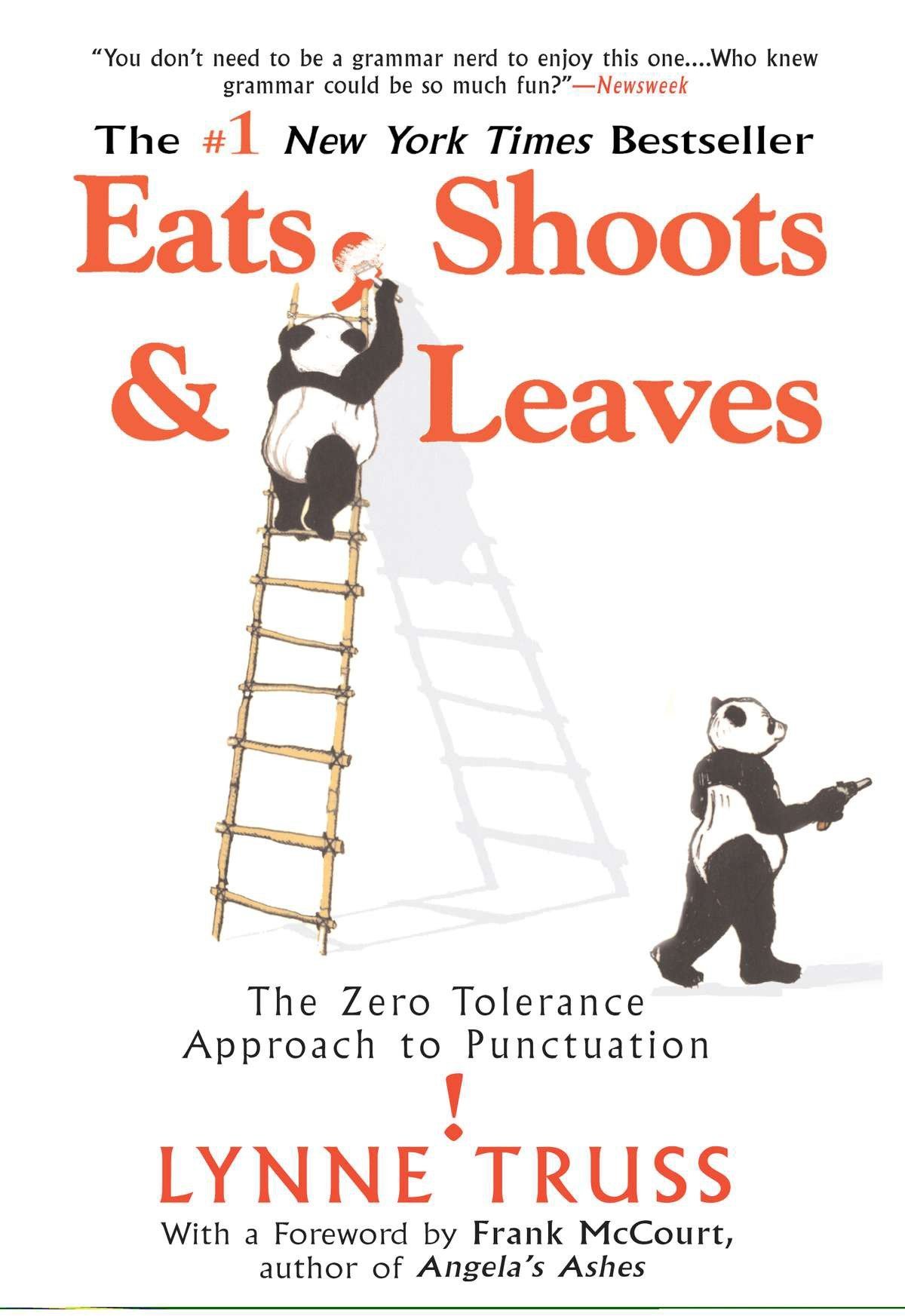
Eats, Shoots & Leaves: Cutting a Dash–Merely Conventional Signs
A sharp-eyed editor explains how small differences in punctuation can have enormous consequences.
Here are links to our lists for the work: Introduction–The Tractable Apostrophe, That'll Do, Comma–Airs and Graces, Cutting a Dash–Merely Conventional Signs
45 words
21 learners
Learn words with Flashcards and other activities
Definition First

Other learning activities
Full list of words from this list:
-
punctuation
the use of marks to clarify meaning of written materialAt this party, the rattled Perekladin insists that, despite his lack of a university education, forty years’ practice has taught him how to use punctuation, thank you very much.
-
catharsis
purging of emotional tensionsI say we should remember the fine example of Perekladin, who found catharsis in an exclamation mark, and also of the French 19th-century novelist Victor Hugo, who - when he wanted to know how Les Miserables was selling - reportedly telegraphed his publisher with the simple inquiry “?” and received the expressive reply “!”
-
spurious
plausible but falseH. W. Fowler said, “An excessive use of exclamation marks is a certain indication of an unpractised writer or of one who wants to add a spurious dash of sensation to something unsensational.”
-
inflection
the patterns of stress and intonation in a languageIncreasingly people are (ignorantly) adding question marks to sentences containing indirect questions, which is a bit depressing, but the reason is not hard to find: blame the famous upward inflection caught by all teenage viewers of Neighbours in the past twenty years.
-
prose
ordinary writing as distinguished from verseIn its traditional orientation, with the curve to the right, it appears to cup an ear towards the preceding prose, which seems natural enough, though perhaps only because that’s how we are used to seeing it.
-
rhetorical
relating to using language effectivelyIn the 16th century the printer Henry Denham had the sophisticated idea of reversing the mark when indicating a rhetorical question (to differentiate it from a direct question), but it didn’t catch on.
-
context
discourse that surrounds and helps explain a word or passageYet ever since italic type was invented in the 15th century, it has been customary to mix italic with roman to lift certain words out of the surrounding context and mark them as special.
-
omit
prevent from being included or considered or acceptedA jangled, surreal (and much shorter) version of the book could be obtained by reading the italic type and omitting the roman.
-
linguistic
consisting of or related to languageInverted commas (or speech marks, or quotes) are sometimes used by fastidious writers as a kind of linguistic rubber glove, distancing them from vulgar words or cliches they are too refined to use in the normal way.
-
emphasis
intensity or forcefulness of expressionBut, as many classically trained actors will tell you, it can be just as effective to lower your voice for emphasis as to raise it. Poets and writers know this too, which is where dashes and brackets come in. Both of these marks ostensibly muffle your volume and flatten your tone; but, used carefully, they can do more to make a point than any page and a half of italics.
-
overt
open and observable; not secret or hiddenThe dash is nowadays seen as the enemy of grammar, partly because overtly disorganised thought is the mode of most email and (mobile phone) text communication, and the dash does an annoyingly good job in these contexts standing in for all other punctuation marks.
-
persona non grata
an individual who for some reason is not wanted or welcomeHowever, just as the exclamation mark used to be persona non grata on old typewriter keyboards, so you may often hunt in vain for the dash nowadays: on my own Apple keyboard I have been for years discouraged from any stream-of-consciousness writing by the belief that I had to make my own quasi-dashes from illicit double-taps on the hyphen.
-
disjunction
the act of breaking a connectionThe word has identical roots with the verb “to dash” (deriving from the Middle English verb dasshen, meaning “to knock, to hurl, to break”) and the point is that a single dash creates a dramatic disjunction which can be exploited for humour, for bathos, for shock.
-
synapse
the junction between two neuronsMeanwhile, Emily Dickinson’s extraordinary penchant for dashes has been said to be a mirror into her own synapses, symbolising “the analogical leaps and flashes of advanced cognition” - either that, of course, or she used a typewriter from which all the other punctuation keys had been sadistically removed.
-
hyphen
a punctuation mark (-) used between parts of a wordWoodrow Wilson said the hyphen was “the most un-American thing in the world” (note the hyphen required in “un-American”); Churchill said hyphens were “a blemish, to be avoided wherever possible”.
-
spatial
pertaining to the expanse in which things are locatedWhat a lot of words the Greeks had for explaining spatial relationships - for placing round, placing underneath, joining together, cutting off!
-
inure
cause to accept or become hardened toEmail addresses are inuring us to this trend, as are advertisements on the internet (“GENTSROLEXWATCH!”), and when I received an invitation to a BBC launch for an initiative called “soundstart”, I hardly blinked an eye.
-
enunciate
express or state clearlyWhen certain words are to be spelled out, it is customary to use hyphens to indicate that you want the letters enunciated (or pictured) separately: “K-E-Y-N-S-H-A-M”.
-
expediency
the quality of being suited to the end in viewPurely for expediency, the hyphen is used to avoid an unpleasant linguistic condition called “letter collision”. However much you might want to create compound words, there will always be some ghastly results, such as “deice” (de-ice) or “shelllike” (shell-like).
-
usage
the customary manner in which language is spoken or writtenAmerican usage is gung-ho for compound words (or should that be gungho?), but a state of confusion reigns these days, with quite psychotic hyphenations arising in British usage, especially the rise of hyphens in phrasal verbs.
-
elucidate
make clear and comprehensiblePartridge, who is just about to elucidate the 17th application of the comma (“Commas in Fully Developed Complex Sentences”), is explaining that in this particular case it is difficult to formulate a set of rigid rules.
-
convention
something regarded as a normative exampleOur punctuation exists as a printed set of conventions
-
nuance
a subtle difference in meaning or opinion or attitudeit has evolved slowly because of printing’s innate conservatism; and is effective only if readers have been trained to appreciate the nuances of the printed page.
-
exponential
involving a quantity being multiplied by itselfInformation is presented to us in a non-linear way, through an exponential series of lateral associations.
-
inherently
in an essential mannerThe internet is a public “space” which you visit, and even inhabit; its product is inherently impersonal and disembodied.
-
ephemeral
lasting a very short timeElectronic media are intrinsically ephemeral, are open to perpetual revision, and work quite strenuously against any sort of historical perception.
-
edited
improved or corrected by critical revisionThe opposite of edited, the material on the internet is unmediated, except by the technology itself.
-
abysmal
very great; limitlessAs I mentioned in this book’s introduction, by tragic historical coincidence a period of abysmal under-educating in literacy has coincided with this unexpected explosion of global self-publishing.
-
disseminate
cause to become widely knownThus people who don’t know their apostrophe from their elbow are positively invited to disseminate their writings to anyone on the planet stupid enough to double-click and scroll.
-
ingenuity
the power of creative imaginationBut I can’t help feeling that our punctuation system, which has served the written word with grace and ingenuity for centuries, must not be allowed to disappear without a fight.
-
unfettered
not bound or restrained, as by shackles and chainsIn 1913, F. T. Marinetti wrote a manifesto he called Destruction of Syntax/Imagination without Strings/Words-in-Freedom which demanded the moral right of words to live unfettered - and only slightly undermined its case by requiring such a lot of punctuation in the title.
-
analogy
drawing a comparison in order to show a similarityBy the imagination without strings (wrote Marinetti) I mean the absolute freedom of images or analogies, or expressed with unhampered words and with no connecting strings of syntax and with no punctuation.
-
contraction
a word made by leaving out letters of a word or wordsWhen I trained as a journalist twenty-five years ago, the intermediate rule on matters of address was that if the contraction of a title still ended with the original final letter - thus “Mr” for “Mister”, or “Fr” for “Father” - no full stop was required, whereas if the title was cut short - “Prof” for “Professor” or “M” for “Monsieur” - a full stop was essential.
-
mediated
acting or brought about through an intervening agencyNaomi Baron has called Netspeak an “emerging language centaur - part speech, part writing” and David Crystal says computer-mediated language is a genuine “third medium”.
-
aggrieve
cause to feel distressAnyone interested in punctuation has a dual reason to feel aggrieved about smileys, because not only are they a paltry substitute for expressing oneself properly; they are also designed by people who evidently thought the punctuation marks on the standard keyboard cried out for an ornamental function.
-
loathe
dislike intensely; feel disgust towardI’ve just spotted a third reason to loathe emoticons, which is that when they pass from fashion (and I do hope they already have), future generations will associate punctuation marks with an outmoded and rather primitive graphic pastime and despise them all the more.
-
conservative
resistant to changeBefore the advent of the internet, our punctuation system was very conservative about admitting new marks; indeed, it held out for decades while a newfangled and rather daft symbol called the “interrobang” (invented in 1962) tried to infiltrate the system, disguised as a question mark on top of an exclamation.
-
conjunction
a function word that serves to conjoin words or phrases“Each time I tried to send one particular e-mail this morning, I got back this error message: ‘Your dependent clause preceding your independent clause must be set off by commas, but one must not precede the conjunction.’
-
intrinsic
belonging to a thing by its very natureIsn’t it the case, in the end, that punctuation is just a set of conventions, and that conventions have no intrinsic worth?
-
allusive
characterized by indirect referencesWe have a language that is full of ambiguities; we have a way of expressing ourselves that is often complex and allusive, poetic and modulated
-
clarity
the quality of being coherent and easily understoodall our thoughts can be rendered with absolute clarity if we bother to put the right dots and squiggles between the words in the right places.
-
impoverishment
the state of having little or no moneyProper punctuation is both the sign and the cause of clear thinking. If it goes, the degree of intellectual impoverishment we face is unimaginable.
-
repercussion
a remote or indirect consequence of some actionIf all these high moral arguments have had no effect, just remember that ignorance of punctuation can have rather large practical repercussions in the real world.
-
anomalous
deviating from the general or common order or typeEven the typographical errors and anomalous uses of grammar are incorporated into the Downing Street document.
-
detriment
a damage or lossSo we ignore the rules of punctuation at our political peril as well as to our moral detriment.
Created on Sun Mar 12 19:42:52 EDT 2017
(updated Tue Sep 25 15:34:35 EDT 2018)
Sign up now (it’s free!)
Whether you’re a teacher or a learner,
Vocabulary.com can put you or your class
on the path to systematic vocabulary improvement.