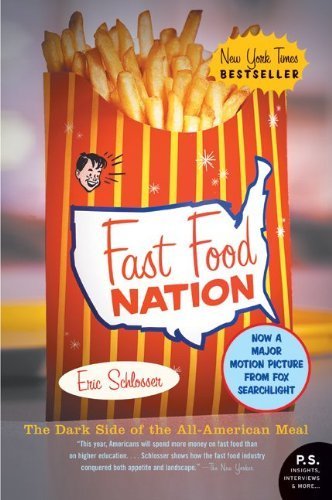
Fast Food Nation: Chapter 8–9
In this exposé, award-winning journalist Eric Schlosser explores the effects of the American fast food industry on global health, labor conditions, and the environment.
Here are links to our lists for the book: Introduction–Chapter 1, Chapters 2–4, Chapters 5–7, Chapters 8–9, Chapter 10–Afterword
40 words
598 learners
Learn words with Flashcards and other activities
Definition First

Other learning activities
Full list of words from this list:
-
primordial
having existed from the beginningAs they hack away, using all their strength, grunting, the place suddenly feels different, primordial. The machinery seems beside the point, and what’s going on before me has been going on for thousands of years—the meat, the hook, the knife, men straining to cut more meat.
-
imposing
impressive in appearanceThe animals are powerful and imposing one moment and then gone in an instant, suspended from a rail, ready for carving.
-
inherent
existing as an essential constituent or characteristicKnocker, Sticker, Shackler, Rumper, First Legger, Knuckle Dropper, Navel Boner, Splitter Top/Bottom Butt, Feed Kill Chain—the names of job assignments at a modern slaughterhouse convey some of the brutality inherent in the work.
-
debilitating
impairing strength and vitalityBut the dramatic and catastrophic injuries in a slaughterhouse are greatly outnumbered by less visible, though no less debilitating, ailments: torn muscles, slipped disks, pinched nerves.
-
berate
censure severely or angrilyEach supervisor is like a little dictator in his or her section of the plant, largely free to boss, fire, berate, or reassign workers.
-
assignation
a secret rendezvous (especially between lovers)Late on the second shift, when it’s dark outside, assignations take place in locker rooms, staff rooms, and parked cars, even on the catwalk over the kill floor.
-
negligence
the trait of ignoring responsibilities and lacking concernEight years earlier, Henry Wolf had been overcome by hydrogen sulfide fumes while cleaning the very same tank; Gary Sanders had tried to rescue him; both men died; and the Occupational Safety and Health Administration (OSHA) later fined National Beef for its negligence.
-
compliance
acting according to certain accepted standardsThe number of OSHA inspectors was eventually cut by 20 percent, and in 1981 the agency adopted a new policy of “voluntary compliance.”
-
adversarial
characterized by feelings of intense dislike or hostilityFor most of the 1980s OSHA’s relationship with the meatpacking industry was far from adversarial. While the number of serious injuries rose, the number of OSHA inspections fell.
-
discrepancy
a difference between conflicting facts or claims or opinionsDuring a three-month period in 1985, the first log recorded 1,800 injuries and illnesses at the plant. The OSHA log recorded only 160—a discrepancy of more than 1,000 percent.
-
slander
words falsely spoken that damage the reputation of anotherConvinced that no such videotape existed and that IBP had fabricated the entire story in order to deny him medical treatment, Kevin Wilson sued the company for slander.
-
disingenuous
not straightforward or candidThe Iowa Supreme Court concluded that the lies she told in this medical case, as well as in others, had been partly motivated by IBP’s financial incentive program, which gave staff members bonuses and prizes when the number of lost workdays was kept low. The program, in the court’s opinion, was “somewhat disingenuously called ‘the safety award system.’”
-
pervasive
spreading or spread throughoutThe National Labor Relations Board had ruled that Monfort committed “numerous, pervasive, and outrageous” violations of labor law after reopening the Greeley beef plant in 1982, discriminating against former union members at hiring time and intimidating new workers during a union election.
-
arduous
difficult to accomplishAfter a long and arduous organizing drive, workers at the Monfort beef plant voted to join the UFCW in 1992.
-
underwrite
protect by insuranceBut ConAgra, IBP, and the other large meatpacking firms are self-insured. They are under no pressure from independent underwriters and have a strong incentive to keep workers’ comp payments to a bare minimum.
-
ergonomics
the use of life sciences to study workers and their environmentsIt began to draw up the first ergonomics standards for the nation’s manufacturers, aiming to reduce cumulative trauma disorders.
-
susceptible
yielding readily to or capable of undergoing a processKenny eventually recovered from the overexposure to chlorine, but it left his chest feeling raw, made him susceptible to colds and sensitive to chemical aromas.
-
gristle
tough elastic tissue found in meatOne day, Kenny was in rendering and saw a worker about to stick his head into a pre-breaker machine, a device that uses hundreds of small hammers to pulverize gristle and bone into a fine powder.
-
virulent
infectious; having the ability to cause diseaseIt said that his stool sample had tested positive for Escherichia coli 0157:H7, a virulent and potentially lethal foodborne pathogen.
-
vector
any agent that carries and transmits a diseaseA modern factory designed for the mass production of food had instead become a vector for the spread of a deadly disease.
-
astute
marked by practical hardheaded intelligenceThe package of hamburger patties in Lee Harding’s freezer and astute investigative work by Colorado health officials soon led to the largest recall of food in the nation’s history.
-
precipitate
bring about abruptlyRecent studies have found that many foodborne pathogens can precipitate long-term ailments, such as heart disease, inflammatory bowel disease, neurological problems, autoimmune disorders, and kidney damage.
-
attribute
explain or regard as resulting from a particular causeAlthough the rise in foodborne illnesses has been caused by many complex factors, much of the increase can be attributed to recent changes in how American food is produced.
-
euphemism
an inoffensive expression substituted for an offensive oneThe medical literature on the causes of food poisoning is full of euphemisms and dry scientific terms: coliform levels, aerobic plate counts, sorbitol, MacConkey agar, and so on.
-
tawdry
cheap and shoddy“The hamburger habit is just about as safe,” one food critic warned, "as getting your meat out of a garbage can.” White Castle, the nation’s first hamburger chain, worked hard in the 1920s to dispel the hamburger’s tawdry image.
-
connotation
an idea that is implied or suggestedAs Hogan notes in his history of the chain, Selling ’Em by the Sack (1997), the founders of White Castle placed their grills in direct view of customers, claimed that fresh ground beef was delivered twice a day, chose a name with connotations of purity, and even sponsored an experiment at the University of Minnesota in which a medical student lived for thirteen weeks on “nothing but White Castle hamburgers and water.”
-
appalled
struck with dread, shock, or dismaySteven P. Bjerklie, a former editor of the trade journal Meat & Poultry, is appalled by what goes into cattle feed these days.
-
eviscerate
remove the entrails ofA single worker at a “gut table” may eviscerate sixty cattle an hour.
-
inadvertently
without knowledge or intentionThey are directly exposed to a wide variety of pathogens in the meat, become infected, and inadvertently spread disease.
-
circumspect
careful to consider potential consequences and avoid risk“Meat and food products, generally speaking,” J. Ogden Armour claimed in a Saturday Evening Post article, “are handled as carefully and circumspectly in large packing houses as they are in the average home kitchen.”
-
impugn
attack as false or wrongThe industry has repeatedly denied that problems exist, impugned the motives of its critics, fought vehemently against federal oversight, sought to avoid any responsibility for outbreaks of food poisoning, and worked hard to shift the costs of food safety efforts onto the general public.
-
antipathy
a feeling of intense dislikeThe industry’s strategy has been driven by a profound antipathy to any government regulation that might lower profits.
-
abscess
a localized collection of pus surrounded by inflamed tissueAt SIS-C slaughterhouses, visibly diseased animals—cattle infected with measles and tapeworms, covered with abscesses—were being slaughtered.
-
adulterate
make impure by adding a foreign or inferior substanceOn September 29, 1993, his replacement, Michael R. Taylor, announced that E. coli 0157:H7 would henceforth be considered an illegal adulterant, that no ground beef contaminated with it could be sold, and that the USDA would begin random microbial testing to remove it from the nation’s food supply.
-
calibrate
make fine adjustments for optimal measuringTheno insisted that every Jack in the Box manager attend a food safety course, that every refrigerated delivery truck have a record-keeping thermometer mounted inside it, that every kitchen grill be calibrated to ensure an adequate cooking temperature, and that every grill person use tongs to handle hamburger patties instead of bare hands.
-
auger
a hand tool used to bore holesIt was ground into fine particles by giant augers, mixed into exact proportions of lean meat and fat, stamped into patties, perforated, frozen, passed through metal detectors and then sealed in plastic wrap.
-
litigious
inclined or showing an inclination to dispute or disagree“We live in a very litigious society,” Jacque Knight, a USDA spokesman explained; if every meat recall was publicly announced, companies would face problems from “everybody with a stomachache.”
-
brash
offensively bold“There have been no illnesses associated with this product,” the company’s press release brashly asserted.
-
pasteurize
heat food in order to kill harmful microorganismsWhen used properly, steam pasteurization cabinets can kill off most of the E. coli 0157:H7 and reduce the amount of bacteria on the meat’s surface by as much as 90 percent.
-
stringent
demanding strict attention to rules and proceduresInstead of focusing on the primary causes of meat contamination—the feed being given to cattle, the overcrowding at feedlots, the poor sanitation at slaughterhouses, excessive line speeds, poorly trained workers, the lack of stringent government oversight—the meatpacking industry and the USDA are now advocating an exotic technological solution to the problem of foodborne pathogens.
Created on Fri Aug 19 21:49:54 EDT 2016
(updated Mon Jul 11 18:54:58 EDT 2022)
Sign up now (it’s free!)
Whether you’re a teacher or a learner,
Vocabulary.com can put you or your class
on the path to systematic vocabulary improvement.