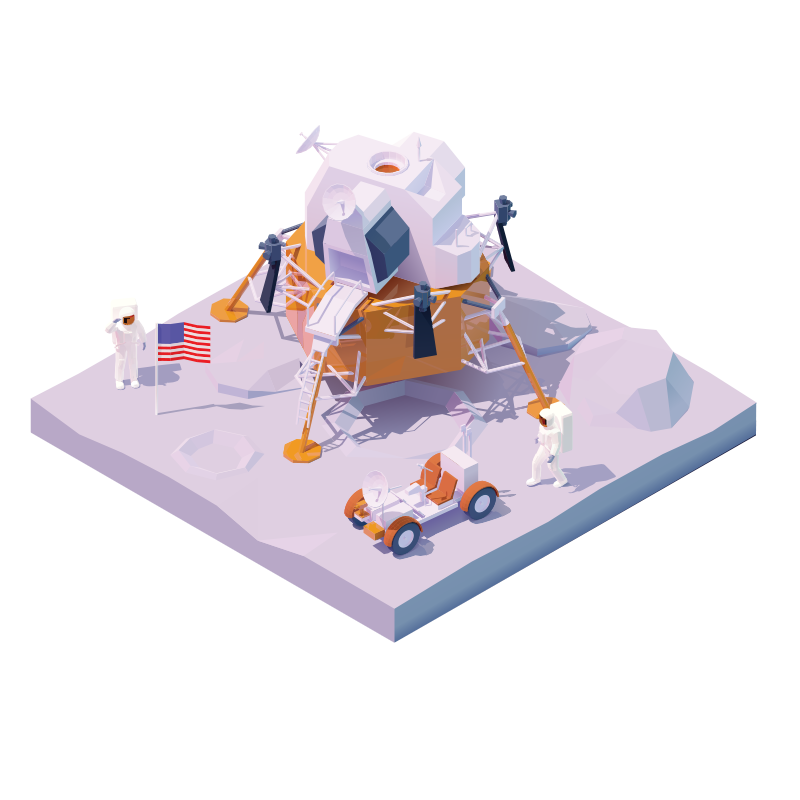
Space Is the Place: A Galaxy of Far Out Words: Quantum of Vocabulary: the Parlance of Particle Physics
Even though atoms and their component parts are incredibly tiny, it's impossible to understand the biggest things in the universe —stars, nebulas, and galaxies — without knowing how these invisible particles behave and interact. Up and atom!
20 words
12814 learners
Learn words with Flashcards and other activities
Definition First

Other learning activities
Full list of words from this list:
-
antimatter
mass consisting of antiparticles of normal substancesIt would be built in an underground tunnel near CERN’s location outside Geneva, Switzerland, and smash together electrons and their antimatter partners, positrons, by the middle of the century. Nature (Jun 23, 2020)See matter, below. One of the enduring mysteries in cosmology is why the universe ended up with so much matter and so little antimatter.
-
atom
the smallest component of an elementQuantum tunnelling — when an atom shimmies its way through a barrier in a way forbidden by classical physics — is not instantaneous. Nature (Jul 23, 2020)In Ancient Greek atomos meant something that could not be divided into smaller pieces. It turns out that atoms are actually made up of smaller particles — see proton, neutron, and electron on this list — and those are in turn made of still smaller things, but you get the idea.
-
electron
an elementary particle with negative chargeQuantum technology seeks to harness the distinct properties of atoms, photons and electrons to build more powerful computers and other tools for processing information. Washington Post (Jul 23, 2020)
-
energy
the capacity of a physical system to do workHe argues that Biden’s support for the Paris climate accord and other policies would lead to higher energy bills and job cuts. Seattle Times (Jul 24, 2020)
-
fission
splitting a massive nucleus with the release of energyMost uses of nuclear energy on Earth rely on fission - which breaks down heavier elements into lighter ones - rather than the fusion that occurs in a star. BBC (Jul 15, 2020)Fission is "splitting the atom." It releases enormous amounts of energy, which is how atomic bombs work. Einstein's famous E=MC2 equation describes this conversion of mass into energy.
-
fusion
reaction in which nuclei combine to form more massive nucleiThe finding addresses a long-standing mystery about the effect, which underlies everything from photosynthesis to nuclear fusion. Nature (Jul 23, 2020)
-
isotope
atom with same atomic number, different number of neutronsThe isotopes were “certainly nuclear fission products, most likely from a civil source”, it said. Reuters (Jun 29, 2020)Some elements, especially radioactive ones, can form different isotopes under certain conditions. Though they have the same properties and atomic number, they have different masses due to a different number of neutrons in their nuclei.
-
mass
the property of a body that causes it to have weightBody mass index is calculated by dividing a person's mass in kilograms by the square of their height in metres. BBC (Jul 24, 2020)Mass is very similar to weight, except that even in outer space, where you'd be weightless, your body would still have the same mass and would thus still behave according to the laws of momentum and inertia.
-
matter
that which has mass and occupies spaceIt wasn't long before the family learned to keep the windows shut so they wouldn't breathe in particulate matter. Salon (Jul 26, 2020)Matter, which describes anything possessing physical substance, comes from the Latin root, materia, meaning "timber" or building material." Materia is in turn built from the word mater, "mother," referring in this case to the trunk of a tree as opposed to its branches: the part from which the best lumber is cut.
-
neutron
a subatomic particle with zero chargeThat is heavier than the accepted limit of 2.5 suns for a neutron star. New York Times (Jun 24, 2020)From the Latin neutralis, meaning "not on either side" or "neither masculine nor feminine," plus the Greek suffix -on used to designate particles, a neutron is one of the three components of an atom. Where a proton is positively charged and an electron is negative, the neutron is... wait for it... neutral.
-
nucleus
the positively charged dense center of an atomAll stars are fueled by nuclear fusion reactions in which protons combine to form helium nuclei, which in turn fuse to create heavier elements. Scientific American (Jul 9, 2020)
-
particle
a body having finite mass but negligible dimensionsCosmic rays, or more precisely, the showers of secondary particles they produce, and which are created by this weak force, provide a direct link between the asymmetry of physics and the asymmetry of biology. Scientific American (Jul 22, 2020)
-
plasma
a fourth state of matter distinct from solid, liquid or gasExcept, she added, they are not spherical and were filled not with soap but with plasma, a highly energetic electrified gas. New York Times (Jun 5, 2020)
-
proton
a stable particle with positive chargeThe paper, published in Nature's Scientific Reports, theorizes that clusters of protons from the sun may correlate to large earthquakes on Earth. Salon (Jul 21, 2020)See neutron, above.
-
quantum
the smallest discrete quantity of some physical propertyNineteenth century physicists never imagined anything like quantum mechanics based what they knew about classical physics. Scientific American (Jul 23, 2020)
-
quark
fundamental subatomic particle that has a fractional chargeTheoretical physicists first proposed the existence of axions in the 1970s in order to resolve problems in the math governing the strong force, which binds particles called quarks together. Scientific American (Jun 17, 2020)Quark first appeared in James Joyce's avant-garde novel Finnegan's Wake in 1939. The physicist Murray Gell-Mann used the word to name the component parts of protons and neutrons.
-
radiation
energy transmitted in the form of rays or waves or particlesAt very high radiation levels, all life would be destroyed. Scientific American (Jul 22, 2020)
-
relativity
the theory that space and time are not absolute conceptsEvolution, plate tectonics, special relativity, anthropogenic climate change—are all theories that replaced conventional wisdom as the weight of evidence accumulated over the years, decades and sometimes centuries in their favor. Scientific American (Jul 16, 2020)
-
spectrum
an ordered array of the components of an emission or waveIt will study the infrared region of the spectrum. The Guardian (Jul 23, 2020)Specere is Latin for "to look." That's also where we get spectacle. Visible light — the colors we can see — exists on a much larger spectrum of electromagnetic waves.
-
wavelength
distance between successive crests of a periodic disturbanceResearchers from Columbia University found that ultraviolet light at a certain wavelength killed more than 99% of seasonal coronaviruses present in airborne droplets. Washington Times (Jul 23, 2020)
Created on Sat Jun 27 16:35:24 EDT 2020
(updated Sun Aug 09 20:18:23 EDT 2020)
Sign up now (it’s free!)
Whether you’re a teacher or a learner,
Vocabulary.com can put you or your class
on the path to systematic vocabulary improvement.