Vocabulary.com Blog
Articles about Vocabulary
With the deepening of "The Great Recession" (or whatever we end up calling the current crisis), our language continues to reflect the tough economic times. Here is a primer on recession-related terminology that has been circulating in recent months, as we struggle to put the global financial uncertainty into words.
Continue reading...
Among the idioms of modern American English, few are as puzzling to unpack as the expression "the whole nine yards," meaning 'the full extent of something.' Though it is of relatively recent vintage, etymologists have yet to discover a credible historical explanation for what the "nine yards" might refer to — there are a multitude of theories, some quite fanciful, but none are supported by documentary evidence. In the past few years, however, some significant progress has been made to unearth early examples of the idiom, which may eventually help to smoke out where those "nine yards" originally came from.
Continue reading...
American sports fans are currently engrossed in the NCAA College Basketball Tournament, a.k.a. "March Madness." Even President Obama filled out a Tournament bracket with his projected winners in the single-elimination format. So far, if you picked the favorites to advance (as Obama mostly did), your bracket is doing nicely: only one team (Arizona) has pulled off a significant upset to get into the "Sweet Sixteen." In betting parlance, chalk has predominated in the Tournament. But how did chalk come to be the term associated with favored teams?
Continue reading...
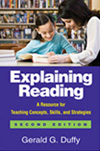 Teachers all over look to Gerald G. Duffy, EdD, for his expert advice on how to teach reading, and part and parcel of Duffy's reading strategies is his focus on vocabulary. In this excerpt from his best-selling text Explaining Reading, Duffy demonstrates how semantic maps can help students visualize how word meanings can be categorized.
Continue reading...
Teachers all over look to Gerald G. Duffy, EdD, for his expert advice on how to teach reading, and part and parcel of Duffy's reading strategies is his focus on vocabulary. In this excerpt from his best-selling text Explaining Reading, Duffy demonstrates how semantic maps can help students visualize how word meanings can be categorized.
Continue reading...
Maria C. of Jersey City, NJ writes in with today's Mailbag Friday question: "My coworker always uses the word reticent when he really means reluctant. Isn't he using the wrong word?"
Continue reading...
 Bob Greenman, an award-winning writer, educator, and speaker, has written two outstanding guides to vocabulary enrichment: Words That Make a Difference and More Words That Make a Difference, with illustrative passages from the New York Times and the Atlantic Monthly, respectively. We asked Bob to pick some choice words from the second volume (co-authored with his wife, Carol), and he came up with a trio of words exposing the seamy underbelly of Old Hollywood.
Continue reading...
Bob Greenman, an award-winning writer, educator, and speaker, has written two outstanding guides to vocabulary enrichment: Words That Make a Difference and More Words That Make a Difference, with illustrative passages from the New York Times and the Atlantic Monthly, respectively. We asked Bob to pick some choice words from the second volume (co-authored with his wife, Carol), and he came up with a trio of words exposing the seamy underbelly of Old Hollywood.
Continue reading...
Yesterday, writing teacher Margaret Hundley Parker offered a delightful lesson on the perils of learning grammar from rock and roll lyrics. Among the grammatical malefactors are Bob Dylan, whose song "Lay, Lady, Lay" uses the verb lay in an intransitive fashion instead of lie. Likewise, Dylan sang "If not for you, babe, I'd lay awake all night," and "I wanna lay right down and die." But he should get points for using lay in the transitive too, as in: "Lay down your weary tune," or using lay as the proper past-tense form of lie: "I spied an old hobo, in a doorway he lay." Still, if the foremost bard of American popular music can't be consistent on this point, what hope is there for the rest of us?
Continue reading...
Sign up now (it’s free!)
Whether you’re a teacher or a learner,
Vocabulary.com can put you or your class
on the path to systematic vocabulary improvement.