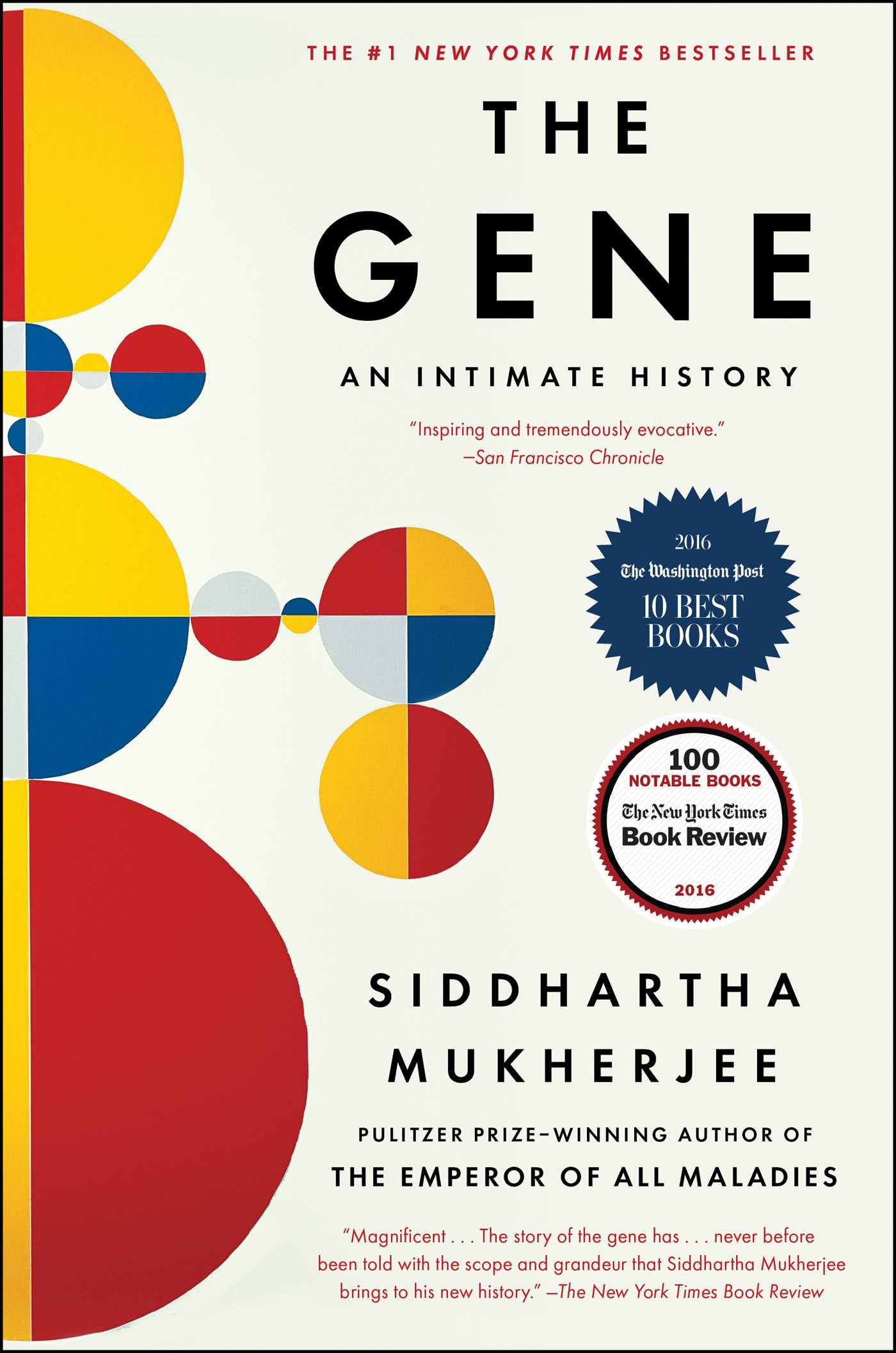
The Gene: Part Four
In this engaging work of nonfiction, Pulitzer Prize-winning author Siddhartha Mukherjee delves into genetics, tracing how our scientific understanding of genes and heredity has changed over time.
Here are links to our lists for the book: Prologue–Part One, Part Two, Part Three, Part Four, Part Five, Part Six–Epilogue
45 words
197 learners
Learn words with Flashcards and other activities
Definition First

Other learning activities
Full list of words from this list:
-
collagen
a fibrous protein found in bone and connective tissueOther families were afflicted by osteogenesis imperfecta, a disease caused by a mutation in a gene for collagen, a protein that forms and strengthens bone.
-
concomitant
following or accompanying as a consequenceMost notably, perhaps, children with Down syndrome have an extraordinary sweetness of temperament, as if in inheriting an extra chromosome they had acquired a concomitant loss of cruelty and malice (if there is any doubt that genotypes can influence temperament or personality, then a single encounter with a Down child can lay that idea to rest).
-
paradigm
the generally accepted perspective of a disciplineThese illnesses lay on the opposite end of the One Gene-One Disease paradigm; they were Many Genes-Many Diseases.
-
aberration
a state or condition markedly different from the normUnlike Marfan or Down syndrome, where a single potent mutation or a chromosomal aberration was necessary and sufficient to cause the disease, the effect of any individual gene in polygenic syndromes was dulled.
-
incongruity
the quality of disagreeingThe definition of disease rests, rather, on the specific disabilities caused by an incongruity between an individual’s genetic endowment and his or her current environment—between a mutation, the circumstances of a person’s existence, and his or her goals for survival or success. It is not mutation that ultimately causes disease, but mismatch.
-
inextricably
in a manner incapable of being disentangled or untiedIf the entry of genetics into the human world carried one immediate lesson, it was this: the imperfect was not just our paradise; it was also, inextricably, our mortal world.
-
multifarious
having many aspectsThe most remarkable feature of X-Men was not its growing, multifarious menagerie of mutant characters—a wolf man with steel claws or a woman able to summon English weather on command—but the reversed roles of the victim and the victimizer.
-
preeminent
greatest in importance, degree, or significanceAs the legal scholar Alexander Bickel described it, “The individual’s [i.e., mother’s] interest, here, overrides society’s interest in the first three months and, subject only to health regulations, also in the second; in the third trimester, society is preeminent.”
-
ad hoc
often improvised or impromptuAd hoc judges were not called in to classify men and women as “imbeciles,” “morons,” and “idiots,” nor was chromosome number decided as a matter of personal taste.
-
laissez-faire
with minimally restricted freedom, especially in commerceBut coupled to this was the desire to instigate an equally expansive, laissez-faire form of “positive eugenics”—a means to select for favorable genetic attributes.
-
germinal
containing seeds of later developmentAlthough Graham’s “genius bank” was ridiculed and eventually disbanded, its early advocacy of “germinal choice”—that individuals should be free to pick and choose the genetic determinants of their offspring—was hailed by several scientists.
-
tenable
based on sound reasoning or evidence...but selecting “genius genes”...was considered a perfectly tenable prospect for the future.
-
staunch
firm and dependable especially in loyaltySupport from scientists, intellectuals, writers, and philosophers poured into the movement. Francis Crick staunchly backed neo-eugenics, as did James Watson.
-
lucidity
freedom from obscurity of expression; comprehensibilityAs McKusick and his colleagues were discovering with increasing lucidity, the interactions between human genes and illnesses were vastly more complicated than newgenics might have anticipated.
-
lesion
any localized abnormal structural change in a bodily partFor Down syndrome, where the chromosomal abnormality was distinct and easily identifiable, and where the link between the genetic lesion and the medical symptoms was highly predictable, prenatal testing...might seem justifiable.
-
cadaverous
very thin, especially from disease or hunger or coldWe suddenly came upon two women, mother and daughter, both tall, thin, almost cadaverous, both bowing, twisting, grimacing.
-
erratic
having no fixed courseIn the summer of 1968, when Wexler was twenty-two, her mother, Leonore Wexler, was chastised by a policeman for walking erratically while crossing a street in Los Angeles.
-
denouement
the outcome of a complex sequence of eventsPart of the macabre denouement of Huntington’s is the late onset of the illness.
-
asymptomatic
having no signs or manifestations of an illness or diseaseNancy and Alice were still asymptomatic, but they each carried a 50 percent chance of being affected, with no genetic test for the disease.
-
prevalence
ratio of occurrences of a disease or event to units at riskA few years earlier, Milton Wexler had heard from a Venezuelan neurologist of two neighboring villages, Barranquitas and Lagunetas, on the shores of Lake Maracaibo in Venezuela with a striking prevalence of Huntington's disease.
-
staccato
marked by or composed of disconnected parts or soundsThere is something in the man’s walk that seems profoundly unnatural. A few steps, and his body begins to move with jerking, staccato gestures, while his hand traces sinuous arcs in midair.
-
sinuous
curved or curving in and outThere is something in the man’s walk that seems profoundly unnatural. A few steps, and his body begins to move with jerking, staccato gestures, while his hand traces sinuous arcs in midair.
-
assiduously
with care and persistenceThey assiduously collected and assembled a family tree of the Venezuelan kindred.
-
derelict
forsaken by owner or inhabitantsIt was a strange region of the genome, largely barren, with a few unknown genes within it. For the team of geneticists, it was like the sudden landing of a boat on a derelict beachhead, with no known landmarks in sight.
-
behemoth
someone or something that is abnormally large and powerfulIT15 was found to encode an enormous protein—a biochemical behemoth containing 3,144 amino acids, larger than nearly any other protein in the human body (insulin has a mere 51 amino acids).
-
aggregate
gather in a mass, sum, or wholeThe longer protein is thought to be aggregated into pieces in neurons, and these pieces accumulate in tangled spools inside cells, possibly leading to their death and dysfunction.
-
viscous
having a relatively high resistance to flowThe secretions of the lung were so viscous that they blocked the airways with gobs of mucus.
-
sanguine
confidently optimistic and cheerfulOther scientists, anticipating this biological revolution, had been less sanguine about it. As the geneticist J. B. S. Haldane had described it in 1923, once the power to control genes had been harnessed, “no beliefs, no values, no institutions are safe.”
-
organelle
a specialized part of a cell; analogous to an organCells and intracellular organelles were revealed, raising questions about the inner anatomy and physiology of a cell, and demanding yet more powerful microscopes to understand the structures and functions of these subcellular compartments.
-
balk
refuse to proceed or complyIn principle, the technology to sequence an entire organismal genome had been invented, but the sheer size of the effort had made scientists balk.
-
disquieting
causing mental discomfortThat cancer was the result of alterations of such endogenous genetic pathways—a “distorted version of our normal selves,” as Harold Varmus, the cancer biologist, put it—was ferociously disquieting: for decades, scientists had hoped that some pathogen, such as a virus or bacterium, would be implicated as the universal cause of cancer, and might potentially be eliminated via a vaccine or antimicrobial therapy.
-
incendiary
inciting action or rebellionPopulist anxieties about genes, mental illness, and crime were fanned further with the publication in the summer of 1985 of Crime and Human Nature: The Definitive Study of the Causes of Crime, an incendiary book written by James Q. Wilson, a political scientist, and Richard Herrnstein, a behavioral biologist.
-
etiology
the cause of a diseaseEven die-hard believers of the genetic theory of schizophrenia had to admit that the etiology of the illness was largely unknown, that acquired influences had to play a major triggering role (hence the 50—not 100—percent concordance among identical twins), and that the vast majority of schizophrenics lived in the terrifying shadow of their illness but had no history of criminality whatsoever.
-
panache
distinctive and stylish eleganceTo sequence all 3 billion base pairs of human DNA, Gilbert estimated, would take about fifty thousand person years and cost around $3 billion—one dollar per base. As Gilbert, with characteristic panache, strode across the floor to inscribe the number on a chalkboard, an intense debate broke out in the audience.
-
demarcate
set, mark, or draw the boundaries of somethingThe structure of the human genome can thus be likened to a sentence that reads—
This…...is the…...str... uc...ture…...of...your…(...gen...ome…)...
—where the words correspond to the genes, the ellipses correspond to the spacers and stuffers, and the occasional punctuation marks demarcate the regulatory sequences of genes. -
reverential
feeling or manifesting profound respect or aweIn the hushed, reverential minute that followed the end of the presentations, Venter did not hesitate to drive a switchblade through his competitors’ spines: “Oh, and by the way, we [have] just started sequencing human DNA, and it looks as if [the technical hurdles are] going to be less of a problem than they had been with the fly.”
-
terse
brief and to the pointClinton had sent his aides a note with a terse, two-word dictum—“Fix this!”—appended to the margin.
-
acquiesce
agree or express agreementVenter mulled over the possibility and acquiesced—but with several caveats.
-
caveat
a warning against certain actsVenter mulled over the possibility and acquiesced—but with several caveats.
-
tortuous
marked by repeated turns and bendsLike so many truces, the fragile armistice between Venter and Collins barely outlived its tortuous birth.
-
amenable
open to being acted upon in a certain wayNot every part of the genome was amenable to cloning and sequencing, and assembling nonoverlapping segments was vastly more complicated than had been anticipated, like solving a puzzle containing pieces that had fallen into the cracks of furniture.
-
consortium
a cooperative association among institutions or companiesOn February 15 and 16, 2001, the Human Genome Project consortium and Celera published their papers in Nature and Science, respectively.
-
respectively
in the order givenOn February 15 and 16, 2001, the Human Genome Project consortium and Celera published their papers in Nature and Science, respectively.
-
intersperse
place between or amongAn enormous proportion—a bewildering 98 percent—is not dedicated to genes per se, but to enormous stretches of DNA that are interspersed between genes (intergenic DNA) or within genes (introns).
-
idiosyncrasy
a behavioral attribute peculiar to an individualThese fragments are vastly more common than genes, resulting in yet another major idiosyncrasy of our genome: much of the human genome is not particularly human.
Created on Fri Oct 18 17:01:04 EDT 2019
(updated Wed Oct 30 08:24:33 EDT 2019)
Sign up now (it’s free!)
Whether you’re a teacher or a learner,
Vocabulary.com can put you or your class
on the path to systematic vocabulary improvement.