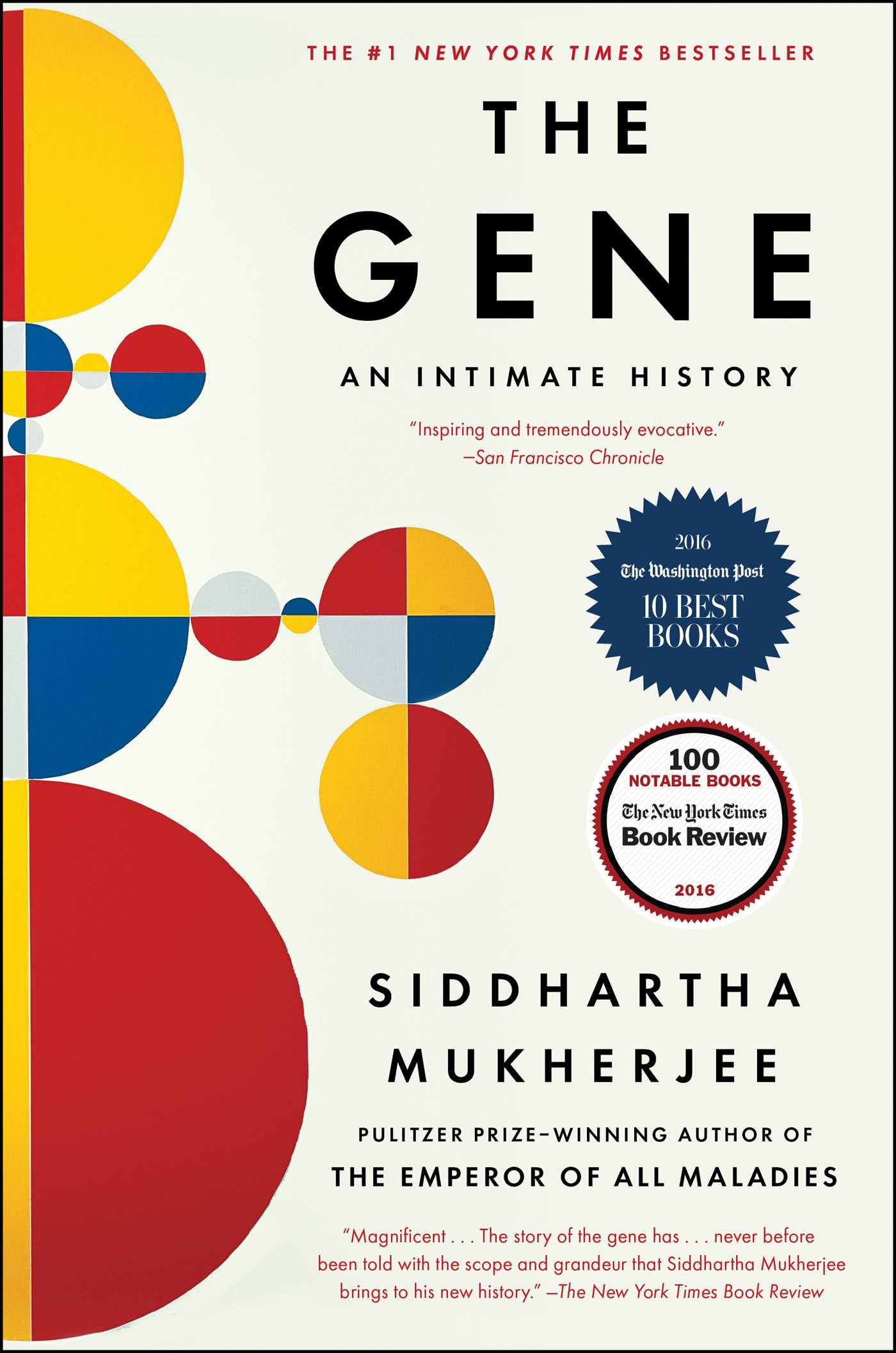
The Gene: Prologue–Part One
In this engaging work of nonfiction, Pulitzer Prize-winning author Siddhartha Mukherjee delves into genetics, tracing how our scientific understanding of genes and heredity has changed over time.
Here are links to our lists for the book: Prologue–Part One, Part Two, Part Three, Part Four, Part Five, Part Six–Epilogue
45 words
590 learners
Learn words with Flashcards and other activities
Definition First

Other learning activities
Full list of words from this list:
-
avuncular
being or relating to an uncleBut my father knew—and I knew—that there was more than just avuncular love at stake for him in these visits.
-
precipitate
bring about abruptlyBoth my father and my grandmother believed that Jagu’s and Rajesh’s mental illnesses had been precipitated—even caused, perhaps—by the apocalypse of Partition, its political trauma sublimated into their psychic trauma.
-
confabulation
a plausible but imagined memoryVisions and voices had started to appear in his adolescence. The need for isolation, the grandiosity of the confabulations, the disorientation and confusion—these were all eerily reminiscent of his uncle’s descent.
-
egregious
conspicuously and outrageously bad or reprehensibleA few weeks later, he committed a “crime” that was so comically egregious that it could only be a testament to his loss of sanity: he was caught flirting with one of the goon’s sisters (again, he said that the voices had commanded him to act).
-
fugue
dissociative disorder in which a person forgets who they areMy father had had at least two psychotic fugues in his life—both precipitated by the consumption of bhang...
-
discrete
constituting a separate entity or partBy byte I am referring to a rather complex idea—not only to the familiar byte of computer architecture, but also to a more general and mysterious notion that all complex information in the natural world can be described or encoded as a summation of discrete parts, containing no more than an “on” and “off” state.
-
evocative
serving to bring to mindThis theory was most evocatively proposed by the physicist John Wheeler in the 1990s: “Every particle, every field of force, even the space-time continuum itself—derives its function, its meaning, its very existence entirely...from answers to yes-or-no questions, binary choices, bits...; in short, that all things physical are information-theoretic in origin.”
-
inherently
in an essential mannerThe simple answer is that matter, information, and biology are inherently hierarchically organized: understanding that smallest part is crucial to understanding the whole.
-
macabre
shockingly repellent; inspiring horrorThe gene entrances English and American reformers, who hope to manipulate human genetics to accelerate human evolution and emancipation. That idea escalates to its macabre zenith in Nazi Germany in the 1940s, where human eugenics is used to justify grotesque experiments, culminating in confinement, sterilization, euthanasia, and mass murder.
-
gamut
a complete extent or rangeTwo technologies transform genetics in the 1970s: gene sequencing and gene cloning—the “reading” and “writing” of genes (the phrase gene cloning encompasses the gamut of techniques used to extract genes from organisms, manipulate them in test tubes, create gene hybrids, and produce millions of copies of such hybrids in living cells.)
-
ignominy
a state of dishonorThe midtown real estate was far too valuable to house them, the emperor had decreed bluntly—and the monks were packed off to a crumbling structure at the bottom of the hill in Old Brno, the ignominy of the relocation compounded by the fact that they had been assigned to live in quarters originally designed for women.
-
redoubtable
worthy of respect or honorPhysics was taught by Christian Doppler, the redoubtable Austrian scientist who would become Mendel’s mentor, teacher, and idol.
-
beget
have childrenWhat kept elephants from morphing into pigs, or kangaroos into beavers? What was the mechanism of heredity? Why, or how, did like beget like?
-
corporeal
characteristic of the body as opposed to the mind or spiritOccasionally, the feature transmitted through heredity was not even corporeal: a manner of walking, say, or a way of staring into space, or even a state of mind.
-
homunculus
a fully formed individual thought to be in the sperm cellSince the homunculus had to mature and produce its own children, it had to have preformed mini-homunculi lodged inside it—tiny humans encased inside humans, like an infinite series of Russian dolls, a great chain of beings that stretched all the way backward from the present to the first man, to Adam, and forward into the future.
-
propagation
the act of producing offspringMen came from small men, as large trees came from small cuttings. “In nature there is no generation,” the Dutch scientist Jan Swammerdam wrote in 1669, “but only propagation.”
-
propensity
a disposition to behave in a certain wayLimbs, torsos, brains, eyes, faces—even temperaments or propensities that were inherited—had to be created anew each time an embryo unfurled into a human fetus.
-
impetus
a force that makes something happenBy what impetus, or instruction, was the embryo, and the final organism, generated from sperm and egg?
-
tractable
easily managedBut the second problem, Herschel thought, was more tractable: Once life had been created, what process generated the observed diversity of the natural world?
-
injunction
a formal command or admonitionThe injunctions against the wrong kinds of investigation were so sharp that the parson-naturalists did not even question the myths of creation; it was the perfect separation of church and mental state.
-
apposite
being of striking appropriateness and pertinenceSlung on a hammock bed above the salt-starched survey maps, he pored over the few books that he had brought with him on the voyage—Milton’s Paradise Lost (which seemed all too apposite to his condition), and Charles Lyell’s Principles of Geology, published between 1830 and 1833.
-
endemic
native to or confined to a certain regionThere were two or three varieties, but each subtype was markedly distinct, and each was endemic to one particular island.
-
piebald
having sections or patches colored differently and brightlyPigeons could be made to look like roosters and peacocks, and dogs made short-haired, long-haired, pied, piebald, bowlegged, hairless, crop-tailed, vicious, mild-mannered, diffident, guarded, belligerent.
-
diffident
showing modest reservePigeons could be made to look like roosters and peacocks, and dogs made short-haired, long-haired, pied, piebald, bowlegged, hairless, crop-tailed, vicious, mild-mannered, diffident, guarded, belligerent.
-
wont
an established customA population’s inherent inclination to expand would be severely counterbalanced by the limitations of resources; its natural wont met by natural want.
-
intrinsic
belonging to a thing by its very natureFor Darwinian evolution to work, the mechanism of inheritance had to possess an intrinsic capacity to conserve information without becoming diluted or dispersed.
-
allele
any of the forms of a gene that can occupy the same locusThe existence of dominant and recessive alleles for a trait contradicted nineteenth-century theories of blending inheritance: the hybrids that Mendel had generated did not possess intermediate features. Only one allele had asserted itself in the hybrid, forcing the other variant trait to vanish.
-
progeny
the immediate descendants of a personHe bred short-tall hybrids with short-tall hybrids to produce third-generation progeny.
-
corpuscle
(nontechnical usage) a tiny piece of anythingBehind the epic variance of natural organisms—tall; short; wrinkled; smooth; green; yellow; brown—there were corpuscles of hereditary information, moving from one generation to the next.
-
desultory
marked by lack of definite plan, purpose, or enthusiasmLike Fermat—the odd French mathematician who had tantalizingly scribbled that he’d found a “remarkable proof” of his theorem, but failed to write it down because the paper’s “margin was too small”—Darwin had desultorily announced that he had found a solution to heredity, but had never published it.
-
excise
remove by cuttingWeismann had surgically excised the tails of five generations of mice, then bred the mice to determine if the offspring would be born tailless.
-
menagerie
a collection of live animals for study or displayBut like Mendel, he began to scour the countryside around Amsterdam to collect strange plant variants—not just peas, but a vast herbarium of plants with twisted stems and forked leaves, with speckled flowers, hairy anthers, and bat-shaped seeds: a menagerie of monsters.
-
preempt
gain possession of by prior right or opportunityReading the paper, he must have felt that inescapable chill of déjà vu running through his spine: the “certain Mendel” had certainly preempted de Vries by more than three decades.
-
despondency
feeling downcast and disheartened and hopeless“I too still believed that I had found something new,” he would later write, with more than a tinge of envy and despondency.
-
proselytize
convert or try to convert someone to another religionDoubly convinced by Mendel’s experimental data, and by his own evidence, Bateson set about proselytizing. Nicknamed “Mendel’s bulldog”—an animal that he resembled both in countenance and temperament—Bateson traveled to Germany, France, Italy, and the United States, giving talks on heredity that emphasized Mendel’s discovery.
-
polymath
a person of great and varied learningHis father was a wealthy banker in Birmingham; his mother was the daughter of Erasmus Darwin, the polymath poet and doctor, who was also Charles Darwin's grandfather.
-
eugenics
the promotion of controlled breeding in human populationsFor Galton, the word eugenics was an opportune fit—“at least a neater word...than viriculture, which I once ventured to use.” It combined the Greek prefix eu—“good”—with genesis: “good in stock, hereditarily endowed with noble qualities.”
-
galvanize
stimulate to actionIn 1859, Galton read Darwin's Origin of Species. Rather, he “devoured” the book: it struck him like a jolt of electricity, both paralyzing and galvanizing him.
-
miscegenation
marriage or reproduction by people of different racesLike many members of the Victorian elite, Galton and his friends were chilled by the fear of race degeneration (Galton’s own encounter with the “savage races,” symptomatic of Britain’s encounter with colonial natives throughout the seventeenth and eighteenth centuries, had also convinced him that the racial purity of whites had to be maintained and protected against the forces of miscegenation).
-
monolithic
imposing in size or bulk or solidityThe location was symbolic. With nearly eight hundred rooms and a vast, monolithic façade overlooking the Thames, the Cecil was Europe’s largest, if not grandest, hotel—a site typically reserved for diplomatic or national events.
-
contingent
a gathering of persons representative of some larger groupThe second presentation—even larger in its scope and ambition—was presented by the American contingent.
-
cursory
hasty and without attention to detail; not thoroughA cursory mental examination, performed on April 1, 1920, by two doctors, classified her as “feebleminded.”
-
promulgate
put a law into effect by formal declarationWhite eugenicists in America had long convulsed with the fear that African slaves, with their inferior genes, would intermarry with whites and thereby contaminate the gene pool—but laws to prevent interracial marriages, promulgated during the 1860s, had calmed most of these fears.
-
manifest
clearly revealed to the mind or the senses or judgmentWriting the 8–1 majority opinion, Oliver Wendell Holmes Jr. reasoned, “It is better for all the world, if instead of waiting to execute degenerate offspring for crime, or to let them starve for their imbecility, society can prevent those who are manifestly unfit from continuing their kind. The principle that sustains compulsory vaccination is broad enough to cover cutting the Fallopian tubes.”
-
virulent
extremely poisonous or injurious; producing venomAs the front of the American eugenics movement advanced from imprisonment to sterilization to outright murder, European eugenicists watched the escalation with a mix of eagerness and envy. By 1936, less than a decade after Buck v. Bell, a vastly more virulent form of “genetic cleansing” would engulf that continent like a violent contagion, morphing the language of genes and inheritance into its most potent and macabre form.
Created on Fri Oct 18 16:58:21 EDT 2019
(updated Wed Oct 30 08:24:06 EDT 2019)
Sign up now (it’s free!)
Whether you’re a teacher or a learner,
Vocabulary.com can put you or your class
on the path to systematic vocabulary improvement.