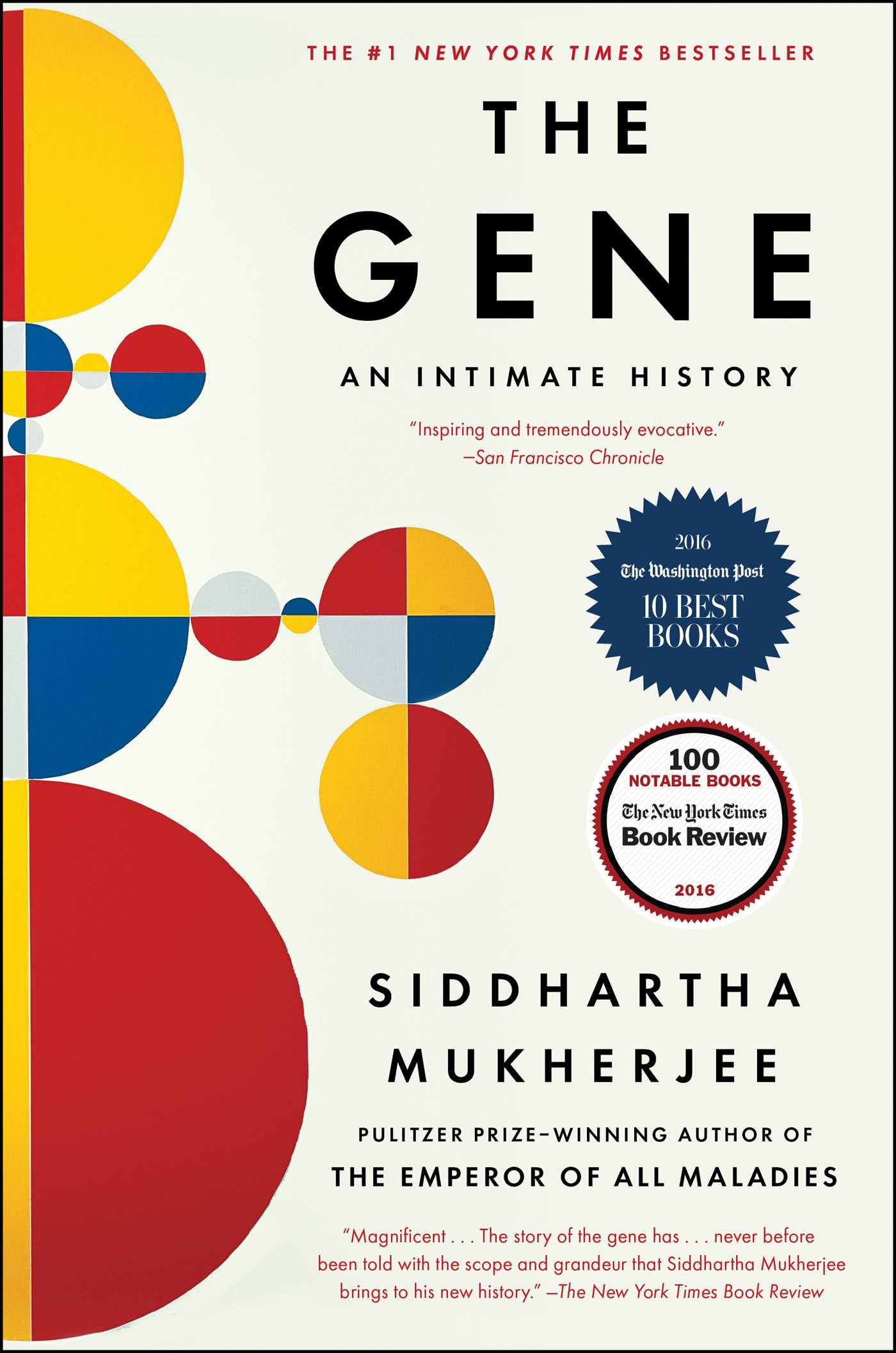
The Gene: Part Two
In this engaging work of nonfiction, Pulitzer Prize-winning author Siddhartha Mukherjee delves into genetics, tracing how our scientific understanding of genes and heredity has changed over time.
Here are links to our lists for the book: Prologue–Part One, Part Two, Part Three, Part Four, Part Five, Part Six–Epilogue
45 words
219 learners
Learn words with Flashcards and other activities
Definition First

Other learning activities
Full list of words from this list:
-
postulate
maintain or assertIn the summer of 1902, working on grasshopper sperm and egg cells—which have particularly gigantic chromosomes—Sutton also postulated that genes were physically carried on chromosomes.
-
laconic
brief and to the pointMuller was favored the least: Morgan found him shifty, laconic, and disengaged from the other members of the lab.
-
unctuous
unpleasantly and excessively suave or ingratiatingAs Alexei grew older, and the hemorrhages more life threatening, Alexandra began to rely on a Russian monk of legendary unctuousness, Grigory Rasputin, who promised to heal the czar-to-be.
-
visceral
coming from deep inward feelings rather than from reasoningEven by the grim standards of Russian assassinations, the violence of this murder was a testimony to the visceral hatred that he had inspired in his enemies.
-
succinct
briefly giving the gist of somethingThe title was rambling, but the message was succinct: if you mixed the effects of three to five variant genes on any trait, you could generate nearly perfect continuity in phenotype.
-
inoculate
insert a bud for propagationHe inoculated two sealed, aerated cartons with a mixture of two fly strains—ABC and CBA—in a one-to-one ratio. One carton was exposed to a cold temperature. The other, inoculated with the same mixture of strains, was left at room temperature.
-
milieu
the environmental conditionObviously, the environment or the milieu that surrounds an organism contributes to its physical attributes.
-
vestigial
not fully developed in mature animalsIn flies, for instance, a gene that determines the size of a vestigial wing depends on temperature: you cannot predict the shape of the wing based on the fly’s genes or on the environment alone; you need to combine the two pieces of information.
-
indolent
slow to heal or develop and usually painlessOne woman with the BRCA1 mutation might develop an aggressive, metastatic variant of breast cancer at age thirty. Another woman with the same mutation might develop an indolent variant; and yet another might not develop breast cancer at all.
-
salubrious
promoting healthEven if that bearer possesses multiple other genes that are salubrious in the long run—a gene for tenacity or for withstanding excruciating pain—the entire gamut of these genes will be damned to extinction during the mating contest, all because of that damned nose.
-
conjecture
a hypothesis that has been formed by speculatingThis mechanism of speciation was not just conjecture; Dobzhansky could demonstrate it experimentally.
-
strident
being sharply insistent on being heard“Seek simplicity, but distrust it,” Alfred North Whitehead, the mathematician and philosopher, once advised his students. Dobzhansky had sought simplicity—but he had also issued a strident moral warning against the oversimplification of the logic of genetics.
-
cohort
a group of people having approximately the same ageIn the winter of 1926, acting on a whim, he exposed a cohort of flies to an even lower dose of radiation.
-
proclivity
a natural inclinationMuller was also hounded for his political proclivities.
-
agitprop
political propaganda communicated via art and literatureWhile the state-run agitprop machine churned to generate passive consent for eugenic sterilizations, the Nazis ensured that the legal engines were also thrumming to extend the boundaries of racial cleansing.
-
adjudicate
hear a case and sit as the judge at the trial ofBy 1934, nearly five thousand adults were being sterilized every month, and two hundred Hereditary Health Courts (or Genetic Courts) had to work full-time to adjudicate appeals against sterilization.
-
euphemism
an inoffensive expression substituted for an offensive oneTo justify the exterminations, the Nazis had already begun to describe the victims using the euphemism lebensunwertes Leben—lives unworthy of living.
-
pretext
a fictitious reason that conceals the real reasonJewish children were disproportionately targeted—forcibly examined by state doctors, labeled “genetically sick,” and exterminated, often on the most minor pretexts.
-
conflate
mix together different elementsNever before in history, and never with such insidiousness, had genes been so effortlessly conflated with identity, identity with defectiveness, and defectiveness with extermination.
-
moribund
not growing or changing; without force or vitalityThe gene, he argued, had been “invented by geneticists” to support a “rotting, moribund bourgeoisie” science.
-
vociferous
conspicuously and offensively loudA dermatologist by training, Siemens was a student of Ploetz’s and a vociferous early proponent of racial hygiene.
-
concordance
a harmonious state of things and of their propertiesThe key test of heredity would be concordance. The term concordance refers to the fraction of twins who possess a trait in common. If twins share eye color 100 percent of the time, then the concordance is 1. If they share it 50 percent of the time, then the concordance is 0.5. Concordance is a convenient measure for whether genes influence a trait.
-
ersatz
artificial and inferiorDespite the ersatz patina of science, Mengele’s work was of the poorest scientific quality. Having subjected hundreds of victims to experiments, he produced no more than a scratched, poorly annotated notebook with no noteworthy results.
-
dearth
an insufficient quantity or number“Hitler may have ruined the long term prospects of German science,” George Orwell wrote in 1945, but there was no dearth of “gifted [German] men to do necessary research on such things as synthetic oil, jet planes, rocket projectiles and the atomic bomb.”
-
posit
put forward, as an ideaThe gene, Schrödinger posited, had to be made of a peculiar kind of chemical; it had to be a molecule of contradictions.
-
entropy
energy in a system no longer available for mechanical workOrganisms exist not because of reactions that are possible, but because of reactions that are barely possible. Too much reactivity and we would spontaneously combust. Too little, and we would turn cold and die. Proteins enable these barely possible reactions, allowing us to live on the edges of chemical entropy—skating perilously, but never falling in.
-
detritus
the remains of something that has been destroyed or finishedBy October 1940, they began to sift through the concentrated bacterial detritus, painstakingly separating each chemical component, and testing each fraction for its capacity to transmit genetic information.
-
subsume
contain or includeThe pretext of genetic cleansing had largely been subsumed by its progression into ethnic cleansing.
-
deus ex machina
an agent who appears unexpectedly to solve a difficultyMedieval biology had departed from that tradition, conjuring up “vital” forces and mystical fluids that were somehow unique to life—a last-minute deus ex machina to explain the mysterious workings of living organisms (and justify the existence of the deus).
-
lattice
an arrangement of points in a regular periodic patternThe only solution to the problem is ingenious: transform a molecule from a solution to a crystal—and its atoms are instantly locked into position. Now the shadows become regular; the lattices generate ordered and readable silhouettes.
-
bonhomie
a disposition to be friendly and approachableWhat she was trying to drown, really, was noise. The chink of beer mugs in pubs infested by men; the casual bonhomie of men discussing science in their male-only common room at King’s.
-
voluble
marked by a ready flow of speechIn the audience that morning—“shirttails flying, knees in the air, socks down around his ankles...cocking his head like a rooster”—was a biologist Wilkins had never heard of, an excitable, voluble young man named James Watson.
-
seminal
influential and providing a basis for later developmentPauling’s seminal paper on the protein helix was published in April 1951. Festooned with equations and numbers, it was intimidating to read, even for experts.
-
pedagogical
relating to the study of teachingAs Gosling recalled, “Rosalind let rip in her best pedagogical style: ‘you’re wrong for the following reasons’...which she proceeded to enumerate as she demolished their proposal.”
-
precarious
not secure; beset with difficultiesThe most important function of DNA—its capacity to transmit copies of information from cell to cell, and organism to organism—was buried in the structure. Message; movement; information; form; Darwin; Mendel; Morgan: all was writ into that precarious assemblage of molecules.
-
equanimity
steadiness of mind under stressThe fussy biochemical setup had taken weeks to perfect—except each time the ribosomes were caught, they crumbled and fell apart. Inside cells, ribosomes seemed to stay glued together with absolute equanimity.
-
ubiquitous
being present everywhere at onceIt had to be something small, common, and ubiquitous—a tiny dab of molecular glue.
-
nascent
being born or beginningBy similar logic, the interlocking of just a few crucial concepts relaunched the science of genetics. In time, as with Newtonian mechanics, the “central dogma” of genetics would be vastly refined, modified, and reformulated. But its effect on the nascent science was profound: it locked a system of thinking into place.
-
turbid
clouded as with sedimentGrown on either sugar alone, the bacterium begins to divide rapidly, doubling in number every twenty minutes or so. The curve of growth can be plotted as an exponential line—1, 2-, 4-, 8-, 16-fold growth—until the culture turns turbid, and the sugar source has been exhausted.
-
temporize
draw out a discussion or process in order to gain timeWitkin and Elledge, working independently, identified an entire cascade of proteins that sensed DNA damage, and activated a cellular response to repair or temporize the damage (if the damage was catastrophic, it would halt cell division).
-
abrogate
revoke formallyIn the late 1980s, Nüsslein-Volhard and her students began to characterize a final flock of fly mutants in which asymmetrical organization of the embryo had been abrogated.
-
outstrip
be or do something to a greater degreeTo understand how genes instruct the fates of cells, Brenner needed an organism so small and simple that each cell arising from the embryo could be counted and followed in time and space (as a point of comparison, humans have about 37 trillion cells. A cell-fate map of humans would outstrip the computing powers of the most powerful computers).
-
ablation
surgical removal of a body part or tissueShe used a laser to singe and kill single cells in a worm’s body. The ablation of one cell could change the fate of a neighboring cell, she found, but under severe constraints.
-
pliant
capable of being influenced or formedIn contrast, cells that were “naturally ambiguous” were more pliant—but even so, their capacity to alter their destiny was limited.
-
meniscus
the curved upper surface of a liquid in a vertical tubeMy father listens silently, patiently—but I can feel the fiery meniscus of rage rising in him, coating his throat with bile.
Created on Fri Oct 18 17:00:07 EDT 2019
(updated Wed Oct 30 08:24:19 EDT 2019)
Sign up now (it’s free!)
Whether you’re a teacher or a learner,
Vocabulary.com can put you or your class
on the path to systematic vocabulary improvement.