The road to a Vocabulary Bowl championship
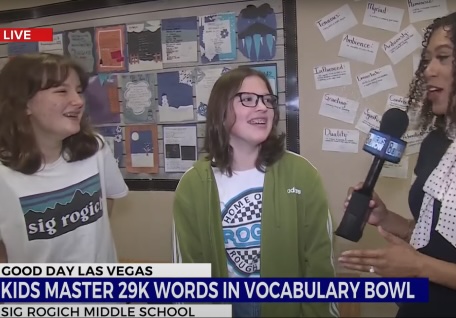
123 Pre-AP English students at Sig Rogich Middle School won the Division I Championship in the Fall 2023 Vocabulary Bowl—despite competing against schools across the country with whole-school implementations of 1,000 students or more. What was their secret? Plenty of practice and a little friendly competition. They mastered 29,000 words over the course of the two-month Vocabulary Bowl, leading to better writing and higher comprehension of high-school-level texts.

Sig Rogich Middle School
About the school
- Location:
- Las Vegas, NV
- Grades:
- 6-8
- Number of students:
- 1,567
- Characteristics:
- Large Urban Public
How they use Vocabulary.com
- Subjects:
- Pre-AP English 9 Honors
- License:
- Classroom license for 120 students
The challenges
Amanda La Roche teaches four sections of Pre-AP English 9 Honors for eighth graders at Sig Rogich. Eighth graders who successfully complete the course earn a high school honors credit.
The high school honors curriculum places a heavy emphasis on literary text, including novels, poetry, and plays. Many of these works have advanced or archaic vocabulary terms that middle school students are not typically familiar with. In poetry, for example, grasping the full meaning of a poem often depends on understanding wordplay that depends on a word’s multiple meanings. Students also grapple with Shakespeare’s plays, which use many unfamiliar terms and words whose meanings and connotations have changed since Shakespearean times.
Vocabulary is an important prerequisite for student success with these advanced texts. Amanda wanted to give students the word knowledge they needed to fully comprehend an author’s meaning and engage deeply with literary works.

Students pose with their Vocabulary Bowl trophy
The solution
Amanda has a Vocabulary.com classroom license that provides access for all of her Pre-AP English students. She was delighted to find pre-made vocabulary lists aligned with the College Board Pre-AP English 1 curriculum. Each unit includes several lists for different texts used over the course of the unit. She can also find lists for the novels and plays students are reading in class. For example, Romeo and Juliet has five vocabulary lists, one for each act of the play. It’s simple to search for and find pre-made vocabulary lists from Vocabulary.com and custom lists uploaded by other teachers. With these resources, students can work on mastery of unfamiliar vocabulary before they start a new unit or book.
In addition to their curriculum-related vocabulary assignments, Amanda builds excitement and enthusiasm for continued word learning with VocabTrainer, Vocabulary.com’s gamified activity that uses adaptive learning to identify and systematically close each student’s vocabulary gaps. Amanda’s Pre-AP students tend to be high-achieving self-starters who are highly motivated by competition—both against each other and against other schools. The competitive and gamified aspects of Vocabulary.com motivate her students to build their overall vocabulary beyond their assignments.

Students love participating in competitive activities, such as Vocabulary Jams and the Vocabulary Bowl. The Vocabulary Bowl is the largest academic competition of its kind. Over 4 million students across 46,000 schools in the US and Canada have mastered 230 million words to see which school can master the most words during the Vocabulary Bowl season. The competition has three divisions based on school size: fewer than 500 students, 500-999 students, or 1,000+ students. Sig Rogich competes in Division I with the largest schools. Students earn points by mastering new words, either on assigned lists or on their own. Amanda motivates her students with her own monthly competitions across classes and prizes such as donuts or candy. With her encouragement, Amanda’s 123 students were able to master more words than any other elementary or middle school with over 1,000 students.

Here’s how Pre-AP English students are using Vocabulary.com:
- Amanda introduces vocabulary in advance of each unit. She assigns pre-made vocabulary lists every other Friday for the books or literary works she is teaching.
- Students have two weeks to demonstrate mastery of the lists assigned for the unit. Students can work on Vocabulary.com during dedicated class time or from home, taking as much (or as little) time as needed to master each list.
- If students have mastered the assigned lists, they may continue to learn on their own using VocabTrainer, which adapts to each student based on their vocabulary proficiency level.
- Amanda encourages fun competition within her classes using the Vocabulary Jams. Students also participate in the Vocabulary Bowl, competing against schools nationwide to master new words.
The results
Providing independent time to master vocabulary ahead of reading enables students to engage more effectively with the readings. Instead of spending class time explaining the basic meaning of a text, Amanda can focus on word choice, diction, and textual analysis. She says her students are able to go deeper into analysis and have more interesting discussions when they already understand the words they are reading. They are also applying their new vocabulary in their own writing.
Amanda also uses the ACT word lists to help students prepare for testing. Students have demonstrated strong growth in vocabulary on the MAP test, used as a district benchmark three times per year. Vocabulary is usually the weakest area on the English Language Arts portion of the test for incoming 8th graders. By the end of the year, it is often their strongest subject. Other teachers have noticed the students’ vocabulary gains across subjects, too, especially in writing assignments.
The Vocabulary Bowl has been a fun and motivating way to get students excited about learning vocabulary. Students love the competition and enjoy tracking their scores and rankings during the Bowl. As Amanda says, “They are in it to win it!”