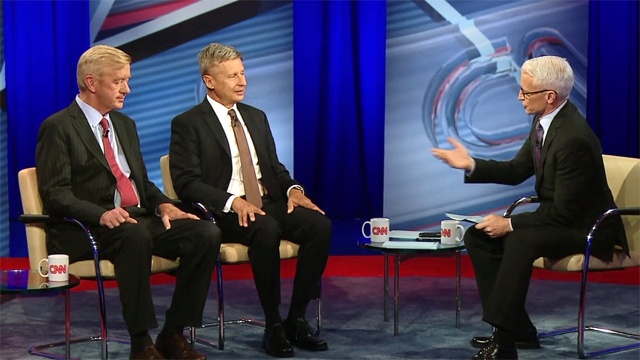
This election season has been unusual to say the least. By one poll 54% of those polled have an unfavorable view of the Democratic Nominee for President, while 58% have an unfavorable view of the Republican nominee.
So it makes some sense that Third Party candidates, traditionally tossed to the side and not really in the conversation, would try to get some notice for their campaigns by being likeable on television. On August 3, 2016, CNN held a Libertarian Town Hall where that party's presidential candidate, former New Mexico Governor Gary Johnson and his running mate, former Massachusetts Governor William Weld tried to explain their positions, answer questions from the audience and appear to be a person one could cast a vote for. Here is a full list of notable vocabulary from the Town Hall. Below, I present some discussion of some interesting vocabulary the candidates used while trying to portray themselves as viable alternatives.
Echelon
While discussing his achievements as Governor of Massachusetts, William Weld used the word echelon:
"And we took out the top three echelons of organized crime by concentrating all the knowledge in one place, and tips and hotlines."
As Weld uses it, echelon means "level" and the word comes from the French échelon which literally means "rung of the ladder." When borrowed into English, the word came to mean "step-like arrangement of troops." All of these variations are still relevant to Weld's usage, as a hierarchy of street "soldiers" can be thought of as what puts the "organized" in "organized crime."
Sinew
From structured crime organizations consisting of many men, to the inner workings of individuals, Governor Gary Johnson used the word sinew in his description of what he takes to be the American Character:
"To me, the real reason might be that we're decent people, we are both inclusive to the tips of our toes, great big, open, loving, if you will, society. And we know that this country has always been a melting pot. We know that's the strength -- the sinew of this country and we want to keep it that way."
Sinew is just a band of tissue that connects muscle to bone, but it's tough and stringy and not something one wants to find on their piece of meat at dinner. This, coupled with bad associations that may spring from the sound of the word, or its relative obscurity, would lead many people to substitute "marrow" or "bones" for sinew in the picture Johnson was painting with words above. Whether it's elegant or not, sinew is appropriate for the metaphor Johnson is constructing here. Sinew is traditionally associated with perseverance and deep reserves of strength, two qualities often associated with America, too. Sinew also binds things together, and Johnson is talking about what defines and holds the country together.
Crony
Sinew may bind individuals together, but relationships between people cement societies together. A crony is a friend, someone you've known for a long time. In fact, it probably comes from the Greek khronos for "time." From a definition standpoint the word may be innocent, but all its connotations are bad. You would never refer to someone as your crony unless you wanted to imply that the two of you were almost too close, so that your pal is given preferential treatment and it is unfair to others in business or other dealings. This sense of questionable backroom shenanigans is the one Gary Johnson invoked when he used the word in the Town Hall, and specifically the term "crony capitalism":
"And I think that, unfairly, the world has really connected crony capitalism and free trade...[they think] that it's one and the same, when in fact it's opposite. So we're all about free trade."
Crony Capitalism is about friendship and favoritism, about keeping the wealth in a small group instead of spreading it around. The best illustration of cronyism maybe an accusation that Johnson made against Hillary Clinton at another point during the Town Hall:
"Well, their own interests, if you will, that they're making money off of this...That [Hillary Clinton] as secretary of state, Bill goes out, does a million dollar speaking gig and then the next day, Hillary signs an agreement with the sponsor of that speaking gig, and, you know, that's not good."
Johnson is referring to Secretary Clinton's time as Secretary of State, and saying that the relationship between Bill Clinton's speaking engagements and Hillary Clinton's actions as Secretary of State were suspicious. This accusation, of you-scratch-my-back-i'll-scratch-yours, is the essence of being in a relationship as cronies. If true, this would be Crony Diplomacy.
It is too early to tell whether the Libertarian candidates will have a meaningful impact on the 2016 race for the White House. The first big hurdle for these candidates is getting their names and faces out there among the people. Gary Johnson and William Weld continued that process with the Town Hall and used some interesting vocabulary in the process.
