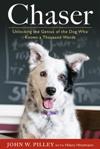
We've been reading this week about Chaser, the three-year-old border collie who has mastered more than 1000 distinct words and inspired her scientist trainer and owner John Pilley to write a book: Chaser: Unlocking the Genius of the Dog Who Knows a Thousand Words.
With appearances on Fox News and The Today Show, not to mention headlines like "World's Smartest Dog?" and "How My Dog Learned a Toddler-Level Vocabulary," we couldn't resist checking this story out and we're glad we didn't.
Because, as it turns out, even we human vocabulary learners can find inspiration in Chaser's and Pilley's story.
Lesson #1 Understand the process of language learning. Pilley used information about how humans learn language to break down what he and Chaser needed to cover in her training. He described the breakdown of learning this way in TIME and we point to it now because it's not something most of us think about as we learn words, but we should. We should be proud of what our brains can do!

Chaser learned that nouns and verbs have independent meanings and can be combined in many different ways (combinatorial understanding). She learned that a single thing can have more than one name, like a favorite stuffed animal that can be identified both by a unique proper name like Franklin and the common noun toy (many-to-one mapping). She learned that a single common noun, like stick or car, can identify several different things (one-to-many mapping). And she learned to reason by exclusion, meaning that she can identify a new object she’s never seen from among a group of familiar objects simply on the basis of hearing its name for the first time (drawing an inference).
 Lesson #2 Trust the distributed practice and practice testing you're using at Vocabulary.com. Apparently, they work for dogs as well. If you've been learning words here, New York Times science writer Nicholas Wade's description of Pilley's teaching technique will sound familiar.
He would show her an object, say its name up to 40 times.... She was taught one or two new names a day, with monthly revisions and reinforcement for any names she had forgotten.
Lesson #3 Learn in a way that brings you joy. Pilley taught Chaser in a way that Chaser best responded to — through play. And not just any kind of play. In a trailer for his book, Pilley describes how important it is to play in the way an animal naturally gravitates to.
Play is the major, major reinforcer for Chaser's learning....Play has to depend on the dog's basic endowment as far as instincts are concerned. Her primary instinct is to herd. These instincts are so endowed within different species that the expression of these yield tremendous joy to the dog and really, really powerfully reinforce the behaviors as they follow.
What is the equivalent to herding games for humans?
We suggest it's games like the one you play on Vocabulary.com. We hear over and over that our game is addictive, and we're not surprised. From magazine quizzes to trivia night in a local pub, human beings like to be asked questions and get instant answers, to challenge their brains to learn more and do better the next time that question comes around.
So why not play the Challenge right now? Just be sure to let us know when your dog is playing too.
(Photos by Dana Cubbage)