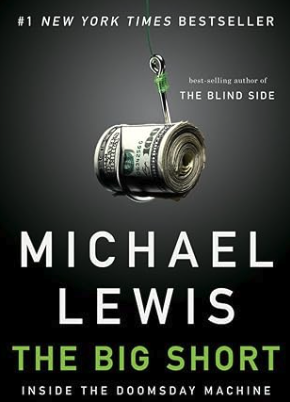
The Big Short: Chapter 9–Epilogue
This nonfiction narrative focuses on the people who were affected by the global financial crisis of 2007–2008, especially those who profited from betting against the risky loans to low-income Americans who couldn't pay for their homes.
Here are links to our lists for the book: Prologue–Chapter 1, Chapters 2–3, Chapters 4–5, Chapters 6–8, Chapter 9–Epilogue
40 words
25 learners
Learn words with Flashcards and other activities
Definition First

Other learning activities
Full list of words from this list:
-
overbearing
having or showing arrogant superiorityEveryone who met him noticed his thick football neck and his great huge head and his overbearing manner, which was interpreted as both admirably direct and a mask. He was loud and headstrong and bullying.
-
bespoke
custom-madeNo ordinary human being had ever heard of these credit default swaps or, if Morgan Stanley had its way, ever would. By design they were arcane, opaque, illiquid, and thus conveniently difficult for anyone but Morgan Stanley to price. “Bespoke,” in market parlance.
-
facilitate
be of useHubler could make hundreds of millions facilitating the idiocy of Morgan Stanley’s customers. He could make billions by using the firm’s capital to bet against them.
-
feasible
capable of being done with means at handAs soon as feasible, Morgan Stanley promised, Hubler would be allowed to spin it off into a separate money management business, of which he’d own 50 percent.
-
putative
purportedThe putative best and brightest on Morgan Stanley’s bond trading floor lobbied to join him.
-
niggle
worry unnecessarily or excessivelyThere was, however, a niggling problem: The running premiums on these insurance contracts ate into the short-term returns of Howie’s group.
-
fluctuate
be unstableHaving never fluctuated much in value, triple-A-rated subprime-backed CDOs registered on Morgan Stanley’s internal reports as virtually riskless.
-
edict
a legally binding command or decisionBy edict of CEO Jamie Dimon, J.P. Morgan had abandoned the market by the late fall of 2006.
-
tenuously
in a weak, uncertain, or insubstantial mannerDeutsche Bank, because of Lippmann, had always held on tenuously.
-
misgiving
uneasiness about the fitness of an actionNot long before that, in April 2007, Howie Hubler, perhaps having misgivings about the size of his gamble, had struck a deal with the guy who ran the doomed Bear Stearns hedge funds, Ralph Cioffi.
-
angst
an acute but unspecific feeling of anxiety“There was a lot of angst about it. It was sort of viewed as, These folks don’t know what they’re talking about. If losses go to ten percent there will be, like, a million homeless people.”
-
incur
receive a specified treatmentThis was a result of an error in judgment incurred on one desk in our Fixed Income area, and also a failure to manage that risk appropriately.
-
ardor
a feeling of strong eagernessOnly the ardor of the Wall Street firms, desperate to buy fire insurance on their burning home, remained undimmed.
-
in earnest
in a serious mannerTwenty-two days later, on August 31, 2007, Michael Burry lifted the side pocket and began to unload his own credit default swaps in earnest.
-
extricate
release from entanglement or difficultyEach Wall Street firm held some share of those losses, and could do nothing to avoid them. No Wall Street firm would be able to extricate itself, as there were no longer any buyers.
-
apt
being of striking appropriateness and relevanceThe metaphor was apt, up to a point: this point. Now the metaphor was two men in a boat, tied together by a rope, fighting to the death.
-
inert
unable to move or resist motionOne man kills the other, hurls his inert body over the side—only to discover himself being yanked over the side.
-
mendacity
the tendency to be untruthfulWhenever Wall Street people tried to argue—as they often did—that the subprime lending problem was caused by the mendacity and financial irresponsibility of ordinary Americans, he’d say, “What—the entire American population woke up one morning and said, ‘Yeah, I’m going to lie on my loan application’? Yeah, people lied. They lied because they were told to lie.”
-
moot
of no legal significance, as having been previously decided“We were positioned for Armageddon,” said Eisman, “but always at the back of our minds was, What if Armageddon doesn’t happen?”
On March 14, the question became moot. -
ergo
(used as a sentence connector) therefore or consequentlyNo one knew what was going on inside Bear Stearns or Merrill Lynch or Citigroup, but these places had always been the smart money, ergo their bets must be the smart bets.
-
illustrious
widely known and esteemedOn March 14, 2008, he was invited into the presence of one of the biggest and most famous bullish investors in Wall Street banks, plus that of the illustrious former chairman of the Federal Reserve.
-
affinity
a close connection marked by community of interestsDanny and Vinny both thought the problem in this case was Eisman’s affinity for Bear Stearns. The most hated firm on Wall Street, famous mainly for its total indifference to the good opinion of its competitors, Eisman identified with the place!
-
demise
the time when something endsThe demise of Bear Stearns had been so unthinkable in March of 2007 that Cornwall Capital had bought insurance against its collapse for less than three-tenths of 1 percent.
-
haphazardly
in a random mannerHedge fund guys such as himself worked uptown and so exited Grand Central to the north, where taxis appeared haphazardly and out of nowhere to meet them, like farm trout rising to corn kernels.
-
picayune
small and of little importanceTo an outsider, this torrent of picayune detail about the financial markets would have been disorienting. To him it all made sense, as long as he didn’t really need to make sense of it.
-
inured
made tough by habitual exposureAn Olympic rowing career had left Porter Collins a bit inured to the pain of others, as he assumed they usually didn’t know what pain was.
-
diffidence
lack of self-assuranceThey actually spent time wondering how people who had been so sensationally right (i.e., they themselves) could preserve the capacity for diffidence and doubt and uncertainty that had enabled them to be right. The more sure you were of yourself and your judgment, the harder it was to find opportunities premised on the notion that you were, in the end, probably wrong.
-
proceeds
the income or profit arising from a transactionThey cooked up a plan to seek revenge upon the rating agencies, for instance. They’d form a not-for-profit legal entity whose sole purpose was to sue Moody’s and S&P, and donate the proceeds to investors who lost money investing in triple-A-rated securities.
-
nebulous
lacking definite form or limitsNo business could be more objective than money management, and yet even in this business, facts and logic were overwhelmed by the nebulous social dimension of things.
-
sullen
showing a brooding ill humor“I have always been able to pull back and carry on my often overly intense affair with this business. Now, however, I am facing personal matters that have carried me irrefutably over the threshold, and I have come to the sullen realization that I must close down the Fund.”
-
harangue
address forcefullyIt’s like, ‘All right, you’ve got your ten million dollars. Don’t keep haranguing me about it.’
-
sidle
move unobtrusively or furtivelyThere he had sidled up to Merrill’s chief financial officer, Jeff Edwards, the same Jeff Edwards Eisman had taunted, some months earlier, about Merrill Lynch’s risk models.
-
trustee
a person who administers property for someone else's benefitThe various CDOs you make from the bonds will go bad not right then but after some trustee sorts out whether there will ever be enough cash to pay them off.
-
recrimination
mutual accusationsThe social disruption caused by the collapse of the savings and loan industry and the rise of hostile takeovers and leveraged buyouts had given way to a brief period of recriminations.
-
formative
capable of molding or fashioningThe first mortgage-backed CDO was created at Credit Suisse in 2000 by a trader who had spent his formative years, in the 1980s and early 1990s, in the Salomon Brothers mortgage department.
-
veneer
an outward appearance that is deliberately misleadingThe same veneer of courtliness masked the same animal impulse to see the world as it is, rather than as it should be.
-
subordination
the quality of obedient submissivenessJust as you revert to being about nine years old when you go home to visit your parents, you revert to total subordination when you are in the presence of your former CEO.
-
contrive
make or work out a plan for; deviseInstead they stepped in to prevent the failure of the big Wall Street firms that had contrived to bankrupt themselves by making a lot of dumb bets on subprime borrowers.
-
intervention
the act of getting involvedThe world’s most powerful and most highly paid financiers had been entirely discredited; without government intervention every single one of them would have lost his job; and yet those same financiers were using the government to enrich themselves.
-
render
cause to becomeIt was no longer the social and economic relevance of a bank that rendered it too big to fail, but the number of side bets that had been made upon it.
Created on Mon Sep 09 09:05:43 EDT 2024
(updated Tue Sep 10 13:46:07 EDT 2024)
Sign up now (it’s free!)
Whether you’re a teacher or a learner,
Vocabulary.com can put you or your class
on the path to systematic vocabulary improvement.