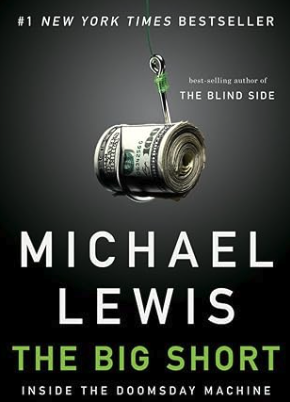
The Big Short: Chapters 6–8
This nonfiction narrative focuses on the people who were affected by the global financial crisis of 2007–2008, especially those who profited from betting against the risky loans to low-income Americans who couldn't pay for their homes.
Here are links to our lists for the book: Prologue–Chapter 1, Chapters 2–3, Chapters 4–5, Chapters 6–8, Chapter 9–Epilogue
40 words
20 learners
Learn words with Flashcards and other activities
Definition First

Other learning activities
Full list of words from this list:
-
propriety
correct behaviorThe round usually began with a collective discomfort on the first tee, after Eisman turned up wearing something that violated the Wall Street golfer’s notion of propriety.
-
swanky
impressively fashionable and elegantOn January 28, 2007, he arrived at the swanky Bali Hai Golf Club in Las Vegas dressed in gym shorts, t-shirt, and sneakers.
-
aplomb
great coolness and composure under strainThe ninth time Eisman retrieved a ball from some sand trap, or pretended his shot had not splashed into the water, he acted with the same unapologetic aplomb he had demonstrated the first time.
-
lampoon
ridicule with satireHe played the game like a child, or like someone who was bent on lampooning a sacred ritual, which amounted to the same thing.
-
inexorably
in a manner impervious to change or persuasionAll by himself, Chau generated vast demand for the riskiest slices of subprime mortgage bonds, for which there had previously been essentially no demand. This demand led inexorably to the supply of new home loans, as material for the bonds.
-
impervious
not admitting of passage or capable of being affectedThat, however, was mere theory; in practice, the sorts of investors who handed their money to Wing Chau, and thus bought the triple-A-rated tranche of CDOs—German banks, Taiwanese insurance companies, Japanese farmers’ unions, European pension funds, and, in general, entities more or less required to invest in triple-A-rated bonds—did so precisely because they were meant to be foolproof, impervious to losses, and unnecessary to monitor or even think about very much.
-
patronize
be a regular customer or client ofThe less mentally alert the two guys, and the fewer the questions they asked about the triple-B-rated subprime bonds they were absorbing into their CDOs, the more likely they were to be patronized by the big Wall Street firms. The whole point of the CDO was to launder a lot of subprime mortgage market risk that the firms had been unable to place straightforwardly. The last thing you wanted was a CDO manager who asked lots of tough questions.
-
condescension
showing arrogance by patronizing those considered inferiorIf Wing Chau detected Eisman’s disapproval, he didn’t show it; instead, he spoke to Eisman in a tone of condescension.
-
extemporaneous
with little or no preparation or forethoughtNow, looking as if he had just rolled in from a night on the town without pausing to take a nap, John Devaney delivered what was clearly an extemporaneous rant about the state of the subprime market.
-
accost
approach and speak to someone aggressively or insistentlyCharlie also accosted a man who analyzed the subprime mortgage bond market for Wachovia Bank, who happened to have been on the panel moderated by the shocking John Devaney.
-
baroque
relating to an elaborately ornamented style of art and musicThe morning after his dinner with Wing Chau, Eisman woke up to his first glimpse of the bond market in the flesh, and a lot of sensationally phony baroque ceiling frescoes.
-
disabuse
free somebody from an erroneous beliefHis experience with Household Finance had disabused him of any hope that the government would intercede to prevent rich corporations from doing bad things to poor people.
-
intercede
act between parties with a view to reconciling differencesHis experience with Household Finance had disabused him of any hope that the government would intercede to prevent rich corporations from doing bad things to poor people.
-
free market
an economy relying on unrestricted competitionInside the free market, however, there might be some authority capable of checking its excess.
-
arbiter
someone chosen to judge and decide a disputed issueThere was a natural role for an independent arbiter to pass judgment on these opaque piles of risky loans.
-
flunky
one who works hard at menial or unimportant tasksIf they roamed the halls they might be mistaken, just, for some low-level commercial bankers at Wells Fargo, or flunkies at mortgage lenders, such as Option One: nine-to-fivers.
-
ostensibly
from appearances alone“Ostensibly other people were going long, but we were not allowed to go short,” said Charlie.
-
treatise
a formal text that treats a particular topic systematicallyAt the end of February a Bear Stearns analyst named Gyan Sinha published a long treatise arguing that the recent declines in subprime mortgage bonds had nothing to do with the quality of the bonds and everything to do with “market sentiment.”
-
manifest
reveal its presence or make an appearance“Sometimes his ideas cannot be manifested in a trade,” said Vinny.
-
morbid
suggesting the horror of death and decay“I have a job to do. Make money for my clients. Period. But boy it gets morbid when you start making investments that work out extra great if a tragedy occurs.”
-
eccentricity
strange and unconventional behavior“Many people have a hobby…. The difference between the normal range and the eccentricity observed in Asperger’s Syndrome is that these pursuits are often solitary, idiosyncratic and dominate the person’s time and conversation.”
-
idiosyncratic
peculiar to the individual“Many people have a hobby…. The difference between the normal range and the eccentricity observed in Asperger’s Syndrome is that these pursuits are often solitary, idiosyncratic and dominate the person’s time and conversation.”
-
ream
a large quantity of written matterOn the other hand, it explained an awful lot about what he did for a living, and how he did it: his obsessive acquisition of hard facts, his insistence on logic, his ability to plow quickly through reams of tedious financial statements.
-
parlance
a manner of speaking natural to a language's native speakersThey weren’t traded often by others; a lot of people took the view that the loans made in 2005 were somehow sounder than the loans made in 2006; in bond market parlance, they were “off the run.”
-
foreclose
take away the right of mortgagors to redeem their mortgageTo counter the assertion, he commissioned a private study, and found that the pools of loans he had shorted were nearly twice as likely to be in bankruptcy and a third more likely to have been foreclosed upon than the general run of 2005 subprime deals.
-
assimilate
take up mentallyA properly functioning market would assimilate new information into the prices of securities; this multi-trillion-dollar market in subprime mortgage risk never budged.
-
adage
a condensed but memorable saying embodying an important fact“One of the oldest adages in investing is that if you’re reading about it in the paper, it’s too late,” he said.
-
iconoclastic
characterized by attack on established beliefs“I almost think the better the idea, and the more iconoclastic the investor, the more likely you will get screamed at by investors,” he said.
-
stimulus
any information or event that acts to arouse actionThey were now responding to the same surface stimuli as the entire screwed-up subprime mortgage market, and trying to force him to conform to its madness.
-
plight
a situation from which extrication is difficultSo I take it the monster dragging us out to sea is the CDS. You have created the plight of the old man and the sea.
-
terse
brief and to the pointThe long list of investors eager to get their money back from him—a list that included his founding backer, Gotham Capital—received the news from him in a terse letter: He was locking up between 50 and 55 percent of their money.
-
extol
praise, glorify, or honorIn January 2006 Gotham’s creator, Joel Greenblatt, had gone on television to promote a book and, when asked to name his favorite “value investors,” had extolled the virtues of a rare talent named Mike Burry.
-
vilify
spread negative information about“A money manager does not go from being a near nobody to being nearly universally applauded to being nearly universally vilified without some effect.”
-
foible
a minor weakness or peculiarity in someone's characterHe refused to wear shoes with laces. He refused to wear watches or even his wedding ring. To calm himself at work he often blared heavy metal music. “I think these personal foibles of mine were tolerated among many as long as things were going well,” he said.
-
cabal
a clique that seeks power usually through intrigueTo Charlie Ledley at Cornwall Capital, the U.S. financial system appeared systematically corrupted by a cabal of Wall Street banks, rating agencies, and government regulators.
-
perpetrate
perform an act, usually with a negative connotationTo Michael Burry, the subprime mortgage market looked increasingly like a fraud perpetrated by a handful of subprime bond trading desks.
-
glom
latch or seize upon; take hold ofI glommed onto ‘silent seconds’ as an indicator of a stretched buyer and made it a high-value criterion in my selection process, but at the time no one trading derivatives had any idea what I was talking about and no one thought they mattered.
-
ensuing
following immediately and as a result of what went beforeOn June 14, the pair of subprime mortgage bond hedge funds effectively owned by Bear Stearns went belly-up. In the ensuing two weeks, the publicly traded index of triple-B-rated subprime mortgage bonds fell by nearly 20 percent.
-
rout
an overwhelming defeatThe moment Goldman was getting in on his trade was also the moment the market flipped. Some kind of rout was now on: Everyone at once seemed eager to talk to him.
-
fallout
any adverse and unwanted secondary effectWhat sane person on Earth would confidently conclude in early 2007, smack dab in the midst of the mother of all teaser rate scams, that the subprime fallout will not result in contagion?
Created on Mon Sep 09 09:05:29 EDT 2024
(updated Tue Sep 10 13:28:31 EDT 2024)
Sign up now (it’s free!)
Whether you’re a teacher or a learner,
Vocabulary.com can put you or your class
on the path to systematic vocabulary improvement.