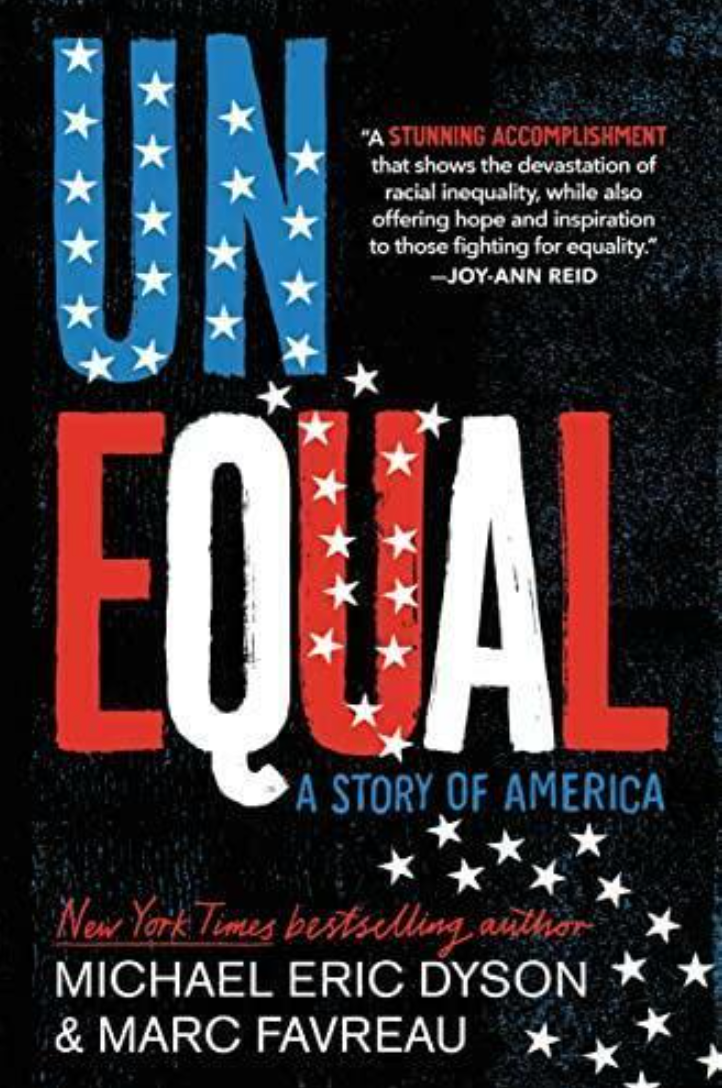
Unequal: A Story of America: Chapter 14–Afterword
In this nonfiction story of America, the authors recount the struggles of key African Americans in the country's march towards the equality and justice promised by the Constitution.
Here are links to our lists for the book: Prologue–Chapter 3, Chapters 4–7, Chapters 8–10, Chapters 11–13, Chapter 14–Afterword
40 words
26 learners
Learn words with Flashcards and other activities
Definition First

Other learning activities
Full list of words from this list:
-
innocuous
not causing disapprovalParole comes with an endless list of prohibitions against the most innocuous human behaviors.
-
commute
exchange a penalty for a less severe oneIn 1999, Sharanda Jones was sentenced to life in prison for conspiring to distribute crack cocaine. She was twenty-three years old. Jones spent seventeen years in prison before her sentence was commuted by President Barack Obama.
-
ostensibly
from appearances aloneA federal judge named Nancy Gertner had a front-row seat to the devastation, and concluded that what was happening was a war on people, not on drugs. “This is a war that I saw destroy lives,” Gertner said. “It eliminated a generation of African American men, [and] covered our racism in ostensibly neutral guidelines and mandatory minimums.”
-
staggering
so surprisingly impressive as to stun or overwhelmThe more Michelle Alexander tallied the numbers, the more staggering they became: In our own time, she realized, more Black people are under the control of the criminal justice system than were enslaved in the years just before the Civil War.
-
cynicism
a pessimistic feeling of distrust“I think the worst thing we can do,” she continued, “is to fall into a sort of cynicism where we imagine nothing can ever be done..."
-
equitable
fair to all parties as dictated by reason and conscienceBut there is also a part of human nature I believe that wants to see the equality, even divinity, in each other and to honor it. And that spirit remains alive in the United States today. And if we give up on it, then I think we’re giving up on the dream of a truly thriving, equitable multiracial, multiethnic democracy.
-
impotent
lacking power or ability“We were poor, we were Black and we were politically impotent,” one protester said.
-
teeming
abundantly filled with especially living things“Feces, toilet paper, and water were near the top of the hole. Although our visit was in October, the pit was teeming with mosquitoes, some sitting on the raw sewage.”
-
fetid
offensively malodorousAt another home, a white plastic pipe led away from the house and emptied into a fetid pool.
-
abstract
existing only in the mindFor the residents of Flint, Michigan, environmental racism isn’t an abstract idea; it’s a poison that flowed directly into their homes.
-
pernicious
exceedingly harmful“Flint and Washington and Newark,” Dr. Mona says, “are all viewed as Black cities and have a shared history of segregation, redlining, race riots, white flight, economic decline, violence, a pernicious drug epidemic, and a loss of local control. Newark’s water crisis, like Flint’s, and even Washington’s, is an obvious case of environmental racism, a case of blindness to the people, places, and problems we choose not to see.”
-
gregarious
temperamentally seeking and enjoying the company of othersTall, lean, and gregarious, Yusef prided himself on the friendships he had made all over his neighborhood.
-
dragnet
a system of procedures for apprehending criminalsNew York City police detectives moved quickly that night to make arrests, sweeping the park for potential suspects. Yusef and his four friends found themselves caught up in the dragnet.
-
render
pass or hand downBefore they had a chance to plead not guilty, the court of public opinion rendered its swift verdict on Yusef Salaam and his four young friends.
-
recant
formally reject or disavow a formerly held beliefThey eventually recanted their confessions, and police found no physical evidence linking them to the crime.
-
exonerated
freed from any question of guiltIt took until December for their convictions to be vacated and the men to be exonerated.
-
ordeal
a severe or trying experienceYusef had entered prison a boy, but he left a man—and he struggled to turn his ordeal into a positive force.
-
discretion
freedom to act or judge on one's ownBut, according to Khalil Gibran Muhammad, the presumption of guilt for Black people “allows law enforcement, just like it did in the 1870s in Alabama, to have the widest berth of discretion to challenge a person, a black male on the streets, to ask them, ‘Where are you going? And do you belong here?’”
-
initiative
a new strategy or plan to solve a problem or improve a situationAccording to the Equal Justice Initiative, “there are more innocent people in our jails and prisons today than ever before.”
-
flimsy
not convincingA young attorney named Bryan Stevenson founded the Equal Justice Initiative (EJI) in 1989, after Stevenson discovered firsthand how many Black people ended up behind bars on the flimsiest evidence.
-
gerrymander
divide voting districts unfairly and to one's advantageVoting rights activists were harassed by government officials, Black voters faced intimidation, and voting districts were “gerrymandered” to reduce the impact of Black voters and enhance the power of white people.
-
provision
a stipulated conditionThe fight to protect voting rights depended on the bravery of local activists and also on a key provision of the Voting Rights Act of 1965: Section 5, which requires local government officials to prove to the federal government that any changes to their system of voting does not discriminate on the basis of race.
-
dissent
the difference of one judge's opinion from the majorityIn a blistering dissent from the majority’s opinion—which she insisted on standing up and reading out loud to the Court—Justice Ruth Bader Ginsburg said that “throwing out [the provision] when it has worked and is continuing to work to stop discriminatory changes is like throwing away your umbrella in a rainstorm because you are not getting wet.”
-
flagrant
conspicuously and outrageously bad or reprehensibleIn the 1960s, a white restaurant owner in Atlanta named Lester Maddox made headlines when he refused to serve Black customers. His flagrant display of racism made Maddox a hero among white people, and he channeled this support into a political career.
-
conniving
acting together in secret toward a fraudulent or illegal endAbrams understood that racial discrimination often factored into these decisions, and that her home state of Georgia had a long history, dating back to the era of the Voting Rights Act, of conniving to reduce the political power of the growing Black electorate.
-
blatant
without any attempt at concealment; completely obviousThe very person in charge of the machinery that denied people access to the vote in Georgia was going to try to use that same machinery to win the governor’s seat. Not surprisingly, perhaps, many Georgians howled at Kemp’s blatant conflict of interest.
-
machination
a crafty and involved plot to achieve your endsDespite all of Kemp’s machinations, Abrams’s supporters came out in huge numbers to vote for her historic candidacy.
-
disposal
the power to use something or someoneAbrams used every legal tool at her disposal to challenge Kemp’s claims, but in the end she ran out of options.
-
disproportionate
out of proper balanceTo make matters worse, African Americans were disproportionately among the “essential workers” who could not avoid in-person jobs at factories, warehouses, stores, hospitals, and other workplaces, further exposing them to potential infection.
-
galvanize
stimulate to actionTen years later, students there would galvanize the Civil Rights Movement with their brave and silent sit-down protests at a local all-white restaurant.
-
demean
reduce in worth or character, usually verballyAfrican American physicians such as Ossian Sweet carried heavy burdens, treating communities that were both excluded and demeaned by white physicians and hospitals, and suspicious of the medical profession as a result.
-
rampant
occurring or increasing in an unrestrained wayMyths about Black people’s pain tolerance run rampant, even among medical professionals.
-
harrowing
causing extreme distressThe doctors and nurses treating Williams initially doubted her when she complained of trouble breathing, and ordered the wrong tests in response—foreshadowing not only Dr. Susan Moore’s harrowing experience in 2020 but those of millions of Black women and men caught up in our unequal health care system.
-
audacious
disposed to venture or take risks“We knew that it was part of our sacred duty to step up,” Abdullah recalled. “And there was an audaciousness that we could transform the world, but we didn’t have a plan for it.”
-
culminate
end, especially to reach a final or climactic stageWhat happened next would be argued over and investigated for months, culminating in a full-scale report by the US Justice Department.
-
citation
a summons that commands the appearance of a partyPeople stopped on street corners for no reason at all and issued fines for murky or nonexistent violations. Arrests for minor parking offenses. Jail time for late fees on unpaid tickets. Citations given for failing to produce identification—even when nobody had committed a crime.
-
tenure
the right to keep a job permanently, especially a teaching jobEarlier that year, the faculty of the journalism school at UNC had voted to offer Hannah-Jones a permanent job as a tenured professor with an endowed chair, only the second such offer of tenure to a Black female journalism professor in the history of the school.
-
conservative
having social or political views favoring the right wingThroughout that winter and spring, attempts to ban or prohibit teaching about The 1619 Project—or even about slavery itself—quickly morphed into a broader and much louder movement, as some conservative writers, media figures, and parent groups added new items to their lists of banned topics.
-
premise
a statement that is held to be trueThey want you to believe that the Civil War, in which hundreds of thousands of Americans died, was not a war over slavery (which is how Americans on both sides of the conflict talked about it at the time) but rather a fight to protect something called “states’ rights.” (To prove how thin a premise that is, ask yourself what rights the states primarily sought to protect. You got it: the right to enslave human beings.)
-
bastion
a group that defends a principleAnd they want you to see America as the bastion of freedom and equality, when for many of its citizens, the opposite has been true throughout all of American history.
Created on Thu Mar 30 13:19:06 EDT 2023
(updated Fri Mar 31 16:54:12 EDT 2023)
Sign up now (it’s free!)
Whether you’re a teacher or a learner,
Vocabulary.com can put you or your class
on the path to systematic vocabulary improvement.