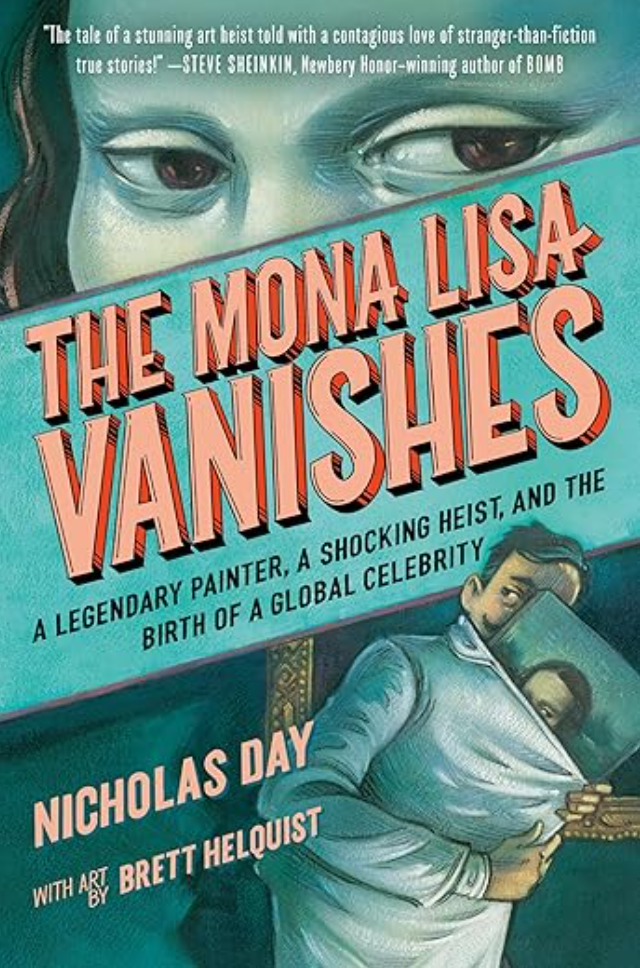
The Mona Lisa Vanishes: List 5
This nonfiction narrative traces how Leonardo da Vinci's 16th-century painting of an ordinary Italian wife and mother became the most recognizable face in the world.
This list covers "A Dangerous Woman"–"Epilogue."
Here are links to our lists for the book: List 1, List 2, List 3, List 4, List 5
40 words
50 learners
Learn words with Flashcards and other activities
Definition First

Other learning activities
Full list of words from this list:
-
cadaver
the dead body of a human beingLeonardo had dissected his first cadaver decades before. It quickly became an obsession. In a single Florence winter, he once dissected twenty bodies.
-
exhaustive
performed comprehensively and completelyHis notes from the dissection sessions are exhaustive. His drawings are astonishing. The sketches make you feel as if you’re looking into the cadaver alongside Leonardo—that this body has been opened up in front of you.
-
succession
a following of one thing after another in timeIn order to outline all the veins, he has to use several bodies in succession, because “a single body would not last long enough”; it decays so fast it becomes unusable.
-
deter
turn away from as by fear or persuasion“You will perhaps be deterred by the rising of your stomach,” he writes.
-
ravenous
extremely hungryHis sublime portraits are partly the product of his time with ravenous flies and rotting bodies.
-
flay
strip the skin offTo look at the Mona Lisa is to see Leonardo in the morgue, a flayed face in front of him, tracing the nerves and muscles that come together to make a smile.
-
heretical
departing from accepted beliefs or standardsDissection is forbidden by the Roman Catholic Church. It’s heretical—against the word of God.
-
buoyant
characterized by liveliness and lightheartednessThe young, buoyant king of France is an intellectual, and a man of tremendous energy and curiosity.
-
obscurity
an unimportant and not well known standingInstead of sliding into obscurity, the Mona Lisa becomes a temptress.
She becomes a dangerous woman. A mysterious woman. The woman we know today. -
contradiction
opposition between two conflicting forces or ideasFor Gautier, women are contradictions: gentle and manipulative, hot and cold, heaven and hell.
When he looks at the Mona Lisa, he sees the same contradictory mix, and it intimidates him. -
enthralled
filled with wonder and delightAbove all, Gautier is enthralled with her expression, which “attracts you irresistibly and intoxicates you.”
-
derision
contemptuous laughter“The arc of her lips,” he adds elsewhere, “appears to be about to erupt into divine sarcasm, heavenly irony, angelic derision.”
-
enigmatic
not clear to the understandingBut after reading Gautier, everyone sees a mystery there. Suddenly, her smile—no longer cheerful, now enigmatic—is the key to the whole painting.
-
grapple
work hard to come to terms with or deal with somethingAn artist leaps to his death and blames the Mona Lisa: “For years I have grappled desperately with her smile,” he writes in a suicide note.
-
alluring
highly attractive and able to arouse hope or desireBefore they came along, the Mona Lisa was “a portrait of a certain merchant’s wife in a cheerful mood,” as one historian put it. By the time Gautier and Pater were done, the Mona Lisa has been transformed. It’s no longer good-natured or innocent. It’s mysterious, alluring, unknowable.
-
flurry
a sudden and overwhelming outpouring or amountThe investigation had gone cold too: after the flurry of excitement over Guillaume Apollinaire, there were no new arrests.
-
authenticity
undisputed credibilityHe said it appeared to be the portrait, but they’d need to be absolutely sure. To confirm its authenticity, they’d have to take the painting to the Uffizi.
-
concierge
a caretaker in an apartment complex or hotelOn their way out of the Hotel Tripoli-Italia, the three were stopped by the hotel’s concierge, who accused them of having a stolen painting.
-
dragnet
a system of procedures for apprehending criminalsLouis Lépine’s international dragnet—the trains stopped in Belgium, the Kaiser Wilhelm II searched in New York—had been for nothing.
-
render
give or supply“I have rendered outstanding service to Italy,” he complained. “I have given the country back a treasure of inestimable worth, and instead of being thankful, they throw me in jail. It’s the height of ingratitude.”
-
insatiable
impossible to fulfill, appease, or gratifyIn Italy, the appetite was insatiable.
-
jubilation
the utterance of sounds expressing great joyThe Mona Lisa arrived in Paris to cheers and jubilation.
-
proceeding
a sequence of steps by which legal judgments are invokedThe French never requested that Perugia be returned for trial, and it was unclear whether the Italians had the right to hold one. They did, but the court proceeding was mostly a glorified fact-finding inquiry.
-
scrutiny
the act of examining something closely, as for mistakesThe panel of judges asked Perugia the questions everyone wanted answered anyway.
Under scrutiny, his story began to fray. -
tarnish
place under suspicion; make less respectedHis patriotic luster became tarnished.
-
purloin
make off with belongings of othersLouis Lépine and Alphonse Bertillon had missed the lesson of the very first detective story: In Edgar Allan Poe’s “The Purloined Letter,” the suspect hides a scandalous letter in plain sight.
-
magistrate
a lay judge or civil authority who administers the law“I do not believe Perugia’s story of how he stole the Mona Lisa,” said a magistrate judge in charge of the investigation.
-
preposterous
inviting ridiculeMeanwhile, the Louvre’s fired director announced that Perugia had been proven to be “a cunning madman. His misdeed and the preposterous explanation he gives seem to prove it.”
-
grim
shockingly repellent; inspiring horrorThe Mona Lisa was recovered just in time. A year later, the portrait might have vanished in the chaos of the war. Even if it had been found, the story of its recovery would have vanished, drowned out by grimmer realities.
-
leonine
of or characteristic of or resembling a lionHe had a head of “leonine” white hair and an air of nobility.
-
swindler
a person who steals by means of deception or fraudEduardo de Valfierno was an Argentine swindler. He’d done a little of everything, but he specialized in art forgeries. Working with a French forger named Yves Chaudron, Valfierno had conned widows and wealthy men across South America.
-
baroque
relating to an elaborately ornamented style of art and musicThe two specialized in religious paintings by a Spanish baroque painter named Murillo, and they presented their fakes as stolen Murillo masterpieces.
-
fleece
rip off; ask an unreasonable priceThey couldn’t sell the painting, because they knew the painting was stolen. The only person they could ask about the painting was Valfierno himself, the person swindling them. It was foolproof, and soon Valfierno and Chaudron left for Europe in search of even wealthier fools to fleece.
-
exploit
a notable achievementHis exploits were notorious. (He once rescued a Cuban revolutionary beauty from prison just before the Spanish-American War broke out. That story was, remarkably, true.)
-
prolific
intellectually productivePablo Picasso lived into his nineties, and when he died, his obituary ran on the front page of newspapers. “The most influential and prolific painter of the 20th century,” wrote the New York Daily News.
-
titan
a person of exceptional importance and reputation“The titan of 20th century art,” said the New York Times.
-
farce
an event or situation that is absurd, empty, or insincereBut Picasso knew how he’d survived the Mona Lisa farce, and only near the end of his long life did he tell the truth about Apollinaire and the affaire des statuettes...
-
inkling
a slight suggestion or vague understandingShe had no inkling of the bizarre afterlife that awaited her.
-
parody
make a spoof of or make fun ofIt’s the most parodied painting in history, but every parody just draws more attention to the original. When the French artist Marcel Duchamp drew a mustache on a copy of the Mona Lisa, he made the most famous parody in art history.
-
dignitary
an important or influential personThe portrait no longer travels, but when it toured the United States in the 1960s, it was received like a visiting dignitary. It rode down empty highways in a fireproof, waterproof case, escorted by Secret Service agents.
Created on Fri Jan 19 10:44:26 EST 2024
(updated Sat Jan 20 14:16:52 EST 2024)
Sign up now (it’s free!)
Whether you’re a teacher or a learner,
Vocabulary.com can put you or your class
on the path to systematic vocabulary improvement.